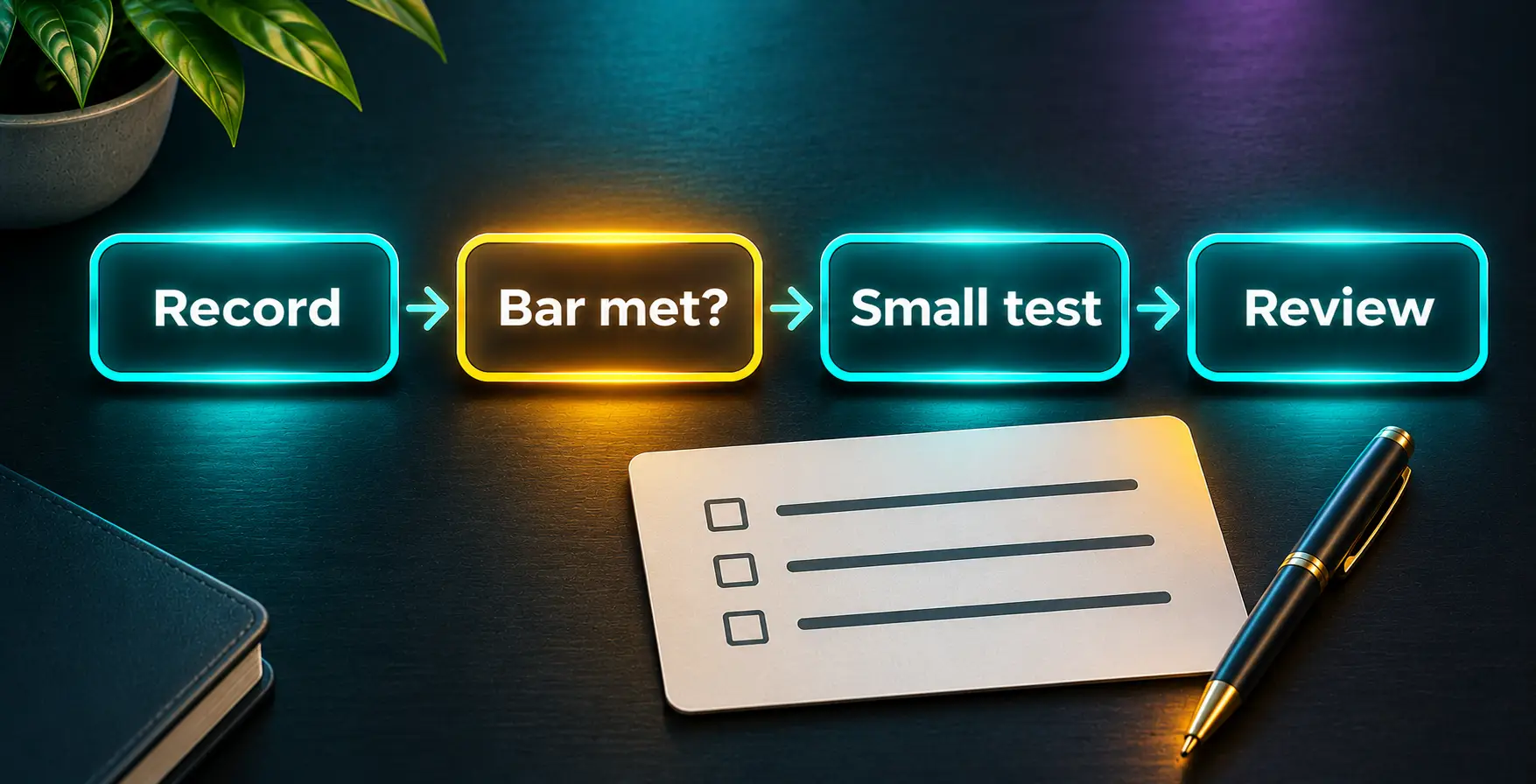
A hypothetical regional distributor of industrial fasteners has started asking every win-interview buyer the same question. The marketing lead has been recording the answers, and she expects finance to ask, in a few months, whether the team knows enough to move money toward AI-related work. Nothing in this scenario is real, and it is not a finding. It shows a step that is easy to skip: deciding what “enough” means before any answers arrive.
The reason is that evidence is easy to argue about afterward. Suppose several buyers mention an AI assistant unprompted. One person at the table sees a trend and wants to move budget. Another sees a few anecdotes and wants to wait. Both are reading the same answers, and neither can be shown wrong, because nothing was agreed beforehand about what the answers would need to look like. The discussion becomes about who is more cautious. A bar written in advance moves the argument to a place where it can end.
A useful bar has three parts. The first is what pattern across the interviews would justify a small test of moving money. That means saying, in plain terms, what the team would need to see: how many interviews, what share of buyers mentioning an assistant without being asked, and whether it appears across different kinds of deals or only one. The second is what pattern would justify stopping the inquiry, such as no unprompted mentions across an agreed number of interviews. The third is the date the team will look, so the evidence has a deadline. This article gives no numbers on purpose. The right ones depend on how many deals the team closes, how long its sales cycle is, and how costly a wrong move would be.
Write the bar before the answers are tallied, and put it somewhere the others can see. A bar adjusted after the fact is not a bar. If the team decides it was wrong, the honest course is to record the change and the date, and treat results before and after as separate groups.
If the bar is met, the next step is a small, reversible test, not a full reallocation. The size of the move should fit the strength of the evidence. Interviews establish that buyers recall assistants as part of how they decided, and that is a different claim from saying that spending in a channel will produce more deals. So the test needs its own plan. Say beforehand what observation would count as an effect, for instance a change in how many new buyers name an assistant when asked the same neutral question, or a change in the sources a buyer says they used. Keep the recording method identical afterward. A before-and-after difference alone does not establish that the change caused it, because other things move at the same time, including sales activity, events and the season.
What counts as small and reversible depends on the team, but the shape is familiar: shifting a modest part of one program’s budget for a limited period with a review date already set, or running a content pilot with an end date. The point is that the move can be undone if the evidence turns out to be thin. Decide the exit at the same time as the entry. Say what result would end the test, and who has the authority to end it, so the test does not drift into a permanent allocation by default.
If the bar is not met, that is a result, and it should be recorded as one. In our framework, WATCH is a legitimate result when the evidence does not yet justify a change: keep recording, set a date to check again, and write down what would change the decision. A team that can say that clearly is in a better position than one that moved money on a few stories and has to explain it later.
Who sets the bar matters. Marketing, sales and finance each see a different part of a deal, so a bar agreed by all three is harder to dispute later. It also means the person who would approve the money has already said what would persuade them, which shortens the later conversation. The bar can record what the team will not do as well. Writing down that no budget moves on a single interview, however vivid, protects the team from its own best story, and it gives whoever tells that story a fair hearing at the review.
Some limits remain whatever the bar says. Interviews capture what buyers remember and are willing to share, and they reach only the buyers who agree to talk. Sales cycles can be long, so evidence builds slowly. A small team may take a while to reach any bar it sets. And a buyer naming ChatGPT, Claude, Gemini or Perplexity does not show which source shaped a particular choice. These are reasons to state how the evidence was collected, and none of them is a reason to skip the bar.
FAQ
What does it mean to set an evidence bar? It means writing down, before the answers arrive, what pattern across interviews would justify a small test, what pattern would justify stopping, and the date the team will look. Agreeing it in advance keeps the argument about the evidence and not the people.
Why does this article give no numbers? The right ones depend on how many deals a team closes, how long its sales cycle is, and what a wrong move would cost. They belong to the team and should be agreed before the interviews are tallied.
If the bar is met, should the team move its full budget? No. Start with a small, reversible test, say beforehand what observation would count as an effect, and keep the recording method the same. A before-and-after difference alone does not establish cause.
What if the bar is not met? That is a result. In our framework, WATCH is a legitimate outcome: keep recording, set a date to check again, and write down what would change the decision.
Who should set the bar? Marketing, sales and finance together, since each sees a different part of a deal. A bar all three agreed to is harder to dispute later.
Is this article reporting a result from Axis Suite? No. The distributor and the scenario are hypothetical, and the article describes a method without reporting a result for any brand.
About Axis Suite Axis Suite is the independent intelligence layer that tracks what AI says about your brand and the observable evidence behind it, retrieval, narrative, recommendation, and corroboration signals, across engines including ChatGPT, Claude, Gemini, and Perplexity. Built by TrendAxis, Axis Suite works from a framework that separates Mentioned, Cited, Recommended, and Chosen. Axis Suite is measurement infrastructure, not a marketing quick fix. Explore the Proof Center.