

Does AI Visibility Need One Universal Score?
The AI industry is starting to standardize how it tests itself. Brand measurement isn’t there yet, and it may not need to be.

What Should You Ask Before Trusting an AI Visibility Score?
A number without context isn’t necessarily wrong. It’s incomplete. Here’s what to ask before you trust one in a boardroom.

Why Did AI Recommend a Competitor Instead of You?
A visibility score tells you something moved. It doesn’t tell you why. Here’s how to find the actual cause before you try to fix it.

Why Are AI Labs Suddenly Talking About Standards?
Three AI labs that rarely agree on anything have been meeting quietly since July. Here’s what their talks actually cover, and what they don’t.

Is Being Mentioned by AI the Same as Being Chosen by AI?
Visibility tells you whether a brand entered an AI answer. It does not tell you whether the brand would survive the moment an AI system actually decides what to do.

Does AI Agentic Commerce Only Apply to Online Shopping?
Checkout inside AI Mode is the visible example, but the underlying shift, AI acting on recommendations rather than just stating them, extends well past retail.
What Does AI Need to Know Before It Buys From a Brand?
AI can mention a brand with incomplete information. Acting on that brand, completing a cart or a checkout, appears to require a different, stricter kind of proof.
Can AI Actually Buy Something for You Now?
AI systems can now complete a purchase in specific, limited cases. Here’s exactly what’s confirmed, what’s still rolling out, and why it matters for how AI recommendations get measured.

What Should an AI Visibility Tool Do When It Does Not Know?
A metric that can only emit a number will emit one for a real result, for a category error, and for a failed API call. All three arrive as the same red panel.

A Third of AI Citations Come From Sites With Domain Authority Under 40
A third of what AI engines cite is not the large publications everyone is competing over. It is smaller sites nobody is bidding on.

Why Publishing More Content Will Not Fix a Category Misfiling
A zero visibility score can mean you are invisible in your category, or that you are being measured inside somebody else’s. The fix for the second one is not on your website.
What the EU’s New AI Transparency Rules Mean for Your Content
The rule that came into effect this month does not draw its line at how the words were produced. It draws it at whether a person put their name against them.

Seven Places an AI Citation Comes From, and Why Only One Is Coverage
We published a six-part framework and a reader pointed out it was missing most of the categories. This is the corrected version, and the correction is the more useful finding.
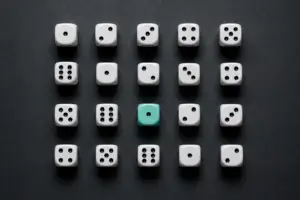
How Many Times Should You Run the Same Prompt Before Trusting an AI Visibility Score?
One run of a prompt is an anecdote. Twenty runs can demonstrate instability and can barely demonstrate stability. What each sample size actually supports, with the arithmetic.

Retrieval Sources vs Independent Judgments: The Two Numbers Your AI Visibility Report Should Show
Most AI visibility reports show one number where there should be two. The fused version systematically overstates how well corroborated a brand is, and the gap takes four minutes to find.

Reddit Citations Dropped 86% in ChatGPT. Does That Mean Anything for Your Brand?
Reddit’s ChatGPT citation share fell 86 percent this month. The figure is real, the caveat attached to it was widely ignored, and neither one can tell you what happened to your brand.

What Does It Mean When AI Cites a Source That Never Mentioned Your Brand?
Stanford’s AI Index turned up in our source panel marked as independent corroboration. It had said nothing about the brand at all. How to tell corroboration from context.

Are Four Sources Really Four Sources? How to Check Whether Your AI Citations Are Independent
We ran a scan on our own company and it reported four independent sources. One of those numbers was wrong, and working out why cut our own Evidence score in half. PRIMARY KEYWORD: AI citation independence SECONDARY: independent sources AI visibility, shared review catalog, brand corroboration AI, AI visibility measurement INTENT: Practitioner auditing an AI visibility report

How to Run an AI Persistence Test in 30 Minutes
A screenshot proves something happened once. It says nothing about whether it keeps happening. This is a step by step method for finding out whether your AI recommendation is a position or an accident, using only the four systems you already have access to.

Why Your AI Visibility Tools Disagree About Your Brand
The IAB found more than 20 companies measuring AI visibility and producing different answers for the same brand. The instinct is to wait for them to agree. That instinct will cost you a year, because two different kinds of disagreement are being treated as one problem.

Directional or Decision-Grade? How to Read an AI Visibility Report
The most useful question a marketing leader can ask about an AI visibility report has nothing to do with the brand. It is whether the data in front of them was built to spot a trend or built to move a budget, and those are very different things.

Mentioned vs Recommended: The AI Metric Most Teams Are Missing
Two things can happen to your brand inside an AI answer. It can be named, or it can be recommended. New behavioral research shows those are not the same commercial event, and most reporting averages them into a single number.

What Should CMOs Actually Measure About AI Visibility?
For a year, every AI visibility vendor measured something different. In August 2026 the IAB published a shared standard built on four pillars. It is a real advance, and it still leaves out the question executives ask about ten seconds after the first one.
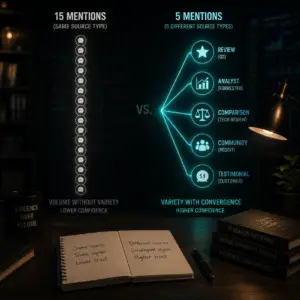
Source Diversity Beats Source Volume for AI Recommendation
AI does not count mentions. It reads patterns. Five mentions from five different source types create a stronger convergence pattern than fifteen mentions from a single source type. Source diversity is the competitive advantage most teams are not tracking.