Sooner or later, someone in finance asks the question directly: is AI working? It is a fair question, and it is asked by people who need to decide where money goes. The temptation is to answer with a confident story, in one direction or the other. A more useful answer says what the records show, what buyers say, what remains unknown, and what the team is doing about it. The sample answers below are illustrative sentences, not scripts, and none of them is a finding.
“Did AI cause this deal?” An honest answer is: “We can’t say. We have one buyer’s recollection and a first-touch record, and they describe different things.” The reasoning is that a buyer’s account is useful evidence that an assistant played a part, such as ChatGPT, Claude, Gemini or Perplexity, and it does not show whether the sale would have happened without it. The answer gives finance both records and does not pick one.
“How often does this happen?” An honest answer is: “We don’t know yet. We now ask every buyer the same question in every interview, and we will report on an agreed date.” That sentence works because it names the method, and because the date turns an open question into a commitment. It also avoids a number the team cannot support. A count of mentions needs a denominator, which is how many interviews took place and how many buyers were reachable.
“Can’t we just look at the dashboard?” An honest answer is: “The dashboard shows the touches it captured.” IAB’s announcement of its AI-Era Attribution Blueprint says that much of the evidence needed to support claims about AI’s role in a conversion is either not captured or sits inside AI platforms. That is a statement about the industry, and a team’s own tools are no exception. It explains why a clean dashboard is not proof that nothing is happening.
“Should we move budget?” An honest answer is: “Not on one account. We have written down what we would need to see, and we propose a review date.” One buyer’s recollection can justify asking better questions. It does not by itself justify moving real money, and a bar agreed beforehand shows finance that the team is not hunting for a reason to spend.
“So is AI working?” An honest answer is: “We can’t say from this evidence. Here is what our records show, here is what buyers say, here is what we don’t know, and here is when we will know more.” The word “working” hides several questions, including whether buyers use assistants, whether assistants mention the company, and whether any of it changes a decision. Splitting them lets the team answer the parts it can.
Some finance leaders will ask for a number. The honest version is what the team can count: how many interviews took place, how many buyers were reachable, and how many mentioned an assistant unprompted. Those figures come with their denominators and a note on how they were collected. A percentage that hides the denominator, or a projection built on a handful of interviews, invites a decision the evidence cannot carry. If there is nothing to count yet, the answer is the plan for counting, with its date.
A few phrases are worth retiring. “AI drove the deal” claims a cause nobody has shown. “AI doesn’t matter, it’s all in our CRM” treats the first captured touch as the whole story. “Attribution is impossible” is a way of avoiding the work, since some questions can be investigated even when others cannot be settled. Each can be replaced by a sentence that states a fact, a limit and a next step.
Order helps. Lead with what the records show and what buyers say, kept as two separate things, then what remains unknown, then the plan. Finance is more likely to trust “we don’t know yet” when it follows a clear statement of what the records and the buyers show and comes with a date. A team that opens with a gap sounds uncertain, while a team that closes with a plan sounds in control.
A short note after the meeting helps as well. Write down the question that was asked, the answer the team gave and the date. When someone later quotes the team’s position, there is a record of what was said and what the team knew at the time. If the answer changes, record when and why it changed, so a later reader can see the evidence that moved it. A position that can be traced is easier to defend than one that has to be remembered.
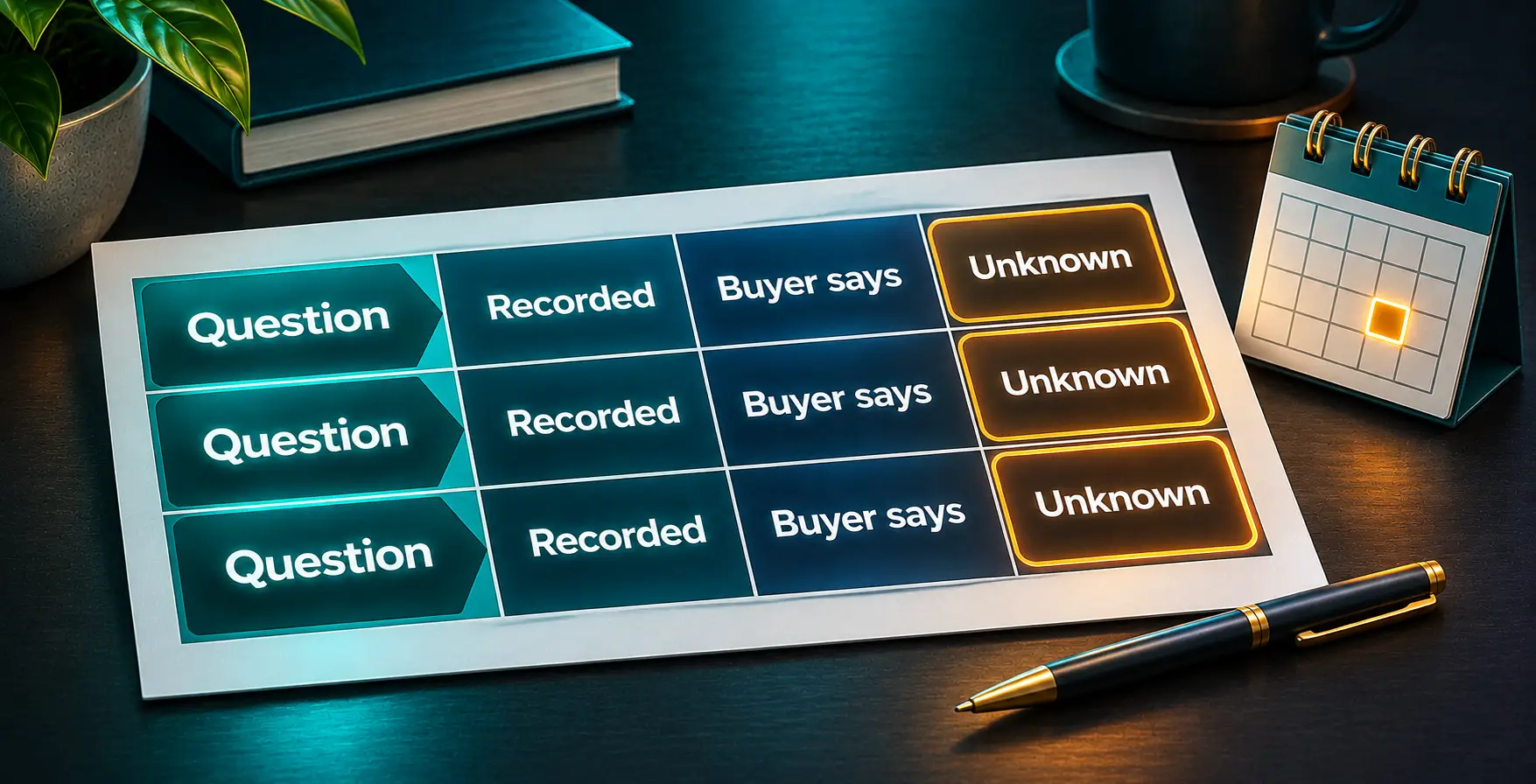
It also helps to bring one page. It needs three fields, kept separate: where the conversion was logged, what the buyer says helped them decide, and what remains unknown. Add the interview question, the review date and the evidence bar the team agreed beforehand. The page is short on purpose, and it lets a finance leader see how the team thinks.
None of this requires a finished answer. The goal is a sentence that is still true when someone repeats it, and one that points to what will be known next.
FAQ
What should a team say when finance asks whether AI is working? Say what the records show, what buyers say, what remains unknown, and the plan with a date. For example: “We can’t say from this evidence. Here is what our records show, what buyers say and what we don’t know, and here is when we will know more.”
Is “we don’t know yet” an acceptable answer? Yes, when it follows a clear statement of what the records show and what buyers say, and comes with a method and a review date. On its own it sounds like a gap, and with a plan it sounds like a commitment.
Why not point to the dashboard? A dashboard shows the touches it captured. IAB’s announcement says that much of the evidence needed to support claims about AI is either not captured or sits inside AI platforms, so a clean dashboard does not show that nothing is happening.
What phrases should a team avoid? “AI drove the deal,” “AI doesn’t matter, it’s all in our CRM,” and “attribution is impossible.” Each claims more than the evidence supports or avoids work that could be done.
What should a team bring to a budget meeting? A short page with where the conversion was logged, what the buyer says helped them decide, what remains unknown, the interview question, the review date and the evidence bar agreed beforehand.
Is this article reporting a result from Axis Suite? No. The sample answers are illustrative, and the article reports no result for any brand.
About Axis Suite Axis Suite is the independent intelligence layer that tracks what AI says about your brand and the observable evidence behind it, retrieval, narrative, recommendation, and corroboration signals, across engines including ChatGPT, Claude, Gemini, and Perplexity. Built by TrendAxis, Axis Suite works from a framework that separates Mentioned, Cited, Recommended, and Chosen. Axis Suite is measurement infrastructure, not a marketing quick fix. Explore the Proof Center.