Workflow Inclusion: The Third Era of AI Visibility Most Brands Have Not Started Measuring
Most businesses have spent the past year asking one question about AI.
Are we appearing in AI answers?
That was the right question to start with.
It is no longer the most important question.
Three eras. Three different questions.
Search era: Can buyers find us?
Recommendation era: Does AI include us on the shortlist?
Workflow era: Is AI using our brand as part of the decision frameworks it builds for buyers?
When a buyer asks AI to evaluate vendors or build a comparison framework, AI constructs the architecture of the decision.
Brands included are being evaluated.
Brands excluded may never enter the process.
Here is the fifteen minute audit that reveals your workflow inclusion gap.
Workflow Inclusion vs Recommendation Presence: The CMO Measurement Gap
CMOs built teams to optimize for search.
Many now realize AI influences buying decisions before prospects reach the website.
But the next measurement challenge is more specific than that.
It is not just whether AI recommends your brand.
It is whether AI includes your brand in the evaluation workflows it builds when buyers ask it to help them choose vendors.
When a buyer asks AI to compare platforms, build a vendor scorecard, or structure a procurement process, AI is coordinating the decision.
The brands in that coordination layer are being evaluated.
The brands outside it may never enter the process.
Most marketing dashboards cannot detect this gap.
Here is what workflow inclusion actually means and why it matters more than recommendation presence for pipeline.
Three Eras of AI Visibility: Which One Is Your Strategy Actually Built For?
Three eras. Three completely different AI visibility challenges.
Search era: Can buyers find us?
Recommendation era: Does AI include us on the shortlist?
Workflow era: Is AI using our brand as part of the decision frameworks it builds for buyers?
Most businesses are optimizing for the first question.
The most forward-thinking are building for the second.
The third is just beginning to form.
And the brands that recognize it early will build a presence inside AI decision workflows that becomes very difficult for late movers to displace.
Because once AI consistently includes a brand in its decision architecture, that inclusion compounds.
The brand stops being something AI occasionally mentions.
It becomes part of how AI helps buyers decide.
Which era is your current AI strategy actually built for?
AI Is Moving From Answering Questions to Orchestrating Decisions
AI is moving from answering questions to orchestrating decisions.
That shift changes everything about what AI visibility means.
Search era: AI surfaces you when someone looks for you.
Recommendation era: AI includes you when buyers ask who to consider.
Workflow era: AI uses you as part of the decision infrastructure it builds for buyers.
When a buyer asks AI to help them evaluate vendors or build a comparison framework, AI is not just retrieving names.
It is constructing the architecture of a decision.
The brands embedded in that architecture are being evaluated.
The brands excluded may never enter the process at all.
Most current AI visibility measurements detect the first two eras.
Almost none detect the third.
Here is how to test your workflow inclusion in fifteen minutes.
Why AI Visibility Is the Wrong Mental Model
AI visibility is becoming the wrong mental model for what is actually happening.
The bigger challenge is not being discovered.
It is understanding what AI has come to believe about your brand after discovery occurs.
AI can find you and still not choose you.
AI can choose you and still carry wrong category impressions into every future interaction.
AI can describe you correctly today and still use hesitation language that positions you below competitors.
Those are not visibility problems.
They are failure modes that occur after discovery.
And they require completely different responses than anything visibility optimization addresses.
Here is the mental model that actually explains what is happening to brands inside AI systems right now.
The Fifteen Minute AI Failure Mode Audit Every B2B Brand Should Run
Most businesses treat AI visibility as one measurement.
It is actually four completely different failure modes.
Retrieval failure: AI cannot reliably find you.
Recommendation failure: AI finds you but recommends competitors.
Memory failure: AI has formed wrong impressions that compound over time.
Narrative failure: AI describes you incorrectly in the moment.
Each one looks the same from the outside.
Each one requires a completely different fix.
Here is a fifteen minute self-audit that identifies exactly which failure mode your brand is experiencing right now.
Four tests. Fifteen minutes. The right diagnosis that changes where you focus.
What AI Durably Believes About Your Brand: The CMO Blind Spot
CMOs are monitoring traffic, rankings, conversions, and pipeline.
Very few are monitoring what category AI has filed their brand under.
Whether AI is using authority language or hesitation language.
Which competitors AI mentally associates them with.
Whether those impressions are accurate or drifting.
These are not one-time snapshot measurements.
They are durable patterns AI has formed over time that shape every recommendation, comparison, and description it makes about your brand.
A brand filed under the wrong category competes against the wrong alternatives in every buyer shortlist.
A brand described with hesitation language gets positioned below competitors described with confidence.
And your standard marketing dashboards will never show any of it.
Here is why this is becoming the most important CMO blind spot in marketing intelligence right now.
AI Visibility, Recommendation Failure, or Memory Failure: Which Problem Do You Actually Have?
Most marketing teams think they have an AI visibility problem.
Many actually have a recommendation problem.
And some have a memory problem they have never thought to measure.
AI can know your brand perfectly and still recommend competitors.
AI can recommend you occasionally and still have filed you under the wrong category for the past year.
AI can describe you correctly in the moment and still be carrying durable incorrect impressions that shape every future interaction.
Three completely different problems.
Three completely different fixes.
Applying the wrong fix to the wrong problem wastes resources and produces nothing.
Here is how to tell which one you actually have in under ten minutes.
The Four Ways AI Systems Fail Brands
Most businesses think they have one AI visibility problem.
They usually have one of four.
Retrieval failure: AI cannot reliably find you.
Recommendation failure: AI finds you but recommends competitors.
Memory failure: AI has formed wrong impressions that persist and compound.
Narrative failure: AI describes you incorrectly in the moment.
Each one looks the same from the outside.
Each one requires a completely different response.
Applying the wrong fix to the wrong problem produces nothing.
The right diagnosis changes everything about where you focus.
Here is a fifteen minute self-audit to identify which failure mode your brand is actually experiencing.
The Revenue Leak That Does Not Show Up in Any Marketing Report
Most marketing stacks measure what happens after buyers reach your website. But there is a new first step in the buyer journey that happens before any of that. A buyer opens ChatGPT and asks who the best options are in your category. A shortlist forms. Some brands make it. Some do not. The brands AI excluded never enter the evaluation. No traffic drop. No alert. No dashboard signal. Just absence from a conversation that determined who got considered. The gap between your current analytics and your AI recommendation presence is your pre-funnel revenue leak. Here is how to find it and close it.
The CMO Visibility Problem That Does Not Appear in Any Marketing Dashboard
CMOs can have strong SEO, growing traffic, and healthy conversion rates.
And still be completely invisible when buyers ask AI who to consider in their category.
Here is the measurement gap most marketing teams have not closed yet.
Most analytics platforms measure what happens after a buyer reaches your website.
But AI systems are increasingly forming vendor shortlists before that visit ever happens.
The question shifting underneath every marketing team right now is not whether buyers can find you.
It is whether AI systems include you when buyers ask who to consider.
Those are not the same measurement.
And most marketing teams are still optimizing for the first one while the second quietly determines who gets evaluated.
Learn how to close the pre-funnel measurement gap before it costs you more pipeline.
AI Buyer Discovery: Are You Measuring the Wrong Moment?
Most B2B marketing dashboards look healthy while buyers are quietly eliminating you from consideration.
Here is what is actually happening.
A buyer opens ChatGPT and asks who the leading platforms are in your category. A shortlist forms. Three to five names. If your brand is not on that list the buyer never visits your website. Never books a demo. Never enters your funnel.
Your analytics will never show you the opportunity you missed.
This is the new first step in the B2B buyer journey. It is happening inside AI systems like ChatGPT, Perplexity, and Claude before any click ever happens.
The brands making the AI shortlist are winning evaluation conversations they never had to compete for.
The brands absent from that list are optimizing a funnel that never started.
Learn how to measure your AI shortlist presence and close the pre-funnel revenue gap.
The Invisible Elimination: Why AI Shortlists Are Replacing the First Click
A prospect can eliminate your company before ever visiting your website if AI leaves you off the shortlist. As buyers increasingly rely on systems like ChatGPT and Perplexity to evaluate vendors, brands missing from these recommendations lose the chance to compete before a single demo or pricing conversation happens. Learn why AI visibility is replacing traditional search clicks, and discover how Axis Suite helps you measure and improve your presence to secure your place on the modern buyer’s shortlist.
AI Search Is Becoming AI Selection Infrastructure
Search engines retrieved facts, but AI systems now mediate buyer decisions. While most companies treat AI visibility like traditional SEO, true success means advancing through four distinct levels—from simply being mentioned to consistently being chosen. To win this new competitive battleground, you need to build a strong Selection Infrastructure. Discover why recommendation persistence is the metric that actually matters, and learn how Axis Suite helps you build the exact signals required to become the undisputed choice for AI engines.
Mentioned vs. Cited vs. Recommended vs. Chosen: The Four Levels of AI Visibility
There is a massive difference between an AI system knowing your brand exists and actively selecting it for a buyer.
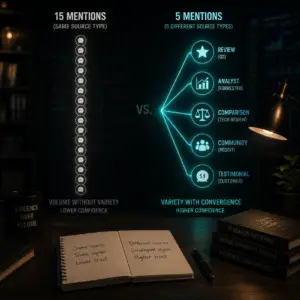
AI visibility actually happens across four distinct levels: Mentioned, Cited, Recommended, and Chosen. Moving from simple mentions to consistent selection requires stronger signals, like category alignment and comparison presence. Many teams measure the wrong layer, assuming basic mentions equal strong recommendations.
Learn how Axis Suite helps you measure your true AI confidence level and close the gap so you get chosen consistently.
AI Search Is Becoming AI Selection
AI discovery is shifting from retrieving search results to mediating buyer decisions. To get selected, brands need strong category association, clear comparison presence, trusted corroboration, and consistent recommendation patterns. Discover why traditional SEO metrics fall short and how Axis Suite bridges the gap between basic visibility and true AI recommendation.
AI Category Discovery: Why Visibility Alone Is the Wrong Metric
Visibility is not the same as category discovery. A brand can appear consistently across AI platforms and still be misunderstood, miscategorized, or compared to the wrong competitors. Read More
Google’s AI Visibility Guidance Misses the Bigger AI Discovery Problem
AI visibility is shifting from search to selection, and that changes the stakes. Ranking well is no longer enough if your brand is not one of the few names AI systems actually choose when buyers ask who to hire or what software to use.
This post explains why that pivot matters, how AI recommendation behavior differs from traditional search, and what businesses need to do now to strengthen their position. Axis Suite helps teams see whether they are simply visible or truly being selected across emerging AI discovery systems.
If your strategy still centers only on rankings, you may be missing the layer that matters most next. Read More
AI System Instability Is Creating a New Competitive Window
AI discovery is far less stable than most businesses think. The same query can produce almost no meaningful brands on one platform and more than twenty on another. That is not a reporting glitch. It is a sign that recommendation patterns are still forming. The brands building strong retrieval and citation signals now may gain an edge before those patterns harden. Axis Suite helps businesses track this instability, identify weak points, and strengthen the signals AI systems are most likely to trust long term. Read More
AI Stability Window: Why Early Citation Signals Matter
AI discovery is still taking shape, and the results prove it. The same query can produce wildly different brand outcomes across platforms, which means trust signals are still being formed. Brands that move now can influence how AI systems recognize and retrieve them later. Axis Suite helps you spot the gaps, strengthen your citation signals, and act before this window closes. Read More
Citation Selection Bias in AI: Why Visibility Alone Misleads
AI retrieval is not neutral. It favors certain source types, authority signals, and semantic patterns, which means visibility is not just about content quality. It is about alignment with the trust signals AI systems prefer. Axis Suite helps brands uncover these biases, strengthen their citation ecosystem, and build a more durable AI presence. Continue reading.
Two Different AI Visibility Problems
Many businesses assume AI visibility is one problem, when in fact it often comes down to two very different root causes: low persistence, where AI does not retrieve your brand often enough, and low category discovery, where AI finds you but misclassifies what you are. Axis Suite helps teams diagnose the difference so they can apply the right fix—building stronger signals or improving category precision. Read more to learn why the root cause of AI visibility matters as much as the outcome.
AI Narrative Audit: Why AI Visibility Is Not Enough
AI visibility can show that your brand appears in AI answers, but not whether AI understands it correctly. Axis Suite helps teams detect positioning drift, uncover missing differentiators, and build a stronger narrative defense. Learn why precision matters more than presence in AI-driven discovery.
Can You Prove AI Visibility Is Repeatable?
Most AI visibility metrics stop at mentions, rankings, and dashboards. But surface-level data cannot explain why AI describes your brand the way it does—or why that narrative shifts over time. This is where Axis Suite changes the approach, helping teams audit AI interpretation, uncover narrative gaps, and build a more repeatable method for narrative defense. If AI understands your brand differently than you intended, visibility alone is not enough. Read more.