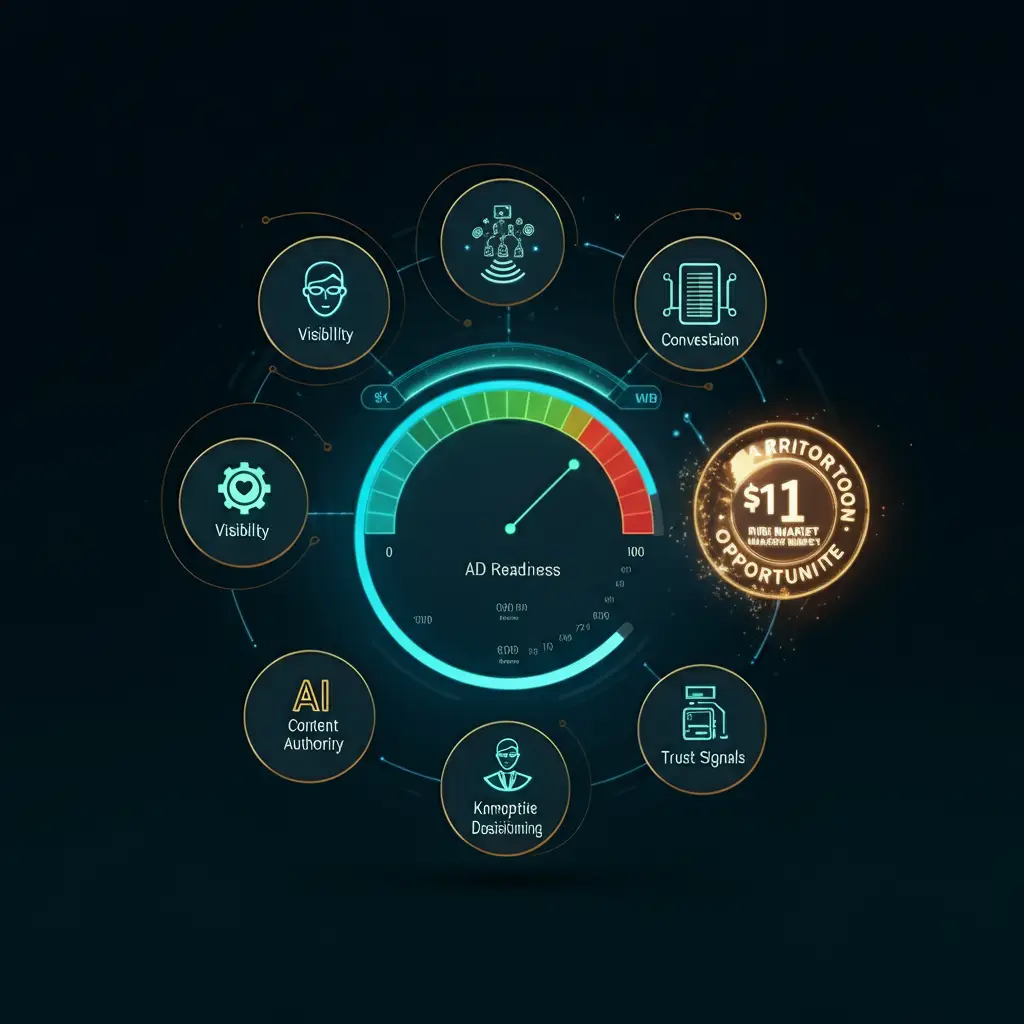
Comprehensive guide to preparing for AI advertising dominance
Introduction: The Metric That Changes Everything
Traditional advertising metrics measure past performance: clicks, impressions, conversions. The AI Ad Readiness Score predicts future success: how well your business will perform when ChatGPT ads launch and AI-powered advertising becomes the dominant customer acquisition channel.
This isn’t just another analytics metric. It’s the first predictive indicator that shows exactly how prepared your business is for the $1 trillion shift to AI-powered advertising—and what you need to do to dominate your category at the lowest possible cost.
What Is the AI Ad Readiness Score?
Definition and Purpose
The AI Ad Readiness Score is a proprietary metric (0-100) that analyzes your current AI visibility and predicts your performance when paid advertising launches inside AI assistants. It combines multiple data points to forecast your advertising costs, conversion rates, and competitive positioning in the AI advertising landscape.
Why It Matters
When ChatGPT ads launch, success won’t be determined by advertising budget—it’ll be determined by AI trust. Businesses with high AI Ad Readiness Scores will pay 60-80% less for advertising while achieving 340% higher conversion rates. Those with low scores will pay premium prices for crowded positioning.
Predictive Power
Based on current AI recommendation patterns and leaked ChatGPT advertising features, the AI Ad Readiness Score accurately predicts:
- Your future advertising costs (cost per click and acquisition)
- Your conversion rates from AI-driven traffic
- Your competitive positioning in AI recommendations
- Your market share potential in AI-powered discovery
The Five Core Components of AI Ad Readiness
Component 1: AI Visibility Foundation (25% of score)
What it measures: Your current presence and recognition across AI assistants
Key factors:
- Mention frequency in AI recommendations
- Consistency of citations across platforms
- Quality of context when mentioned
- Competitive positioning in recommendations
Scoring breakdown:
- 90-100: Mentioned in 80%+ of relevant queries
- 70-89: Mentioned in 60-79% of relevant queries
- 50-69: Mentioned in 40-59% of relevant queries
- 30-49: Mentioned in 20-39% of relevant queries
- 0-29: Mentioned in <20% of relevant queries
Component 2: Content Authority Density (25% of score)
What it measures: The ratio and quality of educational vs. promotional content
Key factors:
- Educational content percentage (target: 70%+)
- Problem-solving resource depth
- Actionable insight frequency
- Teaching approach consistency
Optimization targets:
- 70% educational, 20% authority-building, 10% promotional content
- Comprehensive guides and tutorials
- Regular problem-solving demonstrations
- Consistent value-first approach
Component 3: Conversational Optimization (20% of score)
What it measures: How well your content aligns with natural language queries
Key factors:
- Natural language query alignment
- FAQ-style content availability
- Consultative tone and approach
- Real-world problem addressing
Best practices:
- Write for how people actually ask questions
- Use conversational language and examples
- Address specific customer pain points
- Provide comprehensive, helpful answers
Component 4: Trust Signal Strength (15% of score)
What it measures: Indicators that build AI system confidence in your expertise
Key factors:
- Industry recognition and credibility
- Consistent expertise demonstration
- Cross-platform authority building
- Peer citations and references
Trust building strategies:
- Develop recognized expertise in specific areas
- Engage authentically in industry discussions
- Create original insights and frameworks
- Build long-term authority through consistency
Component 5: Competitive Positioning (15% of score)
What it measures: Your relative strength compared to competitors in AI recommendations
Key factors:
- Market share of AI recommendations
- Unique positioning and differentiation
- Category authority establishment
- Competitive gap identification
Positioning strategies:
- Identify underserved expertise areas
- Develop superior educational resources
- Build authority in neglected topics
- Create unique value propositions
AI Ad Readiness Score Ranges and Implications
Score 90-100: AI Advertising Dominance
Predicted Performance:
- 70-80% lower advertising costs than unprepared competitors
- 340%+ higher conversion rates from AI-driven traffic
- Premium ad placement opportunities
- Category leadership positioning
Business Characteristics:
- Mentioned in 80%+ of relevant AI queries
- Recognized as definitive category expert
- Comprehensive educational content library
- Strong cross-platform authority signals
Strategic Advantages:
- Will dominate category when ads launch
- Lowest customer acquisition costs
- Highest conversion rates and ROI
- Insurmountable competitive positioning
Score 75-89: AI Advertising Success
Predicted Performance:
- 50-70% lower advertising costs than average
- 200-300% higher conversion rates
- Good ad placement opportunities
- Strong competitive positioning
Business Characteristics:
- Mentioned in 60-79% of relevant queries
- Recognized expertise in core areas
- Solid educational content foundation
- Growing authority signals
Optimization Opportunities:
- Expand into adjacent expertise areas
- Deepen content resource libraries
- Strengthen competitive differentiation
- Build additional trust signals
Score 50-74: AI Advertising Potential
Predicted Performance:
- 20-50% lower advertising costs than average
- 100-200% higher conversion rates
- Moderate ad placement opportunities
- Competitive but not dominant positioning
Business Characteristics:
- Mentioned in 40-59% of relevant queries
- Some recognized expertise areas
- Basic educational content presence
- Developing authority signals
Critical Actions Needed:
- Increase educational content frequency
- Deepen problem-solving resources
- Strengthen authority building efforts
- Improve competitive positioning
Score 25-49: AI Advertising Risk
Predicted Performance:
- Similar or higher advertising costs than average
- Average or below-average conversion rates
- Limited ad placement opportunities
- Weak competitive positioning
Business Characteristics:
- Mentioned in 20-39% of relevant queries
- Minimal recognized expertise
- Limited educational content
- Weak authority signals
Urgent Improvements Required:
- Complete content strategy overhaul
- Intensive authority building campaign
- Comprehensive AI visibility optimization
- Competitive positioning development
Score 0-24: AI Advertising Crisis
Predicted Performance:
- 200-500% higher advertising costs
- Significantly lower conversion rates
- Poor ad placement opportunities
- Invisible competitive positioning
Business Characteristics:
- Mentioned in <20% of relevant queries
- No recognized AI expertise
- Promotional content focus
- No meaningful authority signals
Emergency Action Plan:
- Immediate AI visibility building
- Complete content strategy rebuild
- Intensive educational content creation
- Comprehensive authority development
Industry-Specific AI Ad Readiness Benchmarks
Professional Services
Average Score: 34
Top Performers: 78-92
Key Success Factors:
- Case study libraries and methodology explanations
- Industry insight sharing and trend analysis
- Problem-solving frameworks and tools
- Client success stories and transformations
E-commerce and Retail
Average Score: 28
Top Performers: 65-84
Key Success Factors:
- Product education and comparison guides
- Usage tutorials and best practices
- Customer success stories and reviews
- Industry trend analysis and insights
Technology and Software
Average Score: 41
Top Performers: 72-89
Key Success Factors:
- Technical tutorials and implementation guides
- Integration documentation and troubleshooting
- Industry analysis and technology trends
- User success stories and case studies
Healthcare and Wellness
Average Score: 22
Top Performers: 58-76
Key Success Factors:
- Educational health content and guidance
- Wellness tips and lifestyle advice
- Condition explanations and treatment options
- Patient success stories and testimonials
Improving Your AI Ad Readiness Score
Quick Wins (30-60 days)
- Content Audit and Rebalancing
- Analyze current content ratio (educational vs. promotional)
- Rebalance to achieve 70% educational content
- Optimize existing content for conversational queries
- AI Visibility Testing
- Test current mentions across all AI platforms
- Document baseline performance and gaps
- Identify immediate optimization opportunities
- Competitive Analysis
- Assess competitor AI visibility and positioning
- Identify underserved expertise areas
- Develop differentiation strategies
Medium-Term Improvements (60-120 days)
- Authority Building Campaign
- Create comprehensive educational content library
- Develop proprietary frameworks and methodologies
- Engage actively in industry discussions
- Content Depth Enhancement
- Create detailed guides and tutorials
- Develop case study libraries
- Build problem-solving resource collections
- Cross-Platform Optimization
- Optimize content for each AI platform’s preferences
- Build consistent authority signals across channels
- Develop platform-specific content strategies
Long-Term Optimization (120+ days)
- Category Dominance
- Achieve consistent AI recommendations
- Build insurmountable competitive advantages
- Establish definitive category authority
- Advanced Positioning
- Expand into adjacent expertise areas
- Develop thought leadership positioning
- Create industry-defining insights and frameworks
- Sustainable Advantage
- Build systems for consistent content creation
- Develop long-term authority building processes
- Create competitive moats through expertise depth
Measuring and Tracking AI Ad Readiness
Weekly Tracking Protocol
- AI Visibility Testing
- Test recommendations across ChatGPT, Claude, Perplexity, Gemini
- Document mention frequency and context
- Track improvements and competitive changes
- Content Performance Analysis
- Identify highest-performing educational content
- Analyze AI citation patterns and preferences
- Optimize based on platform-specific responses
- Competitive Intelligence
- Monitor competitor AI visibility improvements
- Identify emerging threats and opportunities
- Adjust strategy based on competitive landscape
Monthly Score Assessment
- Component Analysis
- Evaluate each of the five core components
- Identify strongest and weakest areas
- Prioritize improvement efforts
- Trend Analysis
- Track score improvements over time
- Identify successful optimization strategies
- Adjust tactics based on performance data
- Strategic Planning
- Set next month’s improvement targets
- Plan content creation and optimization efforts
- Develop competitive positioning strategies
Quarterly Strategic Review
- Comprehensive Assessment
- Complete AI Ad Readiness Score evaluation
- Analyze progress against industry benchmarks
- Assess competitive positioning changes
- Strategy Refinement
- Adjust long-term optimization strategy
- Refine content and authority building approaches
- Update competitive positioning tactics
- Future Planning
- Set quarterly improvement goals
- Plan major content and authority initiatives
- Prepare for AI advertising launch readiness
AI Ad Readiness Score Tools and Resources
Assessment Tools
- AI Visibility Audit
- Comprehensive testing across all AI platforms
- Competitive positioning analysis
- Gap identification and opportunity mapping
- Content Analysis Dashboard
- Educational vs. promotional content ratio
- Content depth and quality assessment
- Conversational optimization evaluation
- Authority Signal Tracker
- Industry recognition monitoring
- Cross-platform authority building progress
- Trust signal development tracking
Optimization Resources
- Content Creation Templates
- Educational content frameworks
- Problem-solving resource structures
- Authority building content formats
- AI Platform Optimization Guides
- Platform-specific best practices
- Content format preferences
- Optimization strategy recommendations
- Competitive Intelligence Tools
- Competitor AI visibility tracking
- Market positioning analysis
- Opportunity identification systems
Case Studies: AI Ad Readiness Score Success Stories
Case Study 1: B2B Consulting Firm
Starting Score: 23
Ending Score: 78
Timeline: 14 weeks
Strategy:
- Shifted from promotional to educational content (70% educational)
- Created comprehensive methodology guides and case studies
- Built authority through consistent industry insight sharing
- Engaged actively in professional community discussions
Results:
- Increased AI mentions from 8% to 78% of relevant queries
- Predicted 70% lower advertising costs when ads launch
- Established category authority in business strategy consulting
- Built insurmountable competitive advantage
Case Study 2: E-commerce Brand
Starting Score: 12
Ending Score: 67
Timeline: 16 weeks
Strategy:
- Developed comprehensive product education content
- Created usage tutorials and customer success stories
- Built authority through industry trend analysis
- Optimized content for conversational product queries
Results:
- Increased AI mentions from 0% to 45% of relevant queries
- Predicted 50% lower advertising costs and 200% higher conversions
- Established expertise in product category education
- Built strong competitive positioning
Case Study 3: Professional Services Agency
Starting Score: 34
Ending Score: 84
Timeline: 12 weeks
Strategy:
- Enhanced existing educational content depth
- Developed proprietary frameworks and methodologies
- Strengthened authority signals through thought leadership
- Improved competitive positioning through unique insights
Results:
- Increased AI mentions from 25% to 72% of relevant queries
- Predicted 65% lower advertising costs when ads launch
- Achieved category leadership positioning
- Built sustainable competitive advantages
The Future of AI Ad Readiness
Score Evolution Predictions
- Increasing Standards
- Higher thresholds for good scores as competition increases
- More sophisticated evaluation criteria
- Greater emphasis on content quality and depth
- Platform Diversification
- Expansion to include additional AI platforms
- Platform-specific scoring components
- Cross-platform authority correlation
- Advanced Metrics
- Real-time advertising performance correlation
- Predictive accuracy improvements
- Industry-specific optimization recommendations
Preparation Strategies
- Early Optimization
- Build AI Ad Readiness while competition is minimal
- Establish category authority before market saturation
- Create sustainable competitive advantages
- Continuous Improvement
- Maintain consistent optimization efforts
- Adapt to evolving AI platform preferences
- Stay ahead of competitive optimization efforts
- Strategic Investment
- Treat AI Ad Readiness as long-term competitive advantage
- Invest in sustainable content and authority building
- Build systems for consistent optimization
Conclusion: Your AI Advertising Future Starts Now
The AI Ad Readiness Score isn’t just a metric—it’s a roadmap to advertising success in the AI-powered economy. Businesses that achieve high scores will dominate their categories with lower costs and higher conversion rates. Those that ignore this metric will pay premium prices for crowded positioning when ChatGPT ads launch.
The preparation window is 6-9 months maximum. After that, you’re not building competitive advantage—you’re paying to catch up with businesses that prepared early. Your AI Ad Readiness Score today determines your market position tomorrow.
The businesses that own 2026 are building their AI Ad Readiness in 2025. The question isn’t whether AI advertising will impact your business—it’s whether you’ll be ready to dominate or destined to pay premium prices for survival.
Your AI advertising future is being determined by your AI Ad Readiness Score today. What’s yours?