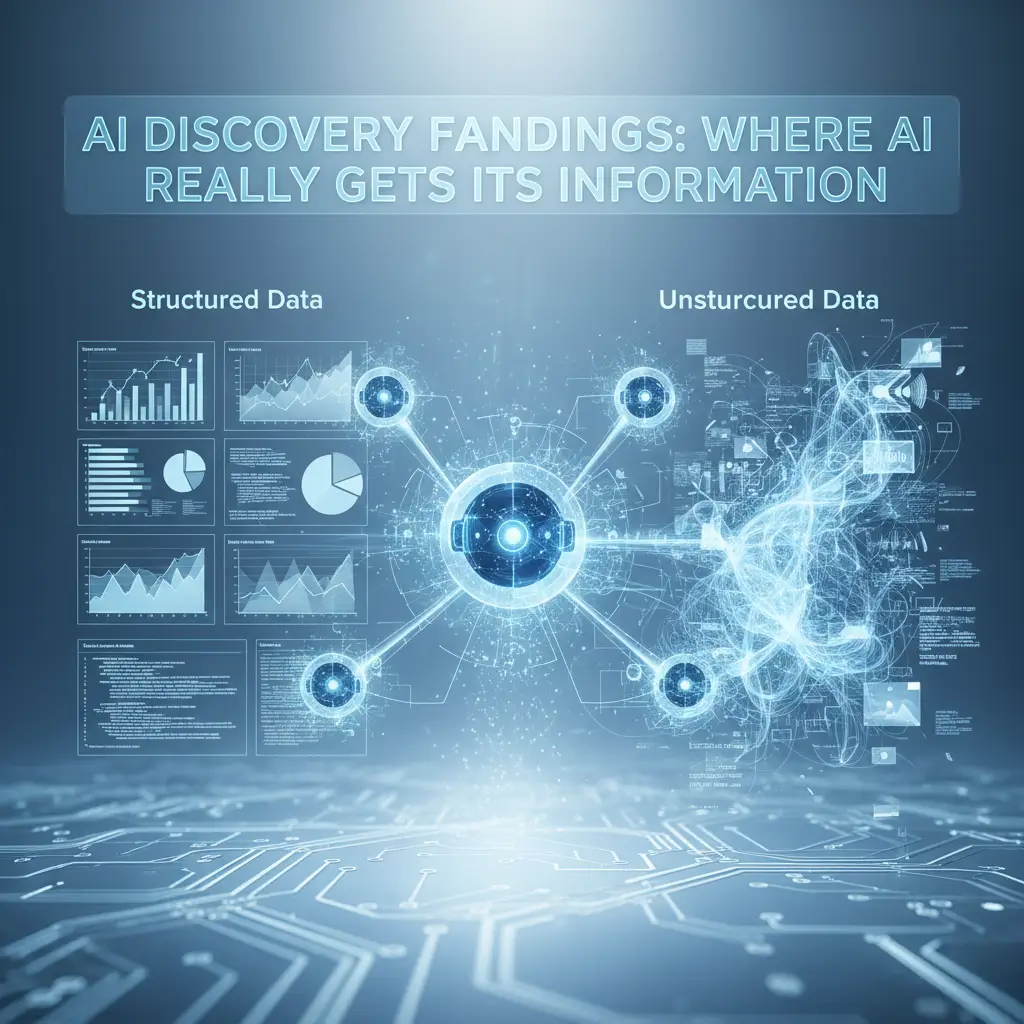
A Clear, Non-Technical Explanation for Founders, Marketers, and Business Owners
Most people assume AI assistants behave like search engines. They don’t. And that changes everything about how businesses get discovered.
Search engines rank pages.
AI systems synthesize answers.
They’re not asking:
“What page has the most keywords?”
but instead:
“What entities can I trust enough to recommend as an answer?”
During the past several months of testing and monitoring behavior across ChatGPT, Claude, Perplexity, and Gemini, one pattern became extremely clear:
AI assistants validate credibility by detecting consistent patterns — across multiple sources — not by popularity or volume.
This report summarizes how discovery currently works, where AI actually pulls information from, and what businesses need to do to become recommendable in 2026.
Important Note: AI systems evolve rapidly. What’s accurate in January 2026 may shift by June 2026. This document reflects current patterns and emerging standards, but continuous monitoring and adaptation are essential.
⭐ 1. AI Doesn’t Pull From One Source — It Cross-Checks Patterns
AI assistants compare signals across multiple categories:
✔ Website structure
- schema markup
- business entity data
- product attributes
- metadata consistency
✔ Social presence
- LinkedIn profiles and company pages
- Instagram bios and brand descriptions
- Professional social media presence
- Consistent brand messaging
✔ Business profiles
- Google Business Profile
- Industry directories (G2, Capterra, Crunchbase)
- Partner and vendor listings
- Professional association memberships
✔ Content ecosystems
- Company blogs and thought leadership
- Video transcripts (especially YouTube)
- Podcast appearances and interviews
- Consistent messaging across channels
✔ Community discussion patterns
- Reddit conversations and mentions
- Quora answers and expertise demonstration
- Industry forums and professional communities
- Stack Overflow and technical discussions
The key takeaway:
AI looks for alignment across all these sources. If your messaging, structure, and identity match across platforms, the model treats your business as “stable” and “authentic.”
Example: If your LinkedIn says ‘Marketing Consultant’ but your website says ‘Growth Strategist’ and your Google Business Profile says ‘Digital Marketing Agency,’ AI sees inconsistency and reduces confidence in recommending you.
🔑 Key Takeaway: Consistency across platforms builds AI trust. Inconsistency destroys it.
⭐ 2. AI Prioritizes Machine-Readable Data First
This is the part most businesses overlook.
AI doesn’t “read” your site like a human — it reads the structure first, then the content.
Top machine-readable signals include:
✔ Schema markup (Organization, Product, Service, Article schemas)
✔ Consistent naming conventions across all platforms
✔ Clear entity definition and business categorization
✔ Linked data connections and structured relationships
✔ Updated metadata and business information
If your website has no structured data, AI sees your brand as:
❌ Undefined entity
❌ Unverified business
❌ Risky to recommend
This structural foundation is why Axis Suite includes WebVector AI and AI Visibility Pulse — to identify and fix the gaps that most businesses never notice but that critically impact AI recommendations.
🔑 Key Takeaway: AI reads structure before content. No structure = no recommendations.
⭐ 3. AI Cross-References You Against Multiple Platforms
AI models verify that you are:
✔ A real, legitimate organization
✔ Consistently described across platforms
✔ Present in multiple validated locations
What matters is consistency, not celebrity status.
Contrary to popular belief:
❌ You do not need a Wikipedia page
❌ You do not need major media coverage
❌ You do not need to be a household brand
Instead, AI checks whether your core business elements appear consistently:
✔ Brand name and variations
✔ Business category and industry classification
✔ Service/product descriptions
✔ Geographic location and service areas
✔ Contact information and domain ownership
✔ Professional identity and expertise areas
🔑 Key Takeaway: AI validates authenticity through cross-platform consistency, not celebrity status or media coverage.
⭐ 4. Where AI Actually Gets Its Live Information
Here are the platforms AI models actively reference during live queries:
1. Reddit
AI values conversational data volume over accuracy. While this creates misinformation risks, AI interprets Reddit as “high human discussion density” — a signal of relevance and interest.
2. LinkedIn
AI treats LinkedIn as professional identity confirmation. The structured nature of profiles, job roles, and company data makes it highly trusted for business recommendations.
3. Company Websites with Structured Data
AI actively pulls from:
- About pages with clear business descriptions
- Product/service pages with proper schema
- Blog content with consistent expertise demonstration
- Contact and location information
- Properly structured metadata
4. YouTube Transcripts
Not the video content itself, but the machine-readable transcripts that provide rich, structured information about expertise and topics.
5. Business Directories and Listings
- Google Business Profile
- Industry-specific directories (G2, Capterra)
- Professional databases (Crunchbase, AngelList)
- Local business listings and chambers of commerce
6. Community Q&A Platforms
- Quora answers demonstrating expertise
- Stack Overflow for technical businesses
- Industry-specific forums and communities
- Professional association discussions
🔑 Key Takeaway: AI prioritizes structured, conversational data from platforms where businesses actively demonstrate expertise and consistency.
⭐ 5. What AI Uses for Trust Calibration vs. Small Business Assessment
The relationship between authority sources and AI recommendations requires nuance:
For Large Entities, AI References:
✔ Wikipedia (as entity definition baseline)*
✔ Major news sources (NYT, WSJ, Reuters for credibility anchoring)
✔ Academic citations (for expertise validation)*
✔ Government databases (for official verification)*
Technical Note: AI models used these sources heavily during training, but live inference typically doesn’t involve real-time scraping unless the model has specific live access (like Perplexity). Most models rely on training data rather than live database queries.
For Small Businesses, AI Relies On:
✔ Cross-platform consistency patterns
✔ Structured data and schema markup
✔ Social proof through community mentions
✔ Directory and profile alignment
✔ Demonstrated expertise through content
✔ Professional network validation
The Key Insight: AI uses high-authority sources to establish trust baselines during training, then applies similar consistency and clarity standards to evaluate smaller entities through their structured presence and cross-platform alignment.
What This Means for You: You don’t need Wikipedia to get recommended, but you do need the same level of consistency and structural clarity that makes Wikipedia reliable for AI systems.
🔑 Key Takeaway: AI uses authority sources as trust calibration tools, then evaluates smaller businesses using consistency and structural clarity as proxies for reliability.
⭐ 6. Emerging AI Optimization Standards
Three standards are becoming critical for AI visibility in 2026:
A. The “Answer Hook” Strategy
AI models prefer pre-formatted, easily extractable information. They function as “lazy” extractors that favor structured summaries.
Implementation:
Include a “Quick Facts” or “TL;DR Knowledge Block” at the top of major pages: Copy code
markdown**Quick Facts:**
- Company: [Your Business Name]
- Service: [Primary Service/Product]
- Location: [City, State/Country]
- Specialty: [Key Differentiator]
- Founded: [Year]
- Best For: [Target Customer Type]
Real Example: Copy code
markdown**Quick Facts:**
- Company: Axis Digital Marketing
- Service: AI-powered marketing automation
- Location: Austin, Texas
- Specialty: B2B SaaS marketing optimization
- Founded: 2023
- Best For: Growing software companies seeking predictable lead generation
B. The LLMS.txt Standard
This emerging standard involves hosting a structured file at yourdomain.com/llms.txt — becoming as important as robots.txt was for search engines.
Note: This is predicted future behavior that’s becoming a best practice, though not yet universally adopted across all AI models. It’s safe and strategic to implement now.
Implementation:
Create a plain markdown file with key business information: Copy code
markdown# [Your Business Name]

## Overview
[Your business name] is a [category] company founded in [year], specializing in [primary service/product].

## Services
- [Service 1]: [Brief description]
- [Service 2]: [Brief description]
- [Service 3]: [Brief description]

## Location
- Primary: [City, State/Country]
- Service Areas: [Geographic coverage]

## Contact
- Website: [URL]
- Email: [Primary contact]
- Phone: [Primary number]

## Key Facts
- Founded: [Year]
- Team Size: [Number] employees
- Primary Market: [Target audience]
- Specialty: [Key differentiator]
C. Semantic Sentiment Consistency
AI systems track the adjectives and descriptive language surrounding your brand across platforms, clustering businesses based on repeated descriptive patterns.
The Challenge: If Reddit discussions consistently describe your brand as “affordable” while your website emphasizes “luxury,” AI experiences “recommender friction” and may avoid suggesting you for either category.
Implementation Strategy:
- Audit semantic positioning across all platforms
- Choose consistent descriptive language (affordable vs. premium, fast vs. thorough, innovative vs. reliable)
- Align messaging so the same adjectives appear across LinkedIn, website, reviews, and social mentions
Example Consistency Framework:
- Website: “Premium marketing automation for growing businesses”
- LinkedIn: “Premium marketing solutions that scale with your growth”
- Google Business: “Premium marketing automation services”
- Social mentions: Encourage “premium” rather than “expensive” or “high-end”
🔑 Key Takeaway: Implementing these emerging standards now, while competition is minimal, creates permanent advantages. Axis Suite is designed to support and streamline this implementation process.
⭐ 7. When AI Treats Businesses as “Unverified”
AI doesn’t categorize businesses as “bad” or “unknown” — rather as “structurally unclear” when it can’t confirm entity details.
AI cannot recommend entities it cannot verify.
Signs of “unverified status” include:
❌ Missing schema markup and structured data
❌ Inconsistent naming across platforms
❌ Mismatched business descriptions and categories
❌ Broken, thin, or outdated website pages
❌ Empty or incomplete social profiles
❌ Conflicting semantic positioning across platforms
When AI encounters ambiguity, it defaults to:
“Low confidence → do not recommend.”
This isn’t a penalty — it’s a safety mechanism. AI systems err on the side of caution when recommending businesses to users.
🔑 Key Takeaway: Ambiguity kills AI recommendations. Structural clarity creates them.
⭐ 8. Why Most Businesses Remain Invisible to AI
The primary reason: they’re still optimizing for Google’s ranking system instead of AI’s synthesis system.
AI assistants do NOT:
❌ Rank based on keyword density
❌ Read long pages sequentially from top to bottom
❌ Rely heavily on backlink authority
❌ Reward high content volume
❌ Respond to traditional SEO tactics
Instead, AI systems reward:
✔ Structural clarity and entity definition
✔ Cross-platform consistency
✔ Factual stability and reliability
✔ Clean, organized information architecture
✔ Multi-source validation and alignment
✔ Demonstrated expertise through helpful content
The Fundamental Difference:
- SEO optimizes for search engine crawlers that rank pages
- AI Optimization optimizes for language models that synthesize answers
🔑 Key Takeaway: SEO optimization ≠ AI optimization. They require different strategies, different metrics, and different success measures.
⭐ 9. The Hidden Reality: AI Is Already Recommending Businesses
Despite low general awareness, AI assistants have quietly become the first consultation point for business decisions.
People are already asking AI:
- “What tool should I use for [specific need]?”
- “Who are the top providers in [industry]?”
- “What company best solves [specific problem]?”
- “Which brands are most trusted for [service]?”
- “What should I buy for [specific situation]?”
- “Which service is best for [particular use case]?”
These AI recommendations form before people:
- Search Google for options
- Visit company websites
- Click on advertisements
- Follow brands on social media
- Read traditional reviews
Discovery is shifting upstream — from search-based exploration to AI-powered consultation.
The businesses that understand and prepare for this shift now will own their categories. Those that wait will pay premium prices to compete when the shift becomes obvious to everyone.
🔑 Key Takeaway: AI discovery is happening now, not in the future. Early positioning creates permanent competitive advantages.
⭐ 10. Common Implementation Mistakes
❌ Mistake #1: Treating AI visibility like traditional SEO
- Focusing on keyword optimization instead of entity clarity
- Optimizing for search engine crawlers instead of AI synthesis
- Measuring website traffic instead of recommendation frequency
❌ Mistake #2: Inconsistent cross-platform messaging
- Using different business descriptions across platforms
- Mismatched categories and industry positioning
- Conflicting semantic sentiment (describing yourself as both “affordable” and “premium”)
❌ Mistake #3: Ignoring structural requirements
- Missing schema markup on websites
- Incomplete metadata and entity definitions
- No LLMS.txt file for AI crawler guidance
❌ Mistake #4: Waiting for market validation
- Delaying optimization until competitors demonstrate success
- Requiring certainty before strategic positioning
- Missing the early-adopter advantage window
🔑 Key Takeaway: The biggest mistake is continuing to optimize for yesterday’s discovery methods while customers have already moved to tomorrow’s consultation patterns.
⭐ 11. Realistic Timeline Expectations
Month 1-2: Foundation Building
- Fix structural issues (schema markup, metadata, consistency)
- Align messaging across all platforms
- Establish clear entity definition
- Implement Answer Hooks and LLMS.txt files
Month 3-4: Signal Strengthening
- AI systems begin recognizing consistent patterns
- Occasional mentions in broad industry queries
- Cross-platform validation improves
- Semantic sentiment alignment takes effect
Month 5-6: Recommendation Frequency
- Regular mentions in relevant, specific queries
- Improved context and competitive positioning
- Differentiation from competitors emerges
- Authority signals strengthen across platforms
Month 7-12: Category Authority
- Consistent recommendations across multiple AI platforms
- Premium positioning within your category
- Sustainable competitive advantages
- Market leadership establishment
Important Considerations:
- These timelines reflect current AI system behavior patterns
- AI models evolve rapidly; optimization cycles may accelerate or require adjustments
- Continuous monitoring and adaptation are essential for sustained success
Timeline Variables:
Results vary significantly based on:
- Industry competition density — saturated markets take longer
- Content volume and quality — comprehensive resources accelerate recognition
- Signal strength — businesses with strong existing presence see faster results
- Implementation consistency — systematic approach beats sporadic efforts
🔑 Key Takeaway: AI visibility builds over months through consistent implementation. Early starters compound advantages over time, but patience and systematic execution are essential.
⭐ 12. Industry-Specific Applications
Professional Services (High Impact Potential)
- AI frequently recommends consultants, agencies, and coaches
- Personal branding and expertise demonstration critical
- LinkedIn presence essential for professional recommendations
- Answer Hooks particularly effective for service descriptions
- Case studies and client results drive authority signals
E-commerce (Moderate to High Impact)
- Product schema and structured data essential for product recommendations
- Customer reviews and ratings significantly influence AI suggestions
- Category clarity determines recommendation frequency
- LLMS.txt files help with product categorization and discovery
- Inventory and availability data affects recommendation timing
Local Businesses (High Impact Potential)
- Google Business Profile optimization crucial for local recommendations
- Local directory consistency directly affects area-based suggestions
- Geographic entity definition required for location-based queries
- Semantic sentiment consistency across review platforms essential
- Community involvement and local authority signals matter significantly
B2B Software (Very High Impact)
- Technical documentation and structured data critical for feature-based recommendations
- Integration capabilities and API documentation influence developer recommendations
- Developer community presence affects technical authority
- LLMS.txt files essential for feature and capability descriptions
- Use case documentation drives specific implementation recommendations
🔑 Key Takeaway: AI visibility strategies should align with industry-specific recommendation patterns and customer consultation behaviors.
⭐ 13. Systematic Implementation Framework
Week 1: Foundation Assessment
✔ Audit current messaging consistency across all platforms
✔ Evaluate existing schema markup and structured data
✔ Document current semantic sentiment across platforms
✔ Identify gaps in entity definition and clarity
✔ Assess competitive positioning in your category
Week 2: Structural Implementation
✔ Add comprehensive schema markup (Organization, Product, Service)
✔ Create and upload LLMS.txt file with business essentials
✔ Standardize business descriptions across all platforms
✔ Fix metadata and entity definition inconsistencies
✔ Establish consistent naming conventions
Week 3: Content Optimization
✔ Add Answer Hook blocks to key website pages
✔ Align semantic sentiment across all platforms
✔ Update LinkedIn, Google Business, and directory profiles
✔ Create consistent messaging templates for team use
✔ Develop content guidelines for ongoing consistency
Week 4: Monitoring and Measurement
✔ Establish baseline AI visibility measurements
✔ Set up regular testing protocols across AI platforms
✔ Create monthly review process for consistency maintenance
✔ Plan ongoing optimization and adaptation schedule
✔ Document initial results and improvement opportunities
🔑 Key Takeaway: Systematic implementation consistently outperforms sporadic optimization efforts. Following a structured approach ensures comprehensive coverage and measurable progress.
⭐ 14. The Axis Suite Advantage
Axis Suite provides businesses with the structure, clarity, and consistency required to become recommendable by AI assistants.
This isn’t simply a “tool” — it’s comprehensive AI-native business infrastructure designed specifically for the new discovery landscape.
Core Capabilities:
- WebVector AI: Fixes structural gaps and implements emerging standards
- AI Visibility Pulse: Monitors and tracks AI recommendation patterns
- Cross-platform consistency: Ensures alignment across all business touchpoints
- Systematic optimization: Guides implementation through proven frameworks
⭐ 15. Strategic Action Plan for 2026
Step 1 — Establish Structural Foundation
✔ Implement comprehensive schema markup and metadata
✔ Create and deploy LLMS.txt file
✔ Define entity clearly across all platforms
✔ Fix cross-platform inconsistencies systematically
Step 2 — Align Messaging Architecture
Ensure consistency across:
✔ Business naming conventions
✔ Service/product descriptions
✔ Category and industry positioning
✔ Semantic sentiment and brand adjectives
Step 3 — Strengthen Digital Presence
✔ Optimize LinkedIn with Answer Hooks and consistent messaging
✔ Improve website structure for AI comprehension
✔ Develop YouTube content with structured transcripts
✔ Maintain directory listing consistency
✔ Create thought leadership content demonstrating expertise
Step 4 — Monitor and Measure Progress
Track key indicators:
✔ AI citations and recommendation frequency
✔ Category appearance and positioning
✔ Competitive positioning changes
✔ Cross-platform consistency maintenance
Step 5 — Iterate and Adapt Monthly
✔ AI discovery systems evolve rapidly
✔ Successful strategies may require adjustment
✔ Continuous optimization maintains competitive advantages
✔ Early adapters gain permanent market positioning benefits
🔑 Key Takeaway: Systematic implementation combined with adaptive iteration creates sustainable competitive advantages in the AI discovery landscape.
⭐ Final Summary
AI doesn’t rank pages — it ranks patterns.
Businesses don’t win by being loud — they win by being discoverable.
The future belongs to those who are structurally clear, not algorithmically clever.
The shift from search-based discovery to AI-powered recommendations is happening now. Businesses that understand and prepare for this transformation will own their categories. Those that wait will pay premium prices to compete when the shift becomes obvious to everyone.
Critical Reality: AI systems evolve rapidly. What’s accurate today may require adjustment tomorrow. The businesses that succeed will implement systematically while remaining adaptable to change.
The opportunity window is narrowing. Early positioning creates permanent advantages, but only for businesses that act with both urgency and strategic precision.
Ready to make your business discoverable to AI?
Start with a comprehensive AI visibility audit to understand your current position, then implement emerging standards systematically while competition remains minimal.
The businesses that master AI discovery now will define their categories for the next decade.
Bonus Link: AI Discovery Implementation Checklist