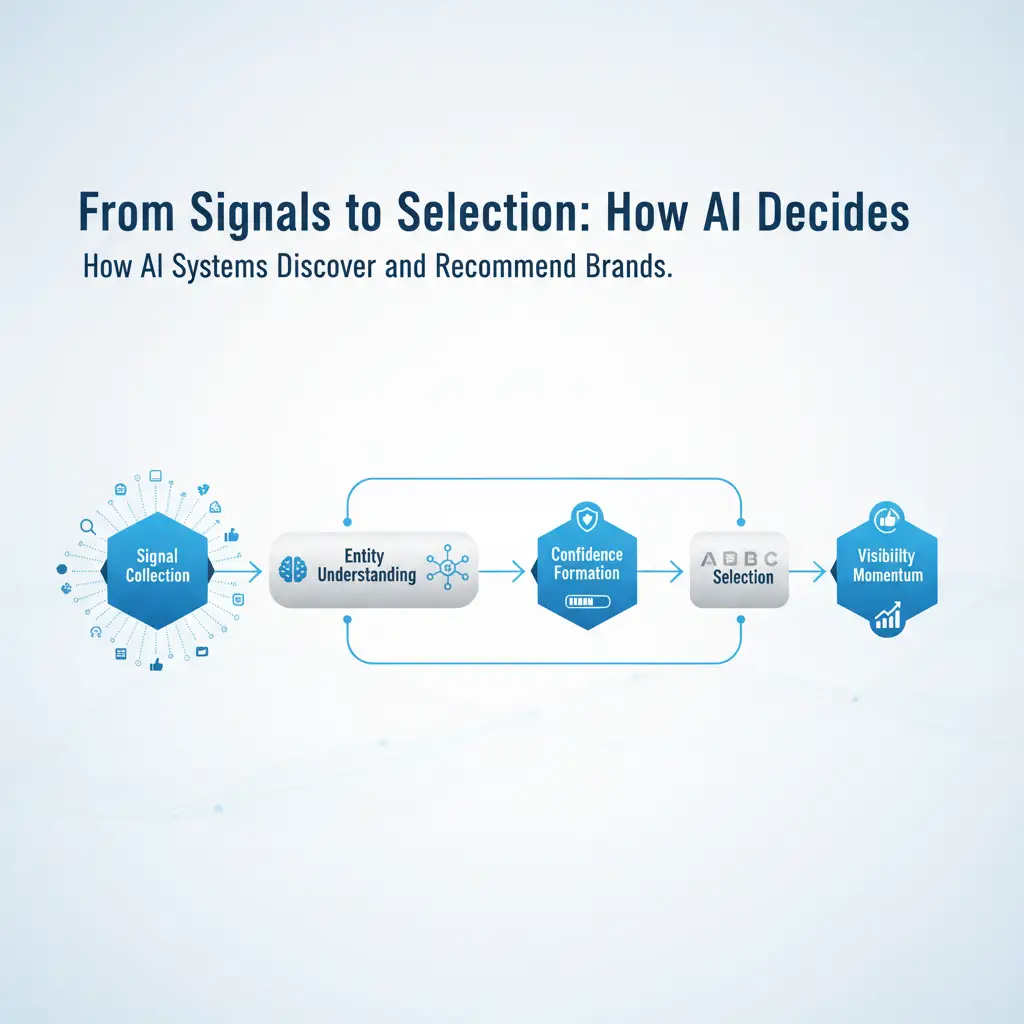
When you ask an AI system for a recommendation, it might feel like the answer appears instantly, as if by magic. The truth is far more complex. AI systems follow a structured, multi-step process to determine which brands to include in their responses. Every step of this process is a combination of data analysis, interpretation, and selection decisions.
For organizations aiming to stand out in AI-generated answers, understanding this process is no longer optional. It’s a blueprint for ensuring your brand doesn’t just get noticed but becomes a trusted choice in AI-generated recommendations.
The Shift from Ranking to Selection
For years, traditional search engines dominated the digital landscape. They ranked pages based on factors like relevance, authority, and keywords, giving users a list of links to explore.
AI systems, however, play an entirely different game. They synthesize information, evaluate multiple entities, and select only a few brands to include in their responses.
This shift introduces a new competitive dynamic:
- Old paradigm: Compete for position on a ranked list.
- New paradigm: Compete for selection in a limited answer.
In AI systems, there is no “page two.” If your brand isn’t selected, you don’t appear at all.
The AI Discovery Process
AI systems don’t randomly decide which brands to recommend. They follow a detailed discovery process that ensures their responses are accurate, meaningful, and trustworthy. Here’s how it works:
1. Signal Collection
What the AI sees
The first step is gathering information from across the web. AI systems scan content and collect signals, including:
- Website content
- Structured data
- Brand mentions
- Customer reviews
- References in third-party sources
- Comparisons in articles
At this stage, the AI isn’t ranking or evaluating anything. It’s simply collecting pieces of information that help define an entity.
2. Entity Understanding
What the AI believes the brand is
Once it has data, the AI tries to understand the entity it’s analyzing. It evaluates elements like:
- Category (e.g., is this a tech company or a wellness brand?)
- Use case (what problems does this brand solve?)
- Target audience (who benefits from this brand’s offerings?)
- Positioning (what makes this brand unique?)
- Differentiation (why choose this brand over others?)
The clearer and more consistent these signals are across platforms, the more accurately the AI can define your brand. If signals are fragmented or contradictory, the AI’s understanding weakens.
3. Confidence Formation
How certain the model feels
After understanding the brand, the AI assigns confidence levels to its interpretation. Confidence grows when:
- Signals are consistent and align across various sources.
- Authoritative content (your website, trusted publications, etc.) reinforces the brand story.
- Descriptions remain uniform on websites, social media, and third-party references.
Conversely, confidence decreases when:
- Positioning is unclear or inconsistent.
- Sources contradict one another.
- Categories are ambiguous, leading to confusion about what the brand represents.
4. Selection
Where the real competition happens
This is the pivotal moment. After building confidence, the AI selects a small number of brands to include in its response.
Unlike traditional search engines, which offer pages of options, AI-generated answers typically feature only a handful of recommendations. If your brand isn’t selected in this stage, it won’t appear at all.
5. Visibility Momentum
Why some brands dominate
Once a brand is repeatedly selected, it begins to gain visibility momentum. This creates a positive feedback loop:
- More selections lead to more visibility.
- Increased visibility generates more signals across the web.
- Reinforced signals further boost the model’s confidence.
Over time, small differences in the early stages of the discovery process can result in significant disparities in how often brands are recommended.
Why Some Brands Are Consistently Recommended
Two companies might offer nearly identical products or services, yet one is consistently included in AI recommendations while the other is not.
This difference isn’t about which brand is “better.” It’s about which brand is clearer, more reliable, and easier for AI to understand. Specifically:
- Signal consistency ensures the AI gets a uniform message.
- Entity definition clarifies categories, use cases, and differentiation.
- Source reinforcement ensures multiple platforms tell a cohesive story.
- Model confidence builds trust in the brand’s reliability.
AI systems prioritize brands that are understandable and trustworthy—not just visible.
The Role of AI Discovery Intelligence
This is where AI Discovery Intelligence comes into play. It doesn’t just monitor whether your brand appears in AI results. It studies the entire process, from signal collection to selection.
By focusing on areas like signal interpretation, entity clarity, and confidence building, AI Discovery Intelligence provides actionable insights into why some brands succeed while others struggle.
What This Means for Businesses
To thrive in an AI-driven discovery environment, organizations must rethink their strategies. Instead of focusing solely on rankings, the shift must be toward clear, understandable brand storytelling.
Businesses should ask:
- Are we consistent in how we define ourselves across all platforms?
- Do our target audience and use cases come through clearly?
- Are our signals reinforced by authoritative sources?
By addressing these questions, brands can transform the way AI systems perceive them.
Where Axis Suite Fits
Axis Suite is designed to help businesses master the AI discovery process. Unlike tools that only track visibility, Axis Suite:
- Identifies and eliminates weak or conflicting signals.
- Measures visibility across platforms like ChatGPT and Perplexity.
- Diagnoses why competitors may be selected over your brand.
- Helps refine how AI interprets your entity.
- Enhances confidence and selection probability.
With Axis Suite, you’re not just tracking outcomes. You’re gaining the tools to influence AI systems at every stage of discovery.
Final Thought
AI systems are no longer just a gateway to information. They’re decision-makers, determining which brands deserve a spot in their answers.
Understanding how these decisions are made is vital for any organization looking to stay competitive in the AI era. By focusing on signal clarity, consistency, and confidence formation, businesses can position themselves as the reliable, understandable choice in AI-generated recommendations.
To begin optimizing for AI discovery, explore how Axis Suite can help you stand out—not just be seen, but thoroughly understood.