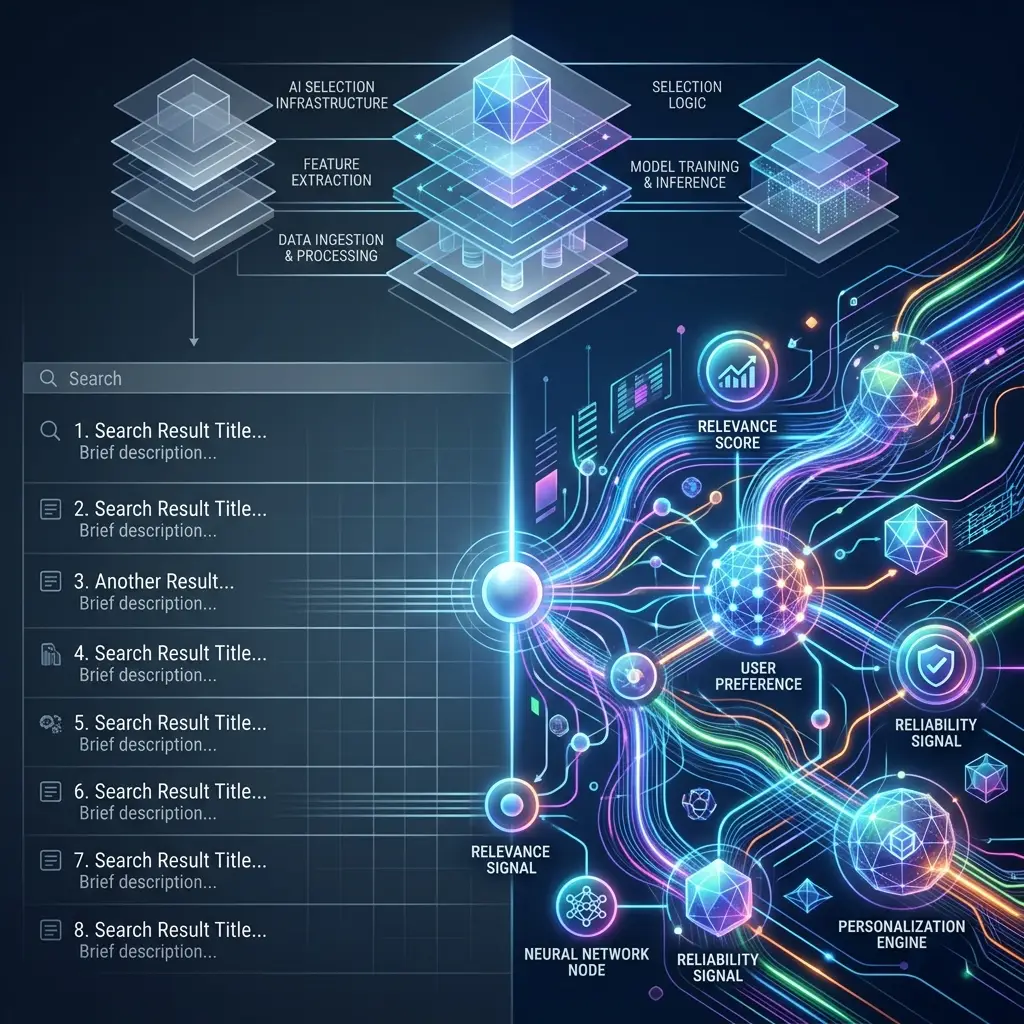
Something changed over the last two weeks. Not suddenly. Not dramatically. But noticeably enough that the framing most businesses use to understand AI visibility feels outdated.
Google AI Mode became more prominent. More businesses felt the difference between appearing in search results and being selected in AI answers. Practitioners started realizing AI search does not behave like traditional SEO. The market is shifting, yet most businesses have not updated their mental models.
Search engines retrieved. AI systems mediate.
There is a framing shift that most teams have not fully processed. Search engines were built as retrieval systems. You optimized your content, you ranked, and you got found.
AI systems do something entirely different. They act as decision mediators. They do not just surface information. They synthesize data, filter uncertainty, compare options, and make direct recommendations that buyers act on before ever visiting a website.
That changes the entire problem. The central question is no longer just how you rank. The question is becoming how AI decides whether to recommend you. Those two questions require completely different answers.
The four levels of AI visibility
Most businesses collapse AI visibility into a single measurement. If their name appears, they assume they are succeeding. But there are actually four distinct states of AI confidence about a brand:
- Mentioned: AI knows you exist.
- Cited: AI references your content as a source.
- Recommended: AI suggests your brand during buyer-intent conversations.
- Chosen: AI repeatedly selects you across competing recommendation scenarios.
These are completely different states. Moving from one layer to the next requires increasingly stronger signals. Right now, most businesses sit at the first or second level, yet they measure their success as if they have reached the fourth. That gap is forming a massive competitive blind spot.
Introducing Selection Infrastructure
The brands building durable AI visibility do not rely on standard optimization tactics. Instead, they build what we call Selection Infrastructure.
This is the underlying signal architecture that makes a brand consistently retrievable, accurately describable, confidently comparable, and repeatedly recommendable across AI systems.
Six properties define a strong Selection Infrastructure:
- Crawlable
- Extractable
- Corroborated
- Structured
- Comparison-ready
- Recommendation-worthy
Most brands have the first two properties covered. Very few have deliberately built the last four. But those final four properties are where actual selection happens. This is exactly where Axis Suite comes in, helping you measure and build the precise signals needed to bridge that gap.
Recommendation persistence is the new metric that matters
Some brands appear in AI answers occasionally. Others appear persistently across repeated buyer-intent prompts, multiple AI surfaces, and different contextual framings of the same question.
That persistence is never random. It is the direct output of Selection Infrastructure built deliberately over time. Once AI systems develop strong recommendation patterns around certain brands, those patterns become self-reinforcing. The brands that get chosen keep getting chosen.
The window to establish that position is open right now, but it will not stay open indefinitely.
The shift worth building for
The future competitive battleground is not about who ranks highest. It is about whether AI systems repeatedly select, trust, compare accurately, and recommend your business when buyers make decisions.
That is the shift we must build for now.
– Dana Billingsley
Founder, Axis Suite