For the past two years the AI marketing conversation has been dominated by one question.
Are we visible in AI answers?
It is a reasonable question. It was the right question to start with.
But it is increasingly the wrong mental model for what is actually happening to brands inside AI systems.
What the Visibility Mental Model Gets Wrong
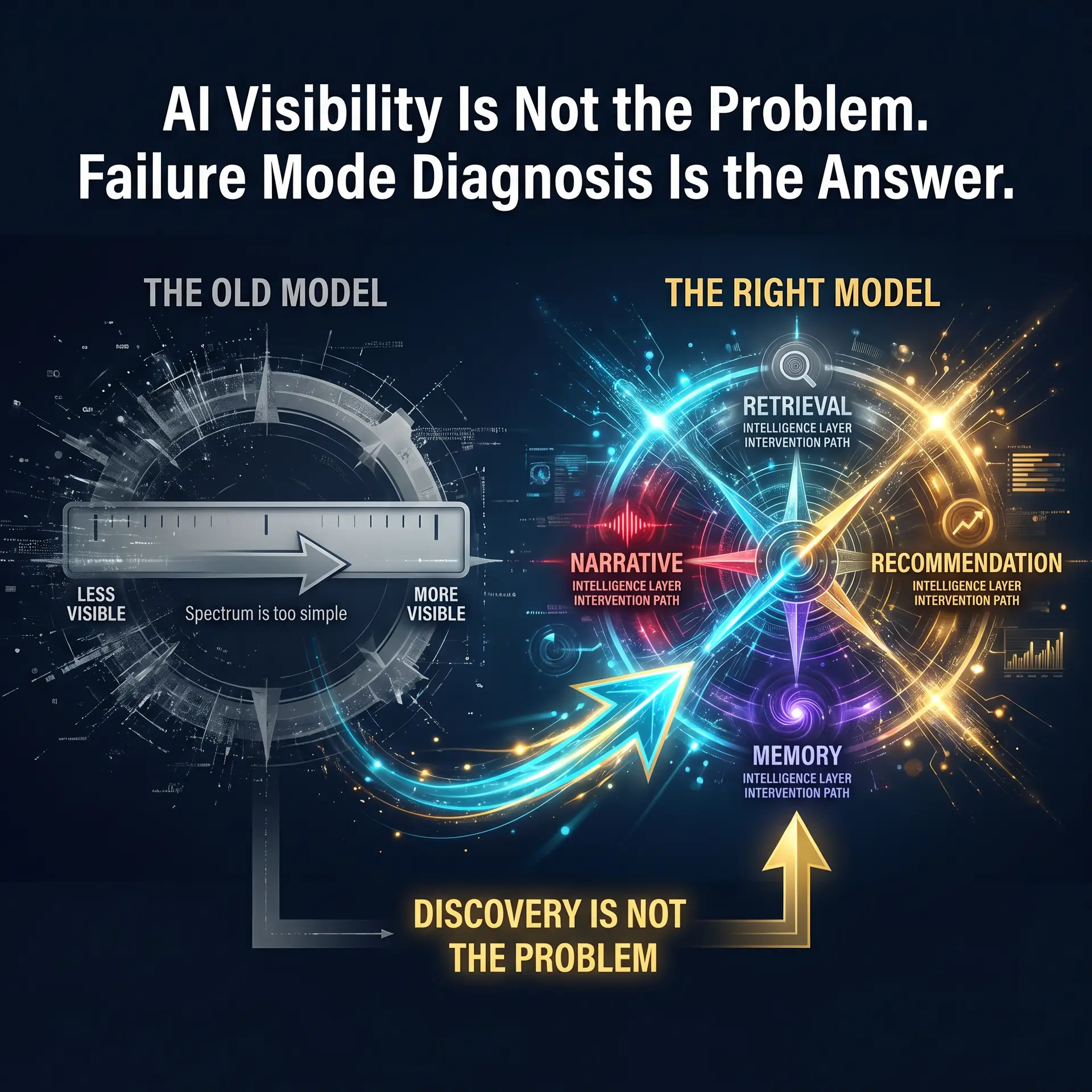
The visibility mental model treats AI brand performance as a spectrum.
More visible on one end. Less visible on the other.
The work is about moving toward the more visible end. More mentions. More citations. More appearances in AI-generated answers.
This model made sense when the primary question was whether AI knew a brand existed.
But that is no longer the primary question for most B2B brands.
Most brands with active digital presence are visible in some form. AI knows they exist. AI can describe them to some degree.
The problem is not visibility.
The problem is what AI has come to believe about them after discovery occurs.
The Three Failures That Visibility Metrics Cannot See
Consider what the visibility model cannot explain.
A brand can be highly visible in AI answers and still never appear when buyers ask who to choose. Recommendation failure. Invisible to visibility metrics.
A brand can be recommended occasionally and still have AI carrying an incorrect category impression that filters every competitive scenario it enters. Memory failure. Invisible to visibility metrics.
A brand can be described accurately most of the time and still have AI using hesitation language that positions it below competitors described with confidence. Also invisible to visibility metrics.
All three of these problems look like visibility problems from the outside. The brand is not performing as expected in AI systems. The dashboard looks fine but something is off.
But none of them are visibility problems. They are deeper failures that occur after discovery and that require completely different responses.
The Mental Model That Actually Explains What Is Happening
Instead of a visibility spectrum the more accurate mental model is a failure mode diagnostic.
AI systems can fail brands in four distinct ways.
Retrieval failure. AI cannot reliably find you. This is the only failure mode that is genuinely a visibility problem.
Recommendation failure. AI finds you but recommends competitors when buyers ask who to choose. This is a category association and co-citation problem not a visibility problem.
Memory failure. AI has formed incorrect or drifting impressions about your brand that persist across every future interaction. This is a longitudinal intelligence problem not a visibility problem.
Narrative failure. AI describes you incorrectly in the moment. This is a signal accuracy problem not a visibility problem.
Three of the four failure modes have nothing to do with visibility in the traditional sense. They occur after AI has already found the brand and they require completely different interventions.
Why the Mental Model Shift Matters Practically
This is not a philosophical distinction.
It has direct practical consequences for how marketing teams invest their time and resources.
A team operating under the visibility mental model will respond to poor AI performance by increasing citation building, improving schema markup, and generating more mentions. This is the right response to retrieval failure.
But if the actual problem is recommendation failure, memory failure, or narrative failure, those interventions produce no meaningful improvement. The brand becomes more visible and still gets excluded from shortlists. Still carries wrong category impressions. Still gets described with hesitation language.
The wrong mental model leads to the wrong interventions which leads to wasted resources and no results.
The right mental model starts with a diagnostic question.
Which failure mode do I actually have?
That question changes everything about where you invest your attention.
The Next Evolution in AI Intelligence
The next evolution is not better visibility tracking.
Better visibility tracking helps you understand retrieval failure more precisely. That is valuable but limited.
The next evolution is accurate failure mode diagnosis across all four layers.
Retrieval Intelligence that shows what AI can reliably find.
Recommendation Intelligence that shows what AI actually selects.
Memory Intelligence that shows what AI keeps believing over time.
Narrative Defense that shows what needs active correction.
Teams that build intelligence across all four layers will understand their AI brand performance in ways that teams optimizing for visibility alone never will.
And the interventions they apply will match the problems they actually have.
That precision is where the real performance improvement lives.
The Question Worth Asking This Week
If you have been optimizing for AI visibility and not seeing the results you expected, the most useful question to ask is not how do we get more visible.
It is which of the four failure modes is actually affecting us.
The answer changes everything about where you focus next.
FAQ
Why is AI visibility the wrong mental model for most B2B brands?
The visibility mental model assumes the primary problem is whether AI knows a brand exists. For most B2B brands with active digital presence that problem has been largely solved. AI knows they exist. The more common and more consequential problems are recommendation failure, memory failure, and narrative failure. All three occur after discovery and are invisible to visibility metrics. Optimizing for visibility when you have one of these three problems produces no meaningful results.
What should replace the AI visibility mental model?
A failure mode diagnostic model. Rather than asking how visible you are, ask which of the four failure modes is affecting your brand. Retrieval failure is the only one that is genuinely a visibility problem. The other three require different intelligence and different interventions. The diagnostic model leads to more precise and more effective action.
How does memory failure differ from the other three failure modes?
Memory failure is the most distinctive because it is longitudinal and observational rather than immediate and correctable. Retrieval, recommendation, and narrative failures can all be assessed in a single testing session. Memory failure reveals itself through patterns across many scans over time. It is also the most durable because the impressions AI has formed compound across every future interaction rather than resetting between sessions.
Can a brand have strong visibility metrics and still be performing poorly in AI systems?
Yes. This is the central insight of the failure mode model. Visibility metrics measure retrieval success. They cannot detect recommendation failure, memory failure, or narrative failure. A brand can score well on all standard visibility measurements and still be systematically excluded from buyer shortlists, misclassified in competitive contexts, or described with hesitation language that positions it below competitors.
What is the most underdiagnosed AI failure mode right now?
Memory failure. Most businesses have never considered measuring what AI durably believes about their brand over time. They check whether they appear in AI answers. They do not check whether AI has filed them under the correct category, whether AI uses authority or hesitation language consistently, or whether AI is carrying competitive associations that no longer reflect their actual market position. Memory failure compounds quietly and its effects are invisible to standard measurements.
How does Axis Suite address all four failure modes?
Axis Suite’s intelligence architecture maps directly to the four failure modes. Retrieval Intelligence monitors what AI can reliably find. Recommendation Intelligence tracks what AI selects during buyer-intent queries. Memory Intelligence reveals what AI keeps believing over time through longitudinal scanning. Narrative Defense identifies and helps correct inaccurate AI descriptions. Each module addresses a specific failure mode rather than treating all AI performance problems as visibility problems.
The right mental model leads to the right diagnosis. Start with yours here: Axis Suite