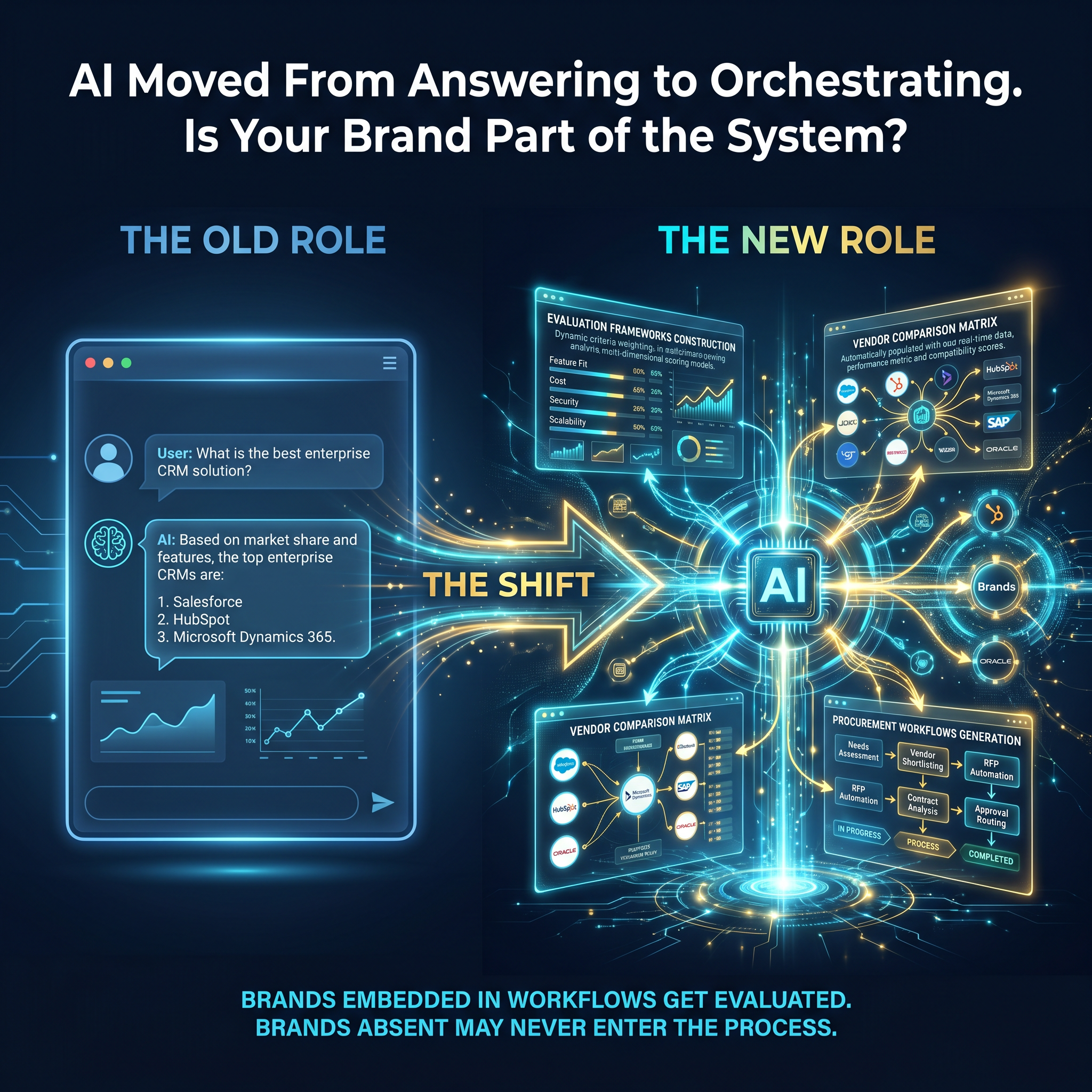
Most businesses built their AI visibility strategy around one question.
Are we appearing in AI answers?
That was the right question for 2023.
It is increasingly the wrong question for 2026.
Because something fundamental has shifted in how AI participates in the buying process.
AI is no longer just answering questions.
It is orchestrating decisions.
And that shift changes everything about what AI visibility actually means for brands trying to reach buyers at the moment that matters most.
Three Different Problems That Look the Same From the Outside
The challenge with understanding this shift is that all three eras of AI visibility look similar from the outside.
Your brand is not performing as expected in AI systems. Pipeline feels thinner than it should. Competitors seem to be showing up more consistently. Something is off.
But the underlying cause is completely different depending on which era you are actually in.
Search era problem: Buyers cannot find you when they search.
Fix: SEO. Discoverability optimization. Ranking improvement.
Recommendation era problem: AI does not include you when buyers ask who to consider.
Fix: Category association. Co-citation strategy. Buyer-intent signal building.
Workflow era problem: AI excludes you from the decision frameworks it builds when buyers ask it to help them choose.
Fix: Something most businesses have not yet started measuring, let alone addressing.
The surface symptom looks the same. The required intervention is completely different.
And most businesses are applying search-era fixes to workflow-era problems.
What AI Decision Orchestration Actually Looks Like
This is where the shift becomes concrete.
When a buyer sits down to evaluate software vendors in 2026, a growing number of them do not start by searching Google.
They open ChatGPT, Perplexity, or Claude and ask something like:
“Help me evaluate vendors for marketing automation.”
Or: “Build me a comparison framework for enterprise CRM platforms.”
Or: “Create a shortlist of options for our procurement process with scoring criteria.”
When AI responds to those requests it is not just retrieving a list of names.
It is constructing the architecture of a decision.
It builds an evaluation framework. It populates that framework with brands it knows and trusts. It applies criteria it has formed from its training data. It generates a comparison structure the buyer uses as the foundation for their entire decision process.
The brands included in that architecture are not just being mentioned.
They are being evaluated.
The brands excluded from it may never enter the decision process at all regardless of how visible they are in individual AI answers.
The Three Eras in Plain Language
Search era: AI surfaces you when someone looks for you.
Recommendation era: AI includes you when buyers ask who to consider.
Workflow era: AI uses you as part of the decision infrastructure it builds for buyers.
Each one is a fundamentally different relationship between a brand and an AI system.
Each one is harder to achieve and harder to displace than the previous.
And the brands that recognize this progression early are building a presence inside AI decision workflows that becomes very difficult for late movers to close.
Why Workflow Inclusion Compounds Differently
This is the strategic implication most businesses have not yet considered.
Search rankings can be displaced. A competitor with better SEO can outrank you.
Recommendation presence can be displaced. A competitor with stronger signals can appear on more shortlists.
Workflow embeddedness is different.
Once a brand is woven into the decision frameworks AI consistently builds for buyers in a category, that presence compounds with every use.
Every buyer who uses AI to evaluate vendors and encounters your brand embedded in the framework reinforces the pattern.
The brand stops being something AI occasionally recommends.
It becomes part of how AI helps buyers decide.
That is a fundamentally different and significantly more durable competitive position.
And the window to build it before the category consolidates is open right now.
The Measurement Gap This Creates
Here is the practical problem for most marketing teams.
Current AI visibility measurements are built to detect recommendation presence.
Are you appearing when buyers ask AI who to consider?
That is a valuable measurement. But it cannot detect workflow inclusion or workflow exclusion.
A brand can appear frequently in individual AI answers and still be systematically absent from the evaluation frameworks AI builds when buyers ask it to help them choose.
Those are different behaviors producing different business outcomes.
And most marketing intelligence stacks have no visibility into the gap.
The Workflow Inclusion Audit
Here is how to test your current workflow inclusion in fifteen minutes.
Ask AI these four questions without mentioning your brand:
“Help me evaluate vendors for [your category].”
“Create a shortlist of providers for [your use case] with comparison criteria.”
“Compare the leading options for [your specific problem].”
“Build a decision framework for choosing [your category].”
For each response note: Does your brand appear? At what stage? How is it framed? Which competitors appear alongside you? What criteria does AI apply?
If your brand is missing from these workflow responses while competitors appear you have a workflow inclusion gap.
That gap is distinct from recommendation failure and requires different signal work to close.
FAQ
What is the difference between AI recommendation presence and workflow inclusion?
AI recommendation presence measures whether your brand appears when buyers ask AI who to consider. Workflow inclusion measures whether your brand appears when AI builds the evaluation frameworks, comparison structures, and decision architectures buyers use to make choices. A brand can have strong recommendation presence and still be absent from decision workflows. The two behaviors require different signals to produce.
Why does workflow inclusion matter more than recommendation presence for enterprise buyers?
Enterprise buyers increasingly use AI to structure their evaluation processes not just to generate initial shortlists. An enterprise buyer asking AI to build an RFP framework, create a vendor scorecard, or structure a procurement process is relying on AI to coordinate the entire decision architecture. Brands embedded in that architecture enter the process at every stage. Brands excluded from it may never be evaluated regardless of their visibility elsewhere.
How does AI decide which brands to include in decision workflows?
Based on what we observe in scans AI appears to favor brands with strong category association clarity, consistent presence in comparison and evaluation contexts, corroboration across trusted sources, and clear differentiated positioning that can be articulated in evaluation criteria. Brands that are frequently discussed in the context of vendor selection, procurement decisions, and competitive comparisons appear to have stronger workflow inclusion than brands primarily known through informational content.
Can a brand build workflow inclusion without changing its product?
Yes. Workflow inclusion is primarily a signal and positioning challenge not a product challenge. The signals AI uses to determine workflow inclusion relate to how a brand is discussed in decision-making contexts, how clearly its evaluation criteria are articulated externally, and how consistently it appears alongside trusted alternatives in comparison environments. These are addressable through targeted signal work without product changes.
How long does it take to build workflow inclusion?
Building workflow inclusion typically takes longer than building recommendation presence because it requires establishing presence in the specific contexts AI uses when coordinating decisions rather than just when answering informational queries. Based on patterns we observe in scans, consistent signal work targeting evaluation and comparison contexts can produce measurable workflow inclusion improvements within eight to sixteen weeks.
How does Axis Suite help measure and build workflow inclusion?
Axis Suite’s Recommendation Intelligence module tests brand presence across buyer-intent queries including decision workflow queries. By running evaluation framework requests, comparison structure queries, and procurement workflow prompts we can detect workflow inclusion gaps that standard visibility measurements miss. The diagnostic connects to specific signal recommendations for building workflow presence in the contexts that matter most for buyer decision coordination.
Start measuring your workflow inclusion presence here: Axis Suite