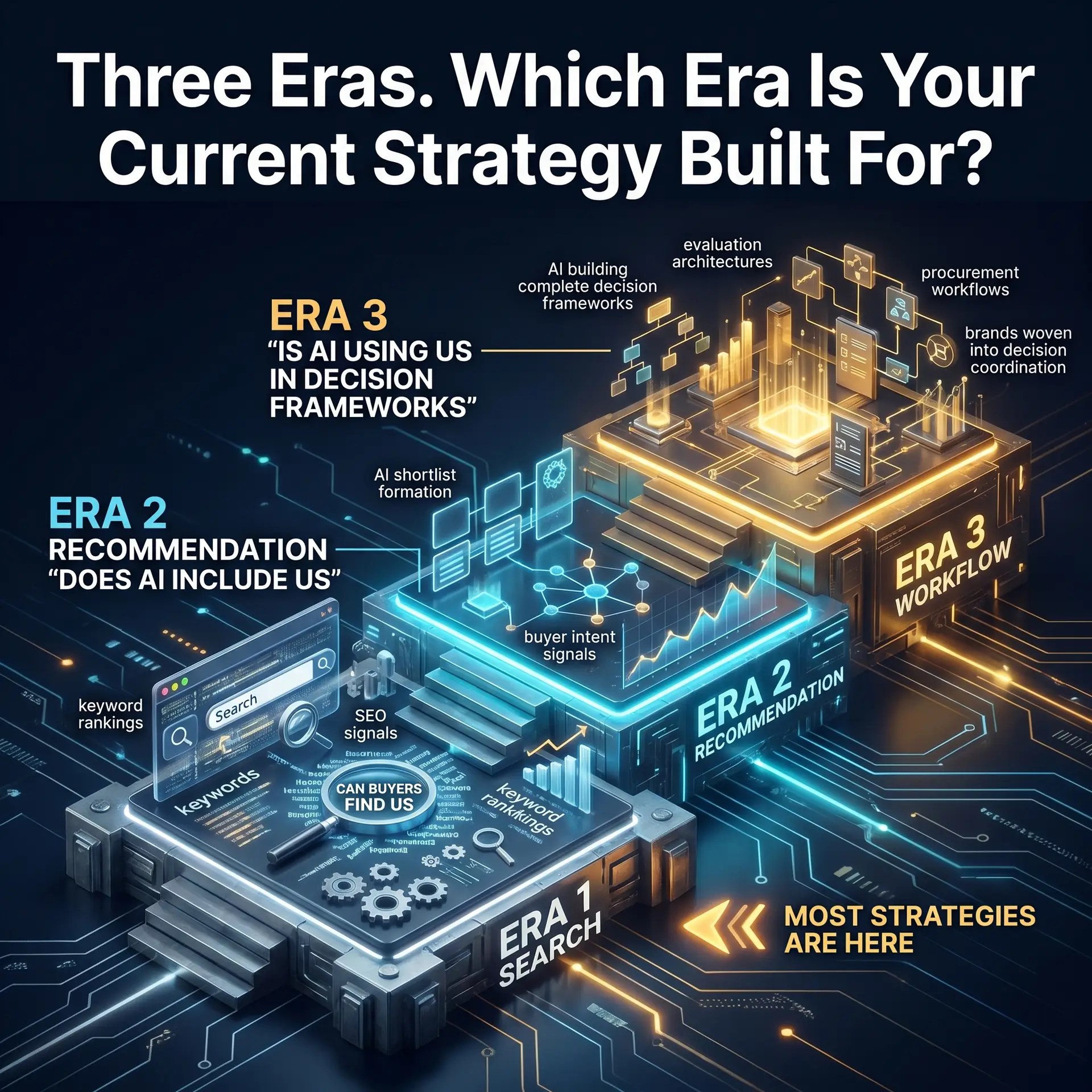
Most businesses assume they have one AI visibility challenge.
They have three.
And they are at completely different stages of formation.
Understanding which era you are actually in changes everything about where you invest your attention and resources.
Era One: The Search Era
The Question: Can buyers find us?
This era belongs to search engines. Google. Bing. Traditional discovery.
The challenge was discoverability. Could a buyer looking for what you offer find you in the results?
The strategy was SEO. Content optimization. Backlink building. Ranking improvement.
Most businesses have spent the past decade optimizing for this question.
Many are still primarily optimizing for it today.
Era Two: The Recommendation Era
The Question: Does AI include us on the shortlist?
This era belongs to conversational AI. ChatGPT. Perplexity. Claude. Gemini.
The challenge is influence. When a buyer asks AI who to consider in your category, is your brand consistently on the list?
The strategy is category association. Co-citation presence. Buyer-intent signal building. Recommendation persistence across multiple AI platforms.
The most forward-thinking businesses are actively building for this question right now.
This is where most of the current AI visibility conversation is focused.
Era Three: The Workflow Era
The Question: Is AI using our brand as part of the decision frameworks it builds for buyers?
This era belongs to AI decision coordination. The emerging behavior where buyers use AI not just to answer questions but to orchestrate their entire evaluation process.
The challenge is embeddedness. When a buyer asks AI to help them evaluate vendors, compare options, or build a decision framework, is your brand part of the architecture AI constructs?
The strategy is workflow inclusion. Building presence in the specific decision coordination contexts where AI acts as an evaluation partner rather than just an information source.
This era is just beginning to form.
And the brands recognizing it early are building a presence that will be very difficult for late movers to displace.
Why the Third Era Is Different
The first two eras share a fundamental characteristic.
They are about being included when a buyer initiates a query.
A buyer searches. You either appear or you do not.
A buyer asks AI for recommendations. You either make the shortlist or you do not.
In both cases your brand is responding to a buyer-initiated query.
The third era is different because it is about being part of the system AI uses to coordinate decisions.
When a buyer asks AI to build an evaluation framework, AI is not just responding to a query.
It is constructing an architecture that the buyer will use as the foundation for their entire decision process.
The brands embedded in that architecture are not just being found or recommended.
They are part of how the decision gets made.
Why Early Movers Build a Durable Advantage
Once AI consistently includes a brand in the decision architecture it builds for buyers something important happens.
The inclusion compounds.
Every time AI builds an evaluation framework in a category and includes a brand, that pattern reinforces itself. The brand becomes part of how AI thinks about vendor evaluation in that space.
Displacing a brand from that position requires not just building stronger signals but overcoming the established pattern of inclusion.
In the search era you could displace a competitor by outranking them on a keyword.
In the recommendation era you can displace them by building stronger recommendation signals.
In the workflow era displacement becomes structurally harder because embeddedness reinforces with every use.
The brands building workflow presence now are establishing a position that compounds quietly and becomes increasingly difficult to challenge from the outside.
How to Assess Which Era Your Strategy Is Built For
Three diagnostic questions worth asking this week:
For Era One: Is our SEO strategy still our primary AI visibility strategy? Are we measuring keyword rankings and organic traffic as our main AI performance indicators?
If yes: You are primarily optimizing for the search era while the recommendation and workflow eras are forming around you.
For Era Two: Are we actively measuring whether our brand appears when buyers ask AI who to consider in our category? Do we track recommendation frequency and recommendation persistence across multiple AI platforms?
If not: You have a recommendation era gap that is directly affecting pre-funnel pipeline right now.
For Era Three: Have we ever asked AI to help evaluate vendors in our category and checked whether our brand appears in the decision framework it builds? Do we have any measurement for workflow inclusion?
If not: You have not yet started measuring the era that is just beginning to form.
Most businesses answer yes to the first question and no to the second and third.
That gap represents the measurement opportunity and the competitive window that is currently open.
The Compounding Dynamic Worth Understanding
There is a reason the workflow era matters strategically beyond just the immediate measurement gap.
Search era presence is relatively easy to build and relatively easy to lose. Rankings fluctuate. Competitors can overtake you with sustained effort.
Recommendation era presence requires more sustained signal work but can also be displaced by competitors who build stronger signals over time.
Workflow era embeddedness is fundamentally different because the presence compounds with each use rather than simply persisting at a steady level.
A brand woven into AI decision workflows benefits from every buyer who uses those workflows.
Every evaluation framework that includes the brand reinforces the pattern.
Every procurement process that references the brand strengthens the association.
The moat does not just persist.
It deepens.
And the window to establish that initial position before the category patterns consolidate is the opportunity that exists right now.
FAQ
Why are there three separate eras rather than one continuous evolution?
Each era represents a fundamentally different relationship between a brand and an AI system. In the search era AI surfaces brands in response to queries. In the recommendation era AI evaluates brands against buyer needs. In the workflow era AI incorporates brands into decision coordination systems. These are different behaviors requiring different signals and different measurement approaches. They are not just increasing levels of the same challenge.
Can a brand be strong in one era and weak in another?
Yes and this is very common. Many brands with strong search visibility have significant recommendation era gaps. Many brands with reasonable recommendation presence have no workflow inclusion measurement at all. The eras are independent enough that strong performance in one does not automatically transfer to another. Each requires specific signal work.
Which era matters most for pipeline right now?
For most B2B brands the recommendation era is where the most immediate pipeline impact lives. Recommendation failure is the most common failure mode affecting pre-funnel pipeline currently. However the workflow era is where the most durable competitive advantages will form over the next two to three years. The optimal strategy addresses recommendation era gaps now while beginning to build workflow era presence in parallel.
How does the workflow era affect enterprise sales specifically?
Enterprise buyers are increasingly using AI to structure procurement processes, build vendor evaluation frameworks, and coordinate RFP processes. A brand embedded in those AI-generated frameworks enters the enterprise evaluation process at every stage rather than just being on an initial shortlist. For enterprise sales cycles where evaluation rigor is high, workflow inclusion may be more consequential than recommendation presence alone.
What signals drive workflow era inclusion?
Based on what we observe in scans, brands with strong workflow inclusion tend to have clear presence in evaluation and comparison contexts, consistent association with procurement and decision-making language, strong corroboration across sources that specifically discuss vendor selection, and differentiated positioning that AI can articulate as evaluation criteria. These are different from the signals that drive recommendation presence.
How does Axis Suite help businesses understand which era they are in?
Axis Suite runs both recommendation queries and decision workflow queries across major AI platforms. By comparing how a brand performs across both query types we can identify which era gaps exist and which specific signal work would most effectively address them. The diagnostic gives marketing teams a clear picture of whether their current strategy is aligned with the eras that actually affect their pipeline.
Assess which era your current AI strategy is built for: Axis Suite