CMOs have spent the past decade building measurement infrastructure for one version of the buyer journey.
Buyer finds you through search. Visits your website. Engages with content. Requests a demo. Enters the funnel.
Every metric in a modern marketing stack maps to some stage of that sequence.
And most of those metrics are now missing something.
The Shift Most CMOs Have Already Recognized
To their credit, most senior marketing leaders have already recognized the first part of the shift.
AI influences buying decisions before prospects reach the website.
Buyers are using ChatGPT, Perplexity, and Claude to research vendors before any website visit occurs. AI-generated shortlists are forming in the pre-funnel stage that standard analytics cannot see.
This realization has driven the growing conversation around AI recommendation presence.
Is our brand appearing when buyers ask AI who to consider?
That is the right question. It is significantly better than only measuring website traffic.
But it is not the complete question.
The More Specific Challenge
The next measurement challenge is more specific than recommendation presence alone.
It is not just whether AI recommends your brand.
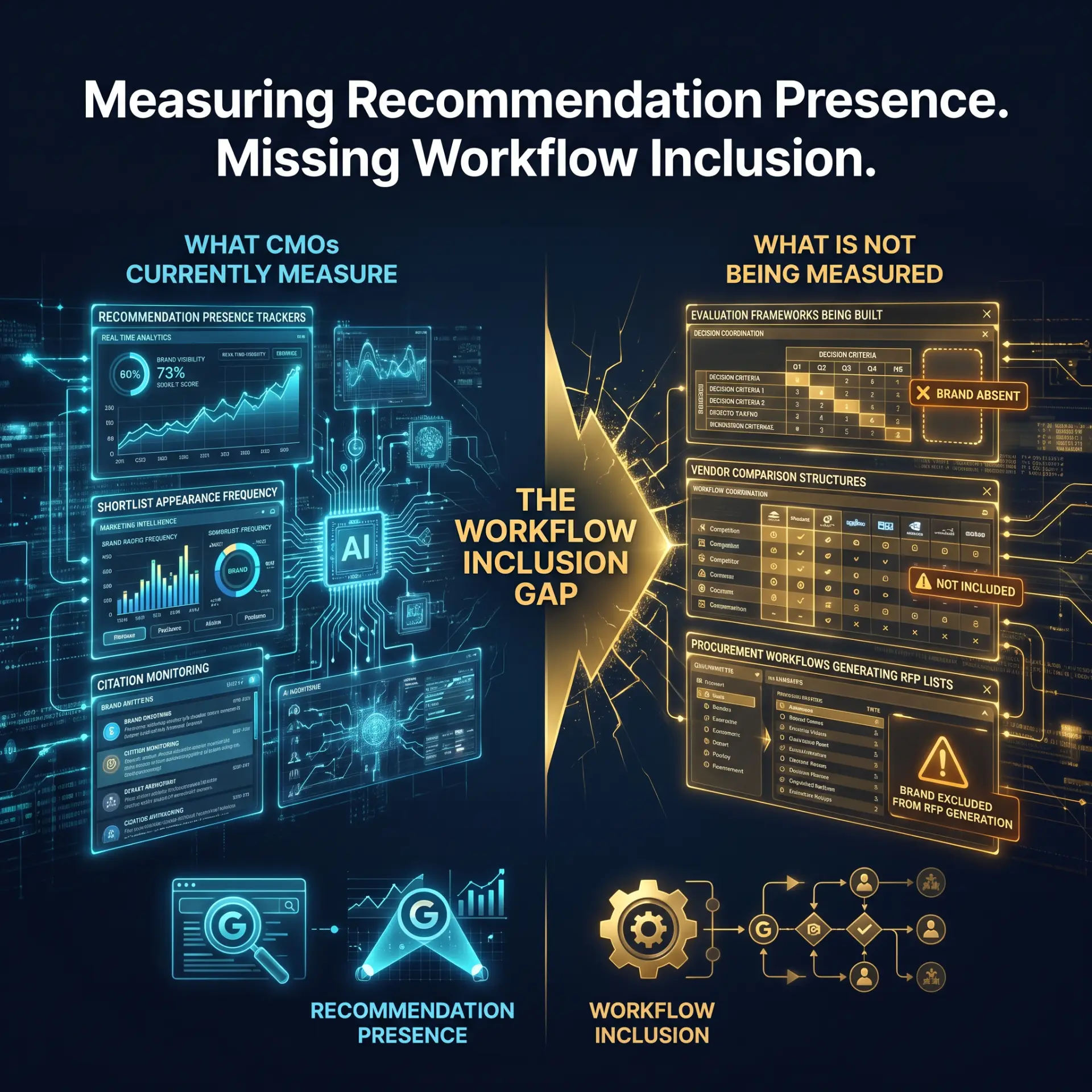
It is whether AI includes your brand in the evaluation workflows it builds when buyers ask it to help them choose vendors.
Those are different behaviors. They require different signals to produce. And they have different pipeline consequences.
What Evaluation Workflows Actually Look Like
When a buyer asks AI a simple recommendation question the interaction is relatively contained.
“Who are the best platforms for [category]?” AI returns a list. Buyer reviews it. Some brands get explored further.
When a buyer asks AI to help them coordinate a decision the interaction is fundamentally different.
“Compare the leading platforms for [category] with pros and cons.”
“Build me a vendor scorecard for evaluating [category] solutions.”
“Help me structure a procurement process for selecting [category] software.”
In these interactions AI is not just retrieving information and presenting options.
It is actively constructing the architecture of a decision.
It builds evaluation criteria. It populates those criteria with brands it associates with the category. It applies comparative judgments. It generates a structure the buyer uses as the foundation for their entire evaluation process.
The brands that appear in that coordination layer are being evaluated against each other.
The brands that do not appear in it may never enter the evaluation process regardless of how visible they are in individual AI answers.
Why This Gap Is Invisible to Standard Dashboards
The measurement problem is structural.
Standard marketing dashboards measure behavior that begins at your website. Clicks. Sessions. Conversions. Form fills. Demo requests.
AI evaluation workflow activity generates none of those signals unless a buyer subsequently visits your website after completing their AI-assisted evaluation process.
A brand that is systematically excluded from AI evaluation workflows will see reduced demo requests and pipeline over time. But the dashboard will not show why. Traffic looks normal. Conversion rates look normal. There is no signal that buyers are conducting evaluation processes without the brand ever entering consideration.
The gap is invisible by design because the measurement infrastructure was built for a buyer journey that no longer fully describes how decisions form.
The Difference Between Recommendation Presence and Workflow Inclusion
This distinction matters practically for how CMOs allocate measurement resources and signal-building investment.
Recommendation presence measures whether your brand appears when buyers ask AI who to consider. It is a point-in-time measurement of shortlist inclusion. Strong recommendation presence means AI consistently names your brand when buyers ask for options.
Workflow inclusion measures whether your brand appears when AI builds the decision coordination infrastructure buyers use to evaluate and choose. It is a deeper measurement of decision architecture embeddedness. Strong workflow inclusion means AI incorporates your brand into the evaluation frameworks, comparison structures, and procurement processes it generates for buyers.
A brand can have strong recommendation presence and weak workflow inclusion.
This happens when AI names the brand on shortlists but excludes it from the more structured evaluation contexts where serious buyers are conducting rigorous comparisons.
A brand in this position appears to be doing well by recommendation metrics while silently losing the evaluation-stage deals where competitive selection is most consequential.
What CMOs Should Be Asking Their Teams
Three specific questions worth adding to your AI intelligence review:
When we ask AI to compare leading vendors in our category, does our brand appear?
When we ask AI to build an evaluation framework for our category, is our brand included in the criteria and comparisons it generates?
When we ask AI to help structure a procurement process for our category, does it recommend us as a vendor to include in the RFP?
If your brand is absent from two or three of those responses while competitors appear, you have a workflow inclusion gap.
That gap is not solved by the same interventions that address recommendation failure. It requires targeted signal work in the specific decision coordination contexts where AI acts as an evaluation partner.
FAQ
What is the difference between recommendation presence and workflow inclusion?
Recommendation presence measures whether your brand appears when buyers ask AI who to consider. Workflow inclusion measures whether your brand appears when AI builds evaluation frameworks, comparison structures, and procurement workflows for buyers. Recommendation presence is about being named. Workflow inclusion is about being embedded in the decision architecture. A brand can have strong recommendation presence and still be absent from evaluation workflows.
Why do CMOs need to measure workflow inclusion separately from recommendation presence?
Because the two behaviors have different pipeline consequences and require different interventions. Recommendation presence primarily affects who gets onto initial shortlists. Workflow inclusion affects who gets seriously evaluated by buyers conducting rigorous comparisons. A brand absent from evaluation workflows may lose the deals that matter most while recommendation metrics look healthy.
What types of buyers are most likely to use AI evaluation workflows?
Enterprise and mid-market buyers with structured procurement processes are most likely to use AI to coordinate their evaluation. They ask AI to build vendor scorecards, structure RFP processes, and create comparison frameworks. These are typically the highest-value deals in a pipeline. Workflow inclusion is therefore most consequential for brands selling to buyers with formal evaluation processes.
How does workflow inclusion affect win rates in competitive deals?
A brand embedded in AI evaluation workflows enters competitive deals having already been incorporated into the decision framework the buyer is using. It appears in the criteria that get evaluated, the comparisons that get made, and the structure the buyer uses to organize their assessment. A brand absent from that framework may be technically on the initial shortlist but faces a structural disadvantage in the evaluation stage.
What signals build workflow inclusion?
Based on what we observe in scans, brands with strong workflow inclusion tend to have clear presence in comparison and evaluation contexts, consistent association with procurement and vendor selection language, differentiated positioning that AI can articulate as evaluation criteria, and corroboration from sources that specifically discuss vendor selection processes. These differ from the signals that primarily drive recommendation presence.
How does Axis Suite help measure workflow inclusion?
Axis Suite runs decision workflow queries alongside standard recommendation queries. By testing brand presence in evaluation framework requests, vendor comparison queries, and procurement workflow prompts we can identify workflow inclusion gaps that recommendation-only measurement misses. The diagnostic reveals where targeted signal work would most effectively build evaluation-stage embeddedness.
Start measuring your workflow inclusion gap here: Axis Suite