Something happened this month that changes the AI recommendation conversation permanently.
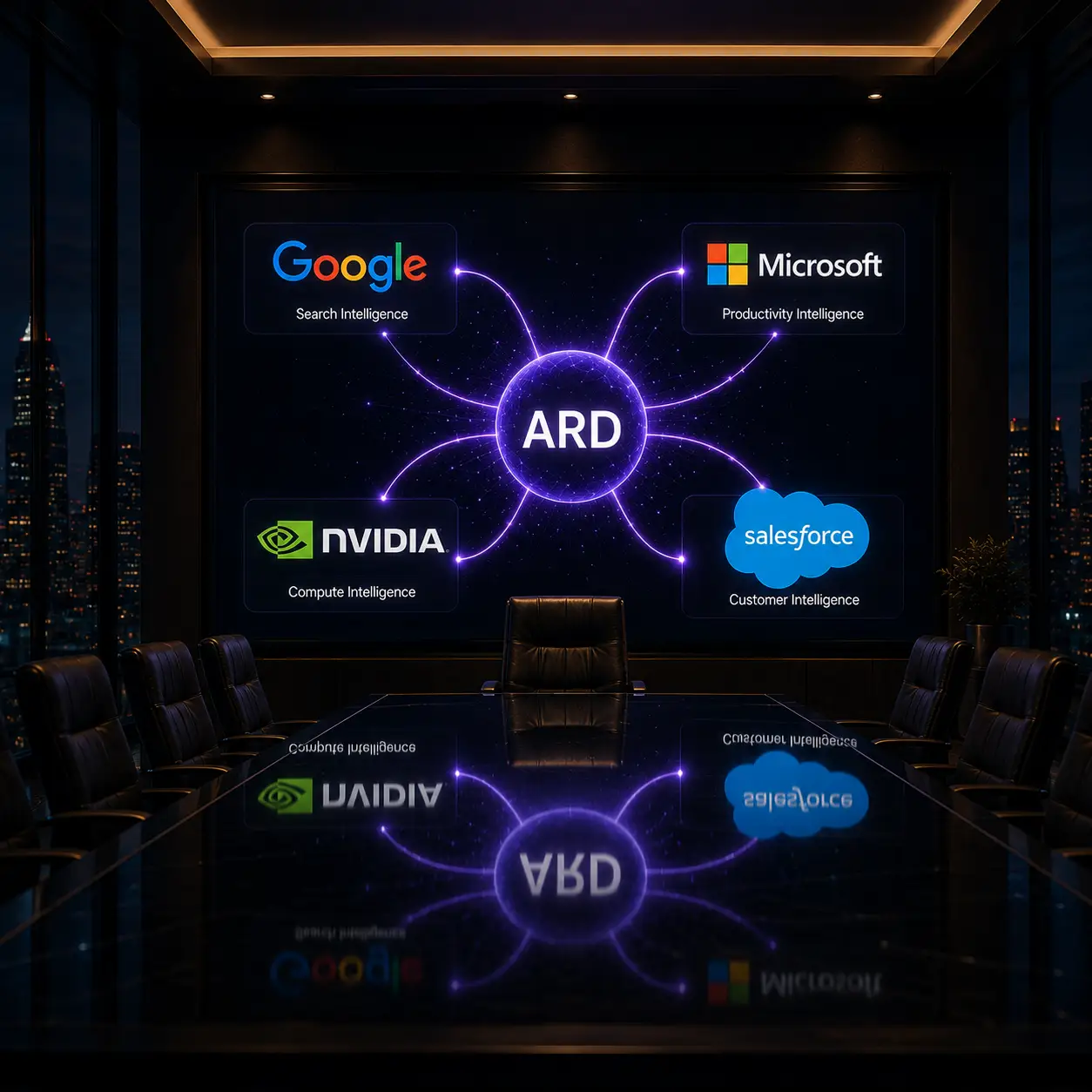
Google, Microsoft, NVIDIA, Salesforce, GitHub, Hugging Face, Snowflake, and several other major technology companies released Agentic Resource Discovery. It is an open specification that allows AI agents to locate, verify, and connect with tools, APIs, and businesses at runtime.
The largest technology companies on the planet just built an address book for AI agents to find and act on behalf of businesses.
That is not a marketing update. That is infrastructure.
What Agentic Resource Discovery Actually Does
The specification works by allowing organizations to publish machine readable catalogs on their own domains. Registries then index those catalogs so AI systems like ChatGPT, Claude, Gemini, and Perplexity can discover available capabilities without requiring preconfigured integrations.
In practical terms this means AI agents can now locate your business, verify what you offer, confirm ownership, and connect with your services at runtime. Without anyone setting up the integration manually.
For businesses that publish these catalogs, AI agents can find them and act on their behalf. For businesses that do not, AI agents cannot interact with them regardless of how visible they are in recommendation queries.
This is the delegation readiness infrastructure that the market has been building toward. And it arrived not as a startup experiment but as an open standard backed by the most powerful technology companies in the world.
Why This Moves the Conversation to the Boardroom
Six months ago AI visibility was a marketing team conversation. Marketing owned it. Marketing measured it. Marketing decided what to do about it.
Agentic Resource Discovery changes that dynamic because it introduces infrastructure decisions that go beyond marketing.
Publishing machine readable catalogs requires coordination between marketing, engineering, product, and security teams. Deciding what capabilities to expose to AI agents requires executive alignment. Governing how AI agents interact with your business requires policy decisions at the organizational level.
When Google, Microsoft, and Salesforce build the standard, the decision about whether to participate is not a marketing call. It is a business strategy decision that belongs in the C-suite.
Three Signals Converging
The ARD specification is not happening in isolation. Three signals are converging that collectively move AI recommendation from a marketing metric to an executive priority.
The first is infrastructure. ARD provides the technical standard for AI agents to discover and interact with businesses. ChatGPT, Claude, Gemini, and Perplexity will increasingly use this infrastructure to determine which businesses they can act on behalf of.
The second is operational transformation. Warner Bros. Discovery announced this month that it is rebuilding its entire advertising technology stack around agentic AI. Not adding features. Rebuilding the architecture. That is an executive decision driven by the recognition that AI agents are becoming the primary coordination layer.
The third is regulation. The Colorado AI Act takes effect June 30, becoming the first comprehensive state AI law in the United States. When regulation arrives for AI systems used in consequential decisions, the conversation moves from marketing to legal, compliance, and the executive team.
What This Means for AI Recommendation Measurement
The measurement conversation is shifting alongside the infrastructure.
For the past two years the primary question has been: does AI mention your brand? That question required monitoring tools. Dashboards that track mentions across ChatGPT, Claude, Gemini, and Perplexity.
The emerging question is different: why does AI choose your competitor instead of you? That question requires diagnosis. Understanding which specific factors cause AI to recommend one brand over another.
Most tools in the AI visibility space answer the first question. Very few answer the second. And the second question is the one executives actually care about because it drives competitive strategy, not just measurement.
The diagnosis layer sits between monitoring and action. It explains why AI systems trust, hesitate, omit, or recommend a brand. That explanation is what turns a marketing metric into an executive decision.
The Five Layers That Determine Every AI Recommendation
Every recommendation your brand receives or misses from ChatGPT, Claude, Gemini, or Perplexity is the result of five distinct layers working together.
Source influence determines where AI learned about your brand and how authoritative those sources are. Category alignment determines how AI classifies your business and which competitive set you enter. Competitive positioning determines where AI ranks you relative to alternatives. Memory persistence determines what AI durably believes about your brand over time. Narrative accuracy determines whether AI describes you correctly.
A problem in any single layer changes the recommendation output. But most measurement stops at the output level. Understanding which layer is causing the result is the difference between knowing your score and knowing what to fix.
What Businesses Should Do Now
The immediate action is awareness. Understand that Agentic Resource Discovery exists and that AI agents will increasingly use this infrastructure to determine which businesses they can interact with.
The strategic action is diagnosis. Move beyond visibility scores and understand which of the five layers is driving your AI recommendation results. Ask ChatGPT, Claude, Gemini, and Perplexity to recommend vendors in your category. Then ask why they chose the brands they chose. The gap between monitoring and diagnosis is where competitive advantage lives.
The organizational action is elevation. Move the AI recommendation conversation from marketing to the executive team. When AI agents can find, verify, and act on behalf of businesses using open standards backed by Google and Microsoft, the decision about how your business participates is not a marketing initiative. It is a strategic priority.
Frequently Asked Questions
What is Agentic Resource Discovery? Agentic Resource Discovery is an open specification released by Google, Microsoft, NVIDIA, Salesforce, and other major companies. It allows AI agents to locate, verify, and connect with businesses at runtime by indexing machine readable catalogs that organizations publish on their domains.
How does ARD affect AI recommendations? ARD gives AI systems like ChatGPT, Claude, Gemini, and Perplexity a standardized way to discover what businesses offer and interact with them. Businesses that publish ARD catalogs become easier for AI agents to find and act on. Businesses that do not may be recommended but cannot be acted on.
Why is AI recommendation becoming an executive decision? Three factors are converging: infrastructure standards like ARD require cross-functional coordination, operational transformations are rebuilding business systems around AI agents, and state-level AI regulation is arriving. These decisions go beyond marketing and require executive alignment.
What is the difference between AI visibility monitoring and diagnosis? Monitoring answers “what is our score” by tracking mentions across AI platforms. Diagnosis answers “why is AI choosing our competitor” by explaining which specific factors drive the recommendation. Executives need the second answer because it drives competitive strategy.
What are the five layers of AI recommendation? The five layers are source influence, category alignment, competitive positioning, memory persistence, and narrative accuracy. Every recommendation from ChatGPT, Claude, Gemini, or Perplexity is the result of these five layers working together. A problem in any layer changes the output.
Should my business publish an ARD catalog now? The specification is new and adoption is early. The immediate priority is understanding that this infrastructure exists and assessing how it affects your competitive position. Businesses that prepare for ARD adoption early will have an advantage as AI agents increasingly use this standard to determine which businesses they can interact with.
Start here: axissuite.ai