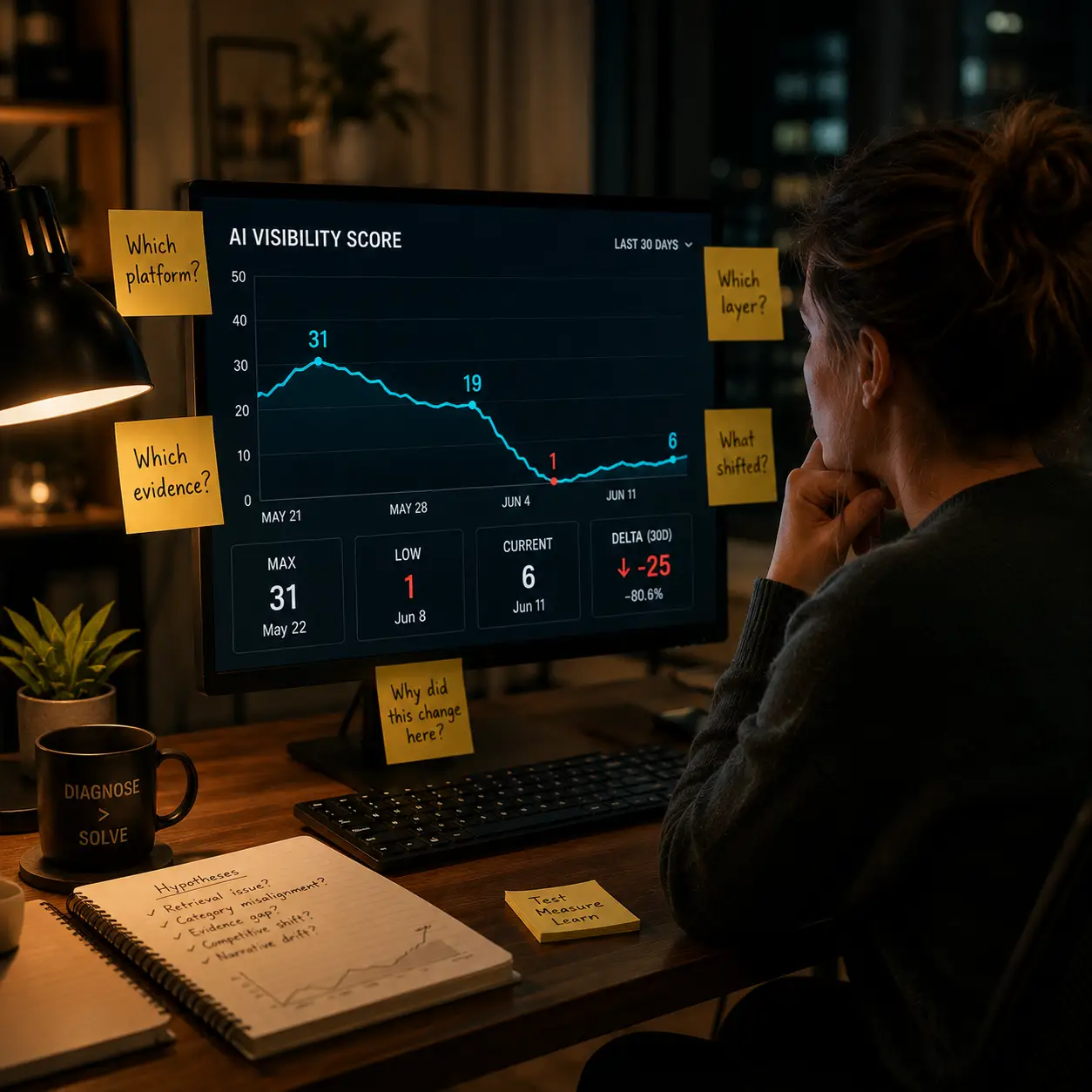
Our AI visibility score hit 31. We celebrated.
Then it dropped to 19. We investigated.
Then it dropped to 1. We diagnosed.
Then it recovered to 6. We understood.
If we had only watched the number, we would have celebrated once, panicked twice, and felt cautious once. Four emotional reactions. Zero understanding.
Instead we asked why at every step. And the answers taught us more about how AI visibility works than any single score ever could.
Why Scores Create False Narratives
An AI visibility score is a snapshot. It tells you where your brand stands at one moment across one or more AI platforms. That information is useful as a starting point.
But snapshots create false narratives when they are treated as trends.
A score of 31 looks like success. A score of 19 looks like decline. A score of 1 looks like failure. A score of 6 looks like recovery.
But what if the drop from 31 to 19 was caused by a model update on one platform that changed how it weights certain evidence types? That is not decline. That is a platform behavior change that requires understanding, not panic.
What if the drop from 19 to 1 was caused by a temporary crawl issue that blocked AI from accessing updated content? That is not failure. That is a retrieval problem that requires a specific fix.
What if the recovery from 1 to 6 happened because the crawl issue resolved and AI re-evaluated the available evidence? That is not recovery through effort. That is the system self-correcting once the underlying problem was fixed.
Each movement has a specific explanation. But the score alone does not carry the explanation. The score is the symptom. The diagnosis is what matters.
Dashboards Show Numbers. Systems Show Causes.
Most AI visibility approaches treat the score as the product. Track it. Chart it. Report it. Celebrate when it goes up. Investigate when it goes down.
That approach works for stable metrics. Organic traffic follows gradual trends. Conversion rates shift in predictable ranges. Revenue grows or declines in patterns that reflect market conditions.
AI visibility is not stable. It is dynamic. Scores can move dramatically in a single week without any change in your content, your marketing, or your competitive strategy. The cause may be entirely external: a model update, a competitor gaining evidence, a platform changing how it weights sources.
That instability makes score-watching actively misleading. A team that watches the score without understanding the system will chase phantom problems and celebrate phantom wins.
A team that understands the system asks different questions when the score moves. Which platform changed? Was it all platforms or one? Which queries changed? Was it a broad shift or specific to certain query types? Which competitors moved? Did someone else gain or did you lose? Which evidence changed? Did the sources AI draws from shift in any measurable way? Which layer moved? Was it retrieval, recommendation, narrative, evidence, or decision?
Those five questions turn a score movement into a diagnosis. The diagnosis tells you what actually happened. What actually happened tells you what to do next.
The System Behind the Score
Every AI visibility score is the output of a system with five layers. Understanding the system means understanding which layer produced the score you see.
Retrieval determines whether AI can access your content. If retrieval breaks, the score drops regardless of content quality, evidence strength, or competitive positioning. Our drop to 1 was likely influenced by the retrieval layer.
Recommendation determines whether AI includes you for relevant queries. Changes in how platforms weight sources can shift recommendation patterns without any change on your end. Our drop from 31 to 19 likely reflected platform behavior changes.
Narrative determines how AI describes you. If AI starts describing you inaccurately, the score may not change immediately but recommendation quality degrades. Narrative drift is a slow-acting problem.
Evidence determines how confidently AI recommends you. Changes in your competitor’s evidence footprint (new G2 reviews, analyst mentions, comparison article inclusion) can shift your relative positioning without you losing any ground absolutely.
Memory determines whether any of it holds. A brand can be retrieved, recommended, described accurately, and evidenced once, and still be absent from the next conversation. Memory is why our score could read 31 one week and 1 the next. Nothing about us collapsed in between. Nothing durable had formed yet.
These five layers are not the decision AI makes about your brand. They are what that decision is made of.
The Score Is Not the Product
Understanding the movement is.
A score of 6 does not tell you what to do. A diagnosis that says “retrieval recovered, narrative is stable, evidence gap against competitor X exists in comparison content, priority action is closing the comparison coverage gap” tells you exactly what to do.
The first gives you a number. The second gives you a strategy.
That distinction is becoming the most important differentiator in AI visibility measurement. The platforms that deliver scores will be commoditized. The platforms that deliver understanding will be essential.
Because every team can watch a number move. Very few teams can explain why.
Frequently Asked Questions
Why are AI visibility scores unstable?
AI visibility depends on model updates, evidence weighting changes, platform behavior shifts, and competitive movements. Unlike stable metrics like organic traffic, AI recommendation can change dramatically in a single week without any change in your own marketing or content.
What should I do when my AI visibility score drops?
Ask five questions: Which platform changed? Which queries changed? Which competitors moved? Which evidence changed? Which layer moved? The answers diagnose the cause of the drop and determine whether the fix is structural, evidence-based, or requires waiting for platform stabilization.
Is a low AI visibility score always bad?
Not necessarily. A low score could reflect a temporary platform issue, a model update that will stabilize, or a measurement artifact. The score becomes meaningful only when paired with diagnosis that explains the cause. A temporarily low score with a known cause is very different from a persistently low score with unknown causes.
How often should I check my AI visibility score?
Regular monitoring (weekly or biweekly) is useful for identifying trends and catching significant changes. But the score check should always be accompanied by diagnostic questions. Checking the score without diagnosing changes creates anxiety without understanding.
What is the difference between watching and understanding AI visibility?
Watching means observing the score move and reacting emotionally. Understanding means diagnosing which layer caused the movement, determining whether the cause is within your control, and choosing a specific intervention based on the diagnosis. Watching creates reactions. Understanding creates strategy.
Can AI visibility scores be compared across competitors?
With caution. Different measurement tools use different methodologies, query sets, and platform coverage. A score of 47 on one tool is not directly comparable to a score of 47 on another. Relative trends within a single tool (your brand vs competitors over time) are more useful than absolute cross-tool comparisons.
Start here: axissuite.ai
Axis Suite by TrendAxis