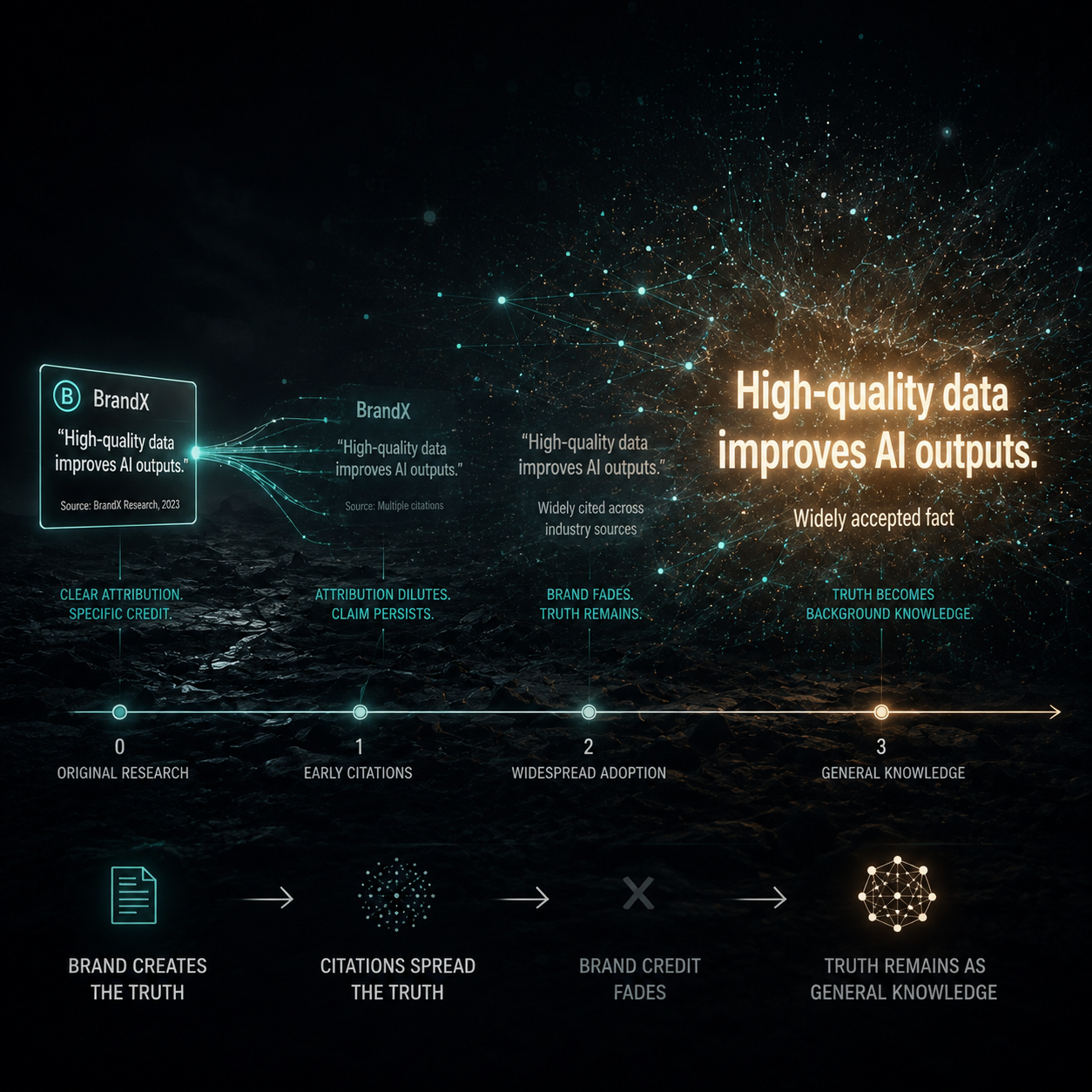
Something unexpected emerged from practitioner research this month that changes how we should think about AI citation as a success metric.
When a brand first gets cited by AI, the citations are attributed. AI references the specific page or source. The brand’s name appears alongside the claim. Traffic flows. Credit is clear.
Over time, if enough independent sources make the same claim, something shifts. The claim graduates from “something this source says” to “something everyone knows.” AI internalizes it as general knowledge and stops attributing it to any single source.
Most teams would see that as a loss. Citations went down. Attribution disappeared. The dashboard shows declining performance.
But what actually happened is the opposite of failure.
The Two Stages of AI Citation
AI citation has a lifecycle that most measurement approaches do not account for.
Stage one is attributed citation. AI recommends your brand and cites the source. The recommendation is linked to your specific page, review, or mention. This is the stage most teams measure and optimize for.
Stage two is internalized belief. AI has absorbed the claim so deeply that it states it as general knowledge without attributing it to anyone. The claim is no longer “according to [source], Brand X is the best option for Y.” It becomes “Brand X is the best option for Y.” No citation. No attribution. Just knowledge.
The transition from stage one to stage two looks like declining performance on a citation dashboard. But it is actually the transition from “recommended because of evidence” to “remembered as the category answer.”
Why the Window Is Finite
The attribution window is the period during which AI actively cites your specific source when making a recommendation. This window appears to be finite for most claims.
Early on, when few sources make the claim, AI needs to cite its evidence because the claim is not yet established. The citation is the model showing its work.
As more sources corroborate the claim, AI becomes increasingly confident. The claim becomes widespread enough that the model treats it as settled knowledge. At that point, citing a specific source becomes unnecessary. AI knows the answer without needing to reference where it learned it.
The window length appears to vary by topic competitiveness. In crowded categories where many sources make similar claims, graduation happens faster because the evidence saturates quickly. In niche categories with fewer competing sources, attributed citations persist longer because the claim remains distinctive enough to need sourcing.
The Strategic Implication
If the attribution window is finite, then the goal is not to maximize citations permanently. It is to be the source that establishes the claim while attribution is still active.
During the attribution window, the citation drives traffic and builds brand awareness. The brand gets credit for the insight. Readers see the brand name attached to the claim. AI is doing the marketing.
After the claim graduates to general knowledge, the value shifts. The brand is no longer the cited source. But it is the brand that defined the category understanding. The claim it established is now what AI simply believes. That is a deeper form of influence than any citation.
The practical implication for GEO strategy: invest in establishing new claims while they are still in the attribution window. Do not wait until a claim is obvious. By then, many sources will already be making it and the attribution window will be shorter.
At the same time, have new claims ready to enter the pipeline as older ones graduate. The brand that continuously establishes new category-defining claims and then lets them graduate into AI’s general knowledge is building something more durable than citations. It is building the category’s baseline understanding.
How to Tell Where Your Claims Are
The diagnostic is straightforward. When AI recommends your brand, check whether it cites the source or states the claim without attribution.
If AI cites your specific page, the claim is still in the attribution window. The citation is actively driving value.
If AI states the claim as general knowledge without citing anyone, the claim has graduated. You established it. AI internalized it. The citation is gone but the influence remains.
If AI states a claim that a competitor established, you missed the window. Someone else defined what AI believes about your category before you did.
The third scenario is the one to avoid. It means the category narrative is being set by someone else’s claims, and your brand is responding to their framing rather than defining its own.
Practical Approach for the Attribution Window
Three moves to work the window effectively.
First, identify claims in your category that are not yet established. These are observations, data points, or positioning angles that are not yet widely published. They are original enough that AI would need to cite someone specific when making them.
Second, publish those claims across your own properties with clear, extractable language. Sentences that can stand alone, that answer a “why” question, that combine a specific claim with reasoning. The kind of passages AI can pull directly.
Third, simultaneously build independent corroboration. Get the same claim echoed by review sites, comparison articles, community discussions, and analyst mentions. This corroboration accelerates the claim through the attribution window toward general knowledge status.
The brand that does this repeatedly, establishing claim after claim and watching each one graduate into AI’s baseline understanding, builds cumulative category authority that compounds over time.
Frequently Asked Questions
What is the attribution window in AI citation?
The period during which AI actively cites a specific source when making a recommendation or claim. Early on, AI needs to show its evidence. Over time, as enough sources corroborate the claim, AI internalizes it as general knowledge and stops attributing it to any single source.
Is losing attribution a bad sign?
Not necessarily. If AI stopped citing your source but continues stating the claim as general knowledge, the claim graduated. That means your brand successfully established what AI believes about the category. The citation is gone but the influence is deeper.
How long does the attribution window last?
It varies by topic competitiveness. Crowded categories with many sources making similar claims see faster graduation. Niche categories with fewer competing sources maintain attributed citations longer. General estimates suggest weeks to months, not days.
How do I know if a competitor established a claim before I did?
Ask AI about your category and listen to how it frames the answer. If the default assumptions, terminology, and positioning reflect a competitor’s language rather than yours, they defined the category narrative first.
Should I try to keep citations active longer?
You can by continuously publishing original claims that AI has not yet internalized. But trying to prevent graduation of established claims is not productive. Let graduated claims build your category authority and focus energy on establishing new ones.
What happens if nobody in my category has established the narrative yet?
That is the best possible situation. It means the attribution window is wide open. The first brand to publish clear, extractable, corroborated claims about the category will define what AI believes. That first-mover advantage in narrative definition is extremely valuable.
Start here: axissuite.ai
Axis Suite by TrendAxis