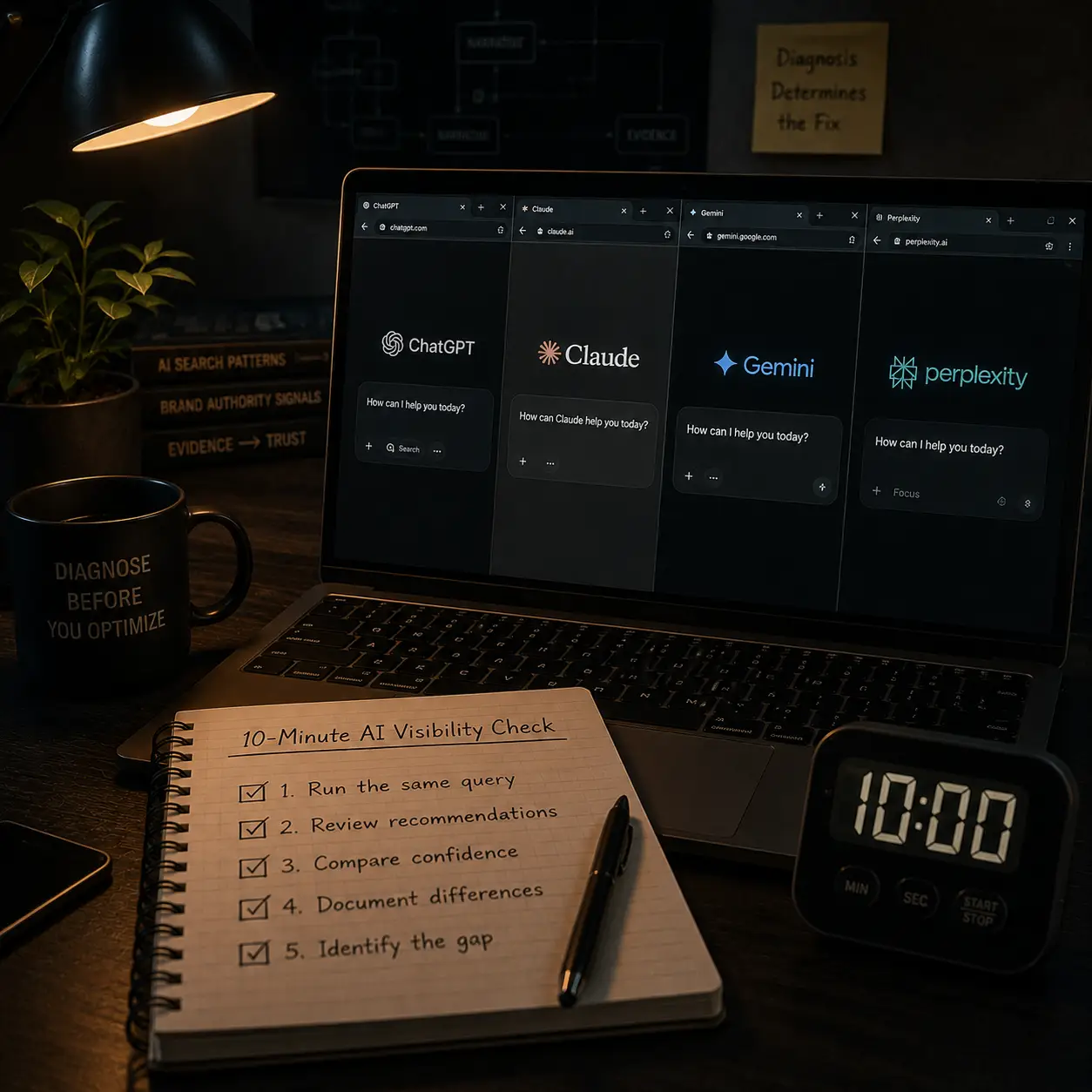
Most competitive analysis for AI visibility takes weeks. Teams build elaborate tracking dashboards, monitor mentions over time, and compile reports comparing keyword positions and content calendars.
There is a faster way to get the most diagnostic insight. It takes ten minutes, costs nothing, and reveals the evidence gap that longer analyses often miss.
The Setup
Pick one competitor that AI consistently recommends over you. Choose the one that appears most frequently when buyers ask about your category. Not the competitor with the best product. The one AI seems to prefer.
Open four browser tabs: ChatGPT, Claude, Gemini, and Perplexity. Use fresh sessions with no conversation history.
The Five Questions
Ask each platform a broad buyer-intent question about your category. Something like “what are the best platforms for [your use case].” Then work through these five diagnostic questions based on the responses.
Question One: How does AI describe the competitor?
Note the specific language. “A leading platform for…” versus “an option that some users…” versus “known for its strength in…” The confidence level in the language is a diagnostic signal. Confident language indicates strong evidence. Cautious language indicates weak evidence.
Question Two: What category does AI place the competitor in?
Check whether AI classifies them the way they would classify themselves. If the competitor positions as “AI search optimization” and AI categorizes them the same way, their positioning is aligned. If AI describes them differently, their positioning has gaps despite being recommended.
Question Three: What evidence does AI cite when recommending the competitor?
Look for whether AI references independent sources (review platforms, analyst reports, comparison articles) or primarily the competitor’s own website. Independent citations indicate a strong evidence footprint. Self-citations indicate that AI is mainly echoing what the brand says about itself.
Question Four: Which independent sources repeat the same claims about the competitor?
This is the convergence check. If multiple independent sources describe the competitor the same way, AI sees a pattern. If each source describes them differently, the evidence is present but not convergent. Convergent evidence produces stronger recommendations.
Question Five: What does AI believe about the competitor that it does not appear to believe about you?
This is the diagnostic question. The answer reveals the specific evidence gap between you and the competitor. It is almost never “they have more content.” It is usually a specific type of independent evidence they have that you do not.
What the Audit Reveals
After ten minutes across four platforms with five questions, you will typically see one of four patterns.
Pattern one: the competitor has more source diversity than you. They appear on review platforms, in analyst reports, in comparison articles, and in community discussions. You appear primarily through your own website. The gap is evidence breadth.
Pattern two: the competitor’s mentions converge but yours scatter. Independent sources describe them consistently but describe you differently. The gap is positioning clarity.
Pattern three: AI describes the competitor accurately but describes you inaccurately. Your own sources are inconsistent and AI is synthesizing a confused narrative. The gap is narrative alignment.
Pattern four: AI places you in a different category than the competitor. Buyers asking about the competitor’s category do not see you. The gap is category association.
Each pattern points to a different fix. The audit does not tell you the fix. But it tells you which fix to investigate, which is the most valuable ten minutes you can spend on competitive AI intelligence.
What To Do After the Audit
Do not immediately react by copying the competitor’s evidence footprint. That puts you in competition for second place in a narrative they defined.
Instead, identify the specific evidence gap and plan how to fill it with your own positioning. If the gap is review coverage, pursue genuine reviews on the platforms where the competitor has presence. If the gap is analyst coverage, invest in analyst relations. If the gap is community presence, participate in relevant discussions where your expertise adds value.
The goal is not to replicate their evidence. It is to build convergent evidence around your own positioning that is strong enough to create a separate, defensible belief in AI’s recommendation landscape.
Why Ten Minutes Changes Strategy
Most competitive analysis produces a report. This audit produces a diagnosis.
A report tells you what the landscape looks like. A diagnosis tells you which specific investment would change your competitive position. Reports are informational. Diagnoses are actionable.
The teams that run this audit before building their next content plan save months of misallocated effort. Because the most common result of the audit is discovering that the problem is not content at all.
Frequently Asked Questions
Why only ten minutes?
The goal is diagnosis, not comprehensive analysis. Ten minutes across four platforms with five focused questions reveals the primary evidence gap. Longer analysis can refine the diagnosis but the directional insight comes from the first ten minutes.
Should I do this for multiple competitors?
Start with one. The competitor AI most consistently prefers. After addressing the primary evidence gap with that competitor, repeat the audit with the next one. Each competitor may have a different advantage, requiring a different diagnosis.
What if the results vary across platforms?
Platform variation is itself a diagnostic signal. If AI recommends the competitor on ChatGPT and Perplexity but not on Claude and Gemini, the evidence that supports the recommendation may not be visible to all platforms. Check whether the sources AI cites on the recommending platforms are also accessible to the non-recommending ones.
How often should I repeat this audit?
Monthly. AI models update frequently and the competitive evidence landscape shifts. A monthly audit tracks whether the evidence gap is closing, stable, or widening.
What if AI does not recommend either of us?
Then neither brand has reached the recommendation threshold for that category query. The audit still works: check who AI does recommend and apply the five questions to that brand instead. Understanding who AI prefers in your category, even if it is a brand you did not consider a direct competitor, is diagnostically valuable.
Start here: axissuite.ai
Axis Suite by TrendAxis