We spent this week auditing Axis Suite’s own actionability, the part of the product that tells a business what to do next, not just what’s true about its AI visibility. What we found changes how we think about every recommendation the product produces, and it’s a finding that applies well beyond our own platform.
Specificity is persuasive. A precise score, a named cause, and a clear next step all read as competence. But specificity is a property of a sentence, not a property of the evidence behind it. A recommendation can be exact and still not have earned the instruction it’s giving you. The audit found several distinct ways this happens inside a product that scores and recommends based on how ChatGPT, Claude, Gemini, and Perplexity represent a brand.
First, a completed task was being treated as evidence that something had improved, when finishing a workflow step and that step producing an effect are two separate claims. Second, and differently, a repair workflow could imply the underlying problem was resolved as soon as the workflow ran, ahead of whether the corrective work behind it had actually taken effect. Third, a score moving in the right direction after a change shipped was read as confirmation the change worked, without first checking whether that size of movement was inside the range you’d expect from the ordinary variability of how AI engines answer the same prompt over time. Fourth, one proposed fix, traced closely, turned out to change the wording of the internal prompt used to measure a score rather than the external condition the score was supposed to represent, the same label answering a different question. Fifth, and most structurally, actions sitting in the queue carried no stored connection back to what had been diagnosed, what the baseline was, what movement was expected, or what got checked afterward, so each recommended step looked reasonable in isolation with no memory of the step before it.
None of these findings are unique to Axis Suite. Any AI visibility or recommendation tool that scores a brand’s presence across ChatGPT, Gemini, Claude, or Perplexity and then tells a user what to fix is vulnerable to the same substitutions, because they’re substitutions the interface makes easy, not mistakes any one team is uniquely prone to.
We’ve also been stress-testing our own methodology against Rand Fishkin’s research on AI visibility measurement, published through SparkToro. Two of his findings matter directly here. Ask an AI tool the same question repeatedly, and the answer varies substantially, not occasionally, but as a rule. And when you ask an AI tool to explain how it arrived at an answer, the explanation it gives is generated the same way the original answer was, by predicting likely next words, not by reporting an actual internal cause. A citation appearing next to an answer doesn’t establish that the citation caused the recommendation. We don’t have a way around either of those findings, and we’re not claiming to. Axis Suite doesn’t solve hidden model causality.
What we’re committing to instead, before interpreting any movement in a score, is defining six things in order: the observation, the measurement conditions it was collected under, the expected variance for that measurement, the strongest observable constraint the evidence actually supports, the intervention, and the specific thing we’d expect to see afterward if the diagnosis is right. That’s a narrower claim than “this works.” It’s also the only kind of claim we can actually stand behind.
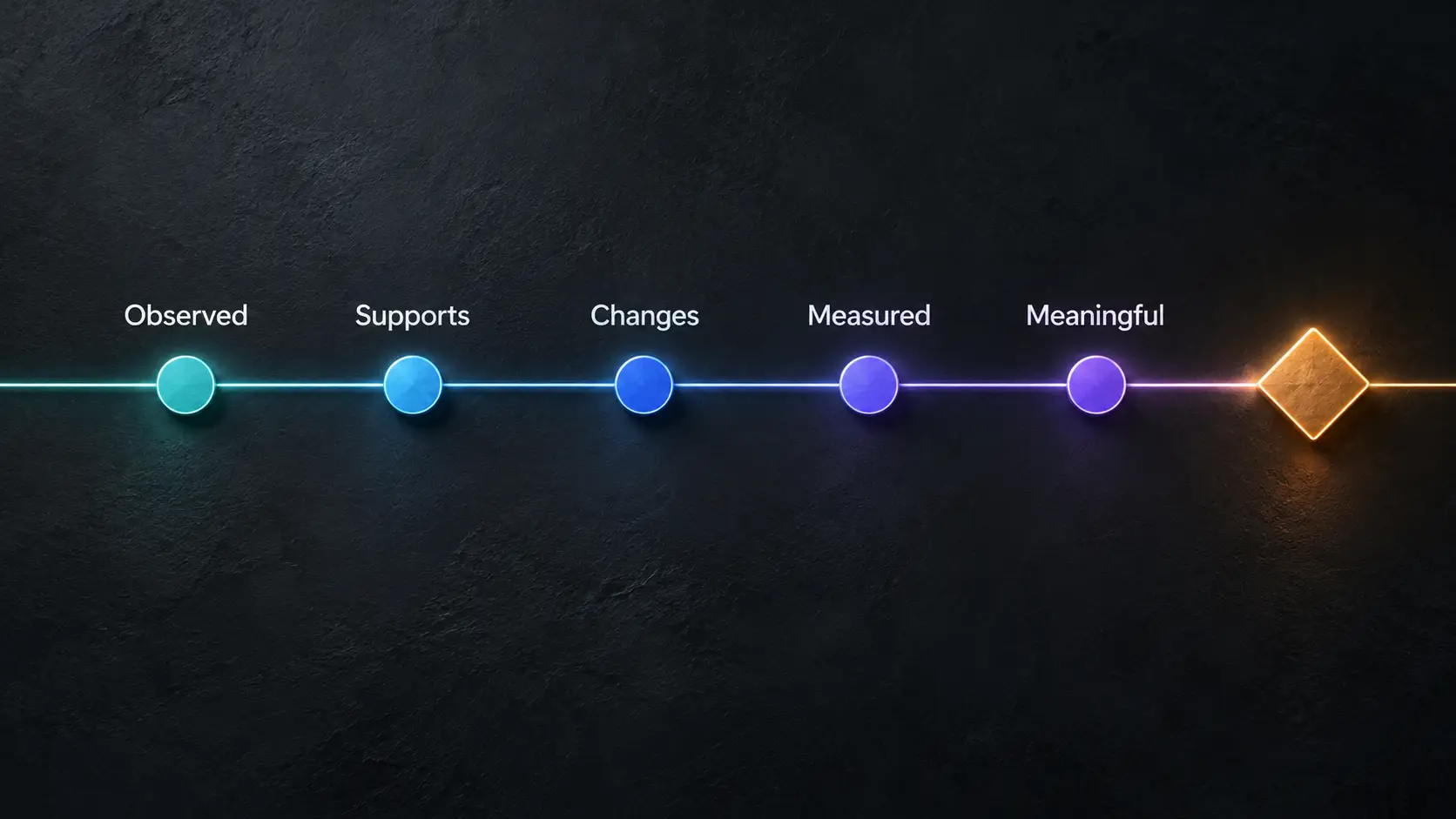
Here is the practical version of that discipline, a five-question test worth running on any AI-driven recommendation before acting on it, ours included. What was actually observed? Why does that observation support this specific action, and not a different one? What condition is the action supposed to change? What will be measured afterward? And how much movement would count as meaningful, versus what you’d expect from normal variation with no intervention at all? If you can’t answer all five, you may not have an actionable recommendation. You may have a plausible-sounding one, which is a different thing.
Autonomous agent action still sits at WATCH for Axis Suite, on purpose. We’re building the defensible path underneath it, so that when the product does eventually act on something, it means it. Removing unsupported certainty doesn’t make Axis Suite less actionable. It makes the recommendations that remain more trustworthy to act on.
It’s worth being clear about what this audit did not find. It didn’t find that Axis Suite’s underlying measurements were wrong, or that the platform’s scores misrepresent how ChatGPT, Claude, Gemini, and Perplexity actually treat a brand. The measurement layer and the actionability layer are different parts of the product, answering different questions, and this audit was specifically about the second one: not is the score accurate, but does the instruction attached to that score deserve the confidence it’s presented with. Keeping those two questions separate is itself part of the discipline this audit reinforced.
FAQ
What does it mean for an AI recommendation to be “specific but not actionable”?
It means the recommendation sounds precise, with a clear cause and a defined next step, without the underlying evidence actually supporting that level of confidence. A recommendation earns the label actionable only when there’s a traceable line from what was observed to why that specific action follows from it.
What is the five-question test for evaluating an AI-driven recommendation?
Ask what was actually observed, why that observation supports this specific action rather than a different one, what condition the action is meant to change, what will be measured afterward, and how much movement would count as meaningful versus normal variation. If any of these can’t be answered, the recommendation likely isn’t actionable yet.
How does Rand Fishkin’s research on AI visibility measurement relate to this?
Fishkin’s research at SparkToro shows that repeated answers from the same AI tool to the same prompt vary substantially, and that an AI tool’s own explanation for its answer is generated the same way the answer was, by predicting likely next words rather than reporting an actual cause. Both findings mean a citation or explanation next to an AI answer doesn’t prove it caused the recommendation.
Does Axis Suite claim to solve the causality problem in AI visibility measurement?
No. Axis Suite doesn’t claim to observe hidden model causality inside ChatGPT, Claude, Gemini, or Perplexity. Instead, before interpreting any score movement, it commits to defining the observation, the measurement conditions, the expected variance, the strongest observable constraint the evidence supports, the intervention, and the expected result to check for afterward.
Why does Axis Suite keep automated agent action at WATCH instead of taking action automatically?
Because a recommendation that tells you exactly what to do can feel more useful than one that says wait, but only if the evidence actually supports the instruction. WATCH is a legitimate outcome whenever the evidence isn’t yet sufficient to justify intervening, and Axis Suite is building the defensible diagnosis-to-verification path before it changes that status.
Does removing unsupported certainty make an AI visibility tool less useful?
No, it makes the recommendations that remain more trustworthy to act on. A tool that only tells you what it can actually defend is more useful over time than one that sounds confident on every recommendation regardless of the evidence behind it.
About Axis Suite
Axis Suite is the independent intelligence layer that explains what AI believes about your brand, why it believes it, and what decision that belief ultimately drives. Built by TrendAxis, Axis Suite measures AI recommendation visibility across engines including ChatGPT, Claude, Gemini, and Perplexity, tracking a brand’s path from Mentioned to Cited to Recommended to Chosen. Axis Suite is measurement infrastructure, not a marketing quick fix, every score is built to be explainable and defensible. Explore the Proof Center.