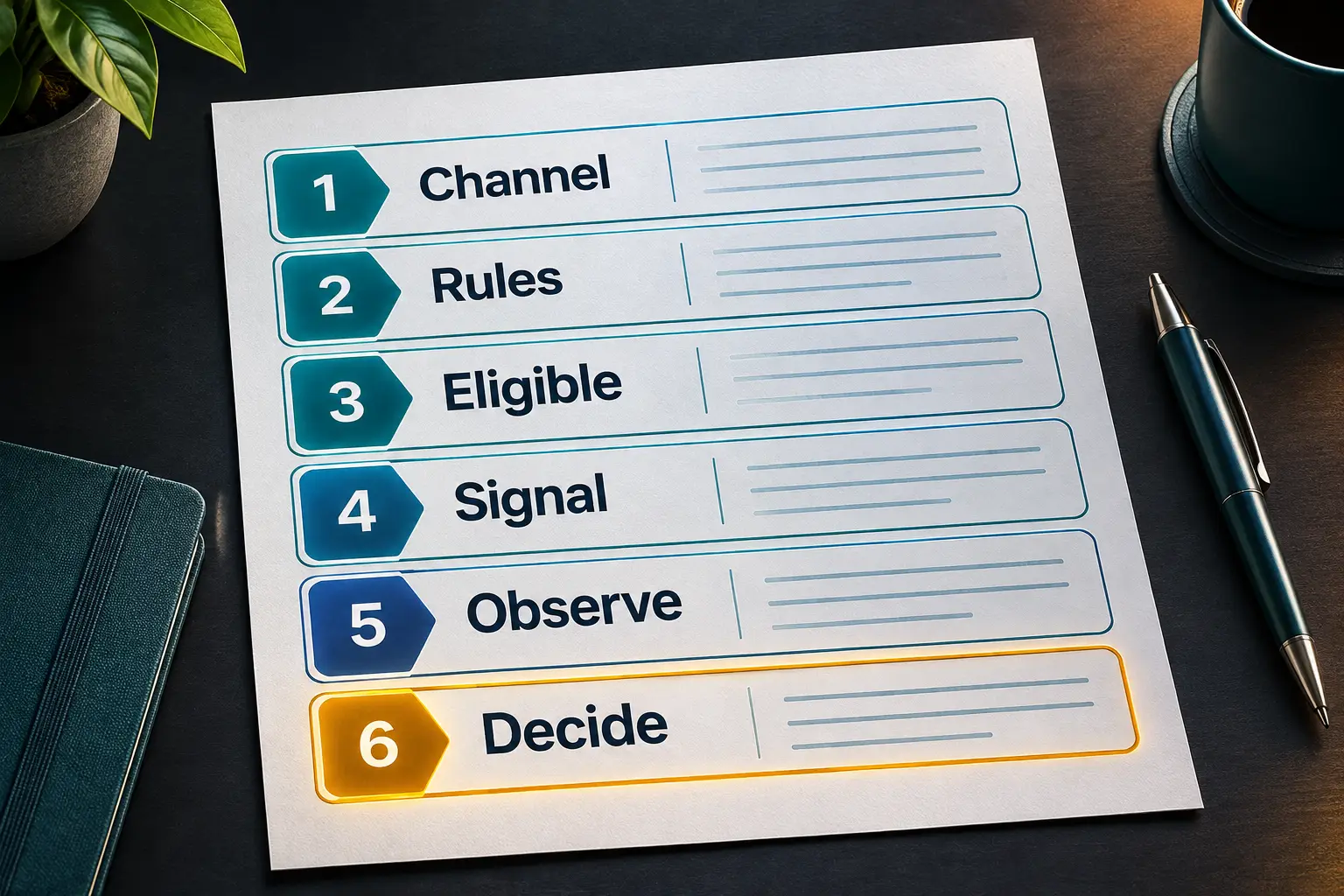
An AI-visibility project usually begins with a proposal: rewrite these pages, add this structure, publish more of that. The proposal is easy to evaluate on its own terms and hard to evaluate against the channel it targets. A short worksheet closes that gap. It fits on a page, and it is meant to be filled in before any money moves, in the same order each time.
The first line is the channel. Name the specific route, not “AI” as a whole. A shopping catalog, a search feature and an assistant’s answer are different channels with different rules, and ChatGPT, Claude, Gemini, and Perplexity do not behave identically. A project aimed at “AI” is aimed at nothing in particular, and the first useful move is to say which route it is meant to reach.
The second line is the rules. Find the platform’s own published inclusion rules, not a summary of them, and record three things: the page, the day you read it, and whether the page shows a date of its own. Some pages show none. Shopify’s Catalog requirements page is one example, and it also says eligibility is reviewed over time and that ineligible product types can change at the platform’s discretion. A rule read on one day is not guaranteed to hold on another, so the read date goes on the worksheet.
The third line is eligibility. Check your own setup against each rule, one by one. Sort the items by who can change them: settings that can change quickly, facts about how the business sells, and operating history that builds over time. If the platform offers an eligibility view inside its admin, use it as a cross-check. Shopify announced one on October 28, and whether it is available to every store is not established in its announcement. If you are not eligible, decide whether entering the channel is worth it on its own merits. Do not change how the business sells only to satisfy one channel’s rule, and treat “not eligible, for now” as a legitimate finding.
The fourth line is the signal. If the platform describes a ranking signal, copy down exactly what it says and exactly what it leaves out. Shopify’s Shop Promise program is a useful example of conditional wording: badged products may rank higher, and each product qualifies separately. A described signal is not a measured effect. The worksheet should show the platform’s words, and a blank for anything the platform does not state, such as the weight of the signal.
The fifth line is the observation plan, and it is the one most often left until after the change. Choose the buyer questions, written in buyer words and without the company name. Choose the engines, and keep each one’s results separate. Decide the recheck date. Fix all of it before changing anything, so that the change has something to be compared with. Last week’s four fields apply here: the buyer question, the decision it informs, the evidence that would change the decision, and the stop or recheck condition. Keep failed or missing responses separate from valid answers that did not mention the brand, and check that enough of the planned responses succeeded to support the result. Repeating the same set shows stability, while changed wording or new questions are a different test.
The sixth line is the decision, and there are three honest options. Fix, when the rules say the channel can include you and an intervention is justified, with the expected observation written down. Hold, when eligibility is unresolved or the channel cannot include you, so the spend is not yet justified. Watch, when the evidence does not yet support a change. In our framework, WATCH is a legitimate result: keep observing, set a date to check again, and write down what would change the decision.
Keeping one worksheet per channel and per date also gives the team a history. When a rule changes or a signal is clarified, the new page can be compared with the old one, and the decision to fix, hold or watch can be revisited with the change in view. It also makes handoffs easier, because the person who inherits the project can see what was checked, when, and what was left open.
Reading the finished page, it is worth remembering what it can and cannot support. A completed worksheet supports a narrow statement: on this date, this channel’s published rules say this about eligibility, this signal is described this way, and this is the observation planned. It does not show that the channel recommends the business, and it does not show that a buyer chose it. Eligibility is a different kind of fact from Mentioned, Cited, Recommended, and Chosen. And a before-and-after difference alone never establishes that a change caused it.
The page is short on purpose. Its value is that every project gets the same six questions, in the same order, before a fix is bought.
FAQ
What does the worksheet ask me to decide at the end? Whether to fix, hold or watch. Fix means the rules allow inclusion and an intervention is justified, with the expected observation written down. Hold means eligibility is unresolved or the channel cannot include you, and watch means the evidence does not yet support a change.
Why name a specific channel instead of “AI”? Different channels have different rules, and ChatGPT, Claude, Gemini, and Perplexity can each answer differently. A project aimed at “AI” as a whole has no specific rules to check.
Why record the day I read the rules? Platforms can change their rules, and some pages show no date of their own. Your read date is then the only reliable date you have.
Is a described ranking signal the same as a measured effect? No. A platform’s description says what it intends or allows. An effect has to be observed in real answers under recorded conditions, and even then a before-and-after difference does not establish cause.
What if the worksheet shows I am not eligible? That is a legitimate finding. Decide whether the channel is worth entering on its own merits, and avoid changing the business only to satisfy one rule.
Is this article reporting a result from Axis Suite? No. It describes a way to check a channel before a content project and reports no result for any specific brand.
About Axis Suite Axis Suite is the independent intelligence layer that tracks what AI says about your brand and the observable evidence behind it, retrieval, narrative, recommendation, and corroboration signals, across engines including ChatGPT, Claude, Gemini, and Perplexity. Built by TrendAxis, Axis Suite works from a framework that separates Mentioned, Cited, Recommended, and Chosen. Axis Suite is measurement infrastructure, not a marketing quick fix. Explore the Proof Center.