Most AI visibility tools tell you one simple thing: whether your brand appears.
That sounds useful, and it is. But it is no longer enough.
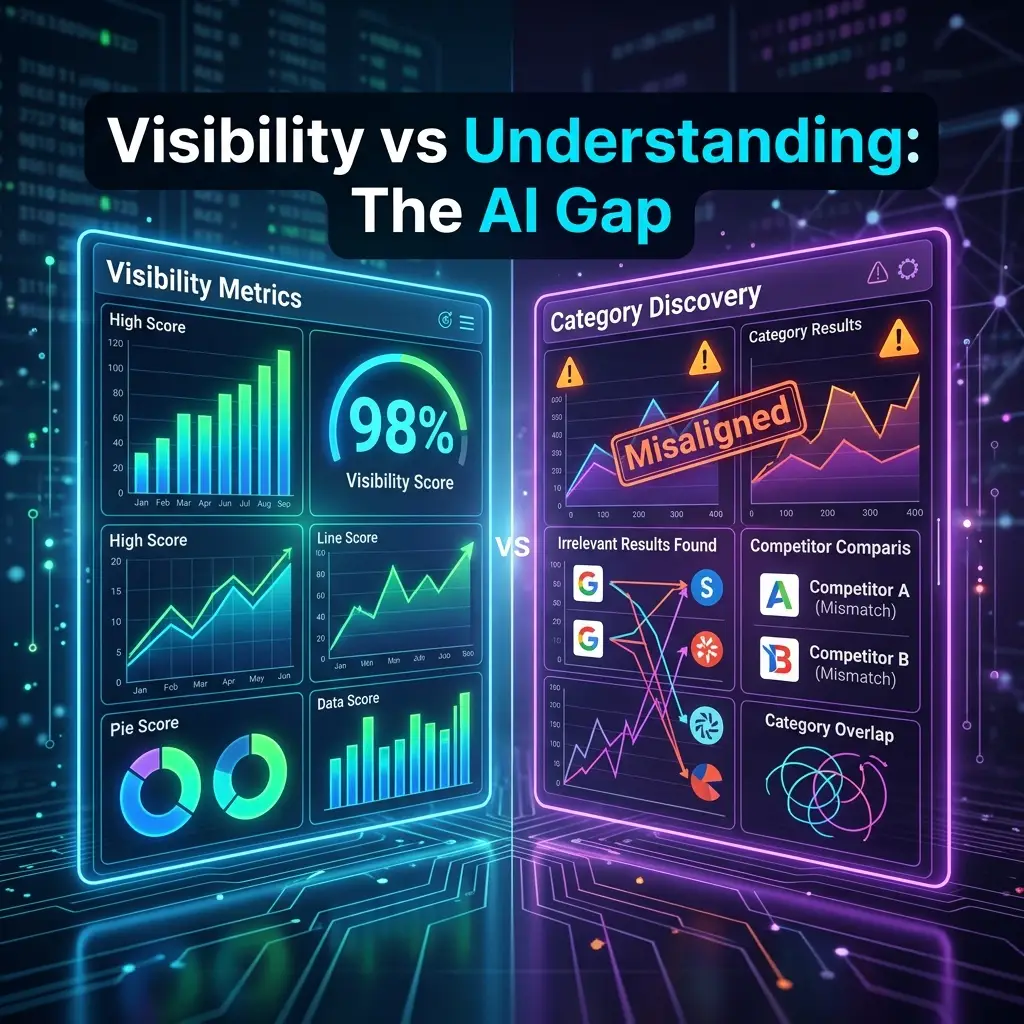
After reviewing deeper AI discovery scans, a more important pattern is starting to show up. Some businesses appear often across AI platforms. They have strong mention signals, solid persistence, and steady inclusion. On the surface, that looks like success. But when you look closer, a different problem appears. AI systems may retrieve the brand consistently while still failing to understand what category the business belongs in. In some cases, they compare the company to the wrong competitors. In others, they surface the brand in the wrong buying context.
That changes the diagnosis completely.
The issue is not always low visibility. Sometimes the issue is poor category discovery. And those are not the same problem.
In this post, we will break down:
- why appearance is becoming the wrong top-line metric
- the difference between retrieval weakness and interpretation instability
- what businesses can do to improve category discovery
- how Axis Suite helps close this growing AI visibility gap
Why AI visibility tools are missing the bigger issue
Many AI visibility tools were built to answer a basic question: does your brand show up?
That was a reasonable starting point. If AI systems cannot find you, you have a visibility problem. But as AI-driven discovery matures, that answer only covers part of the picture.
A business can appear in results and still lose.
For example, imagine a software company that shows up repeatedly in AI-generated answers. At first glance, that looks healthy. But if the AI describes it as a general analytics platform when it is really a retail forecasting solution, the business is visible without being clearly understood. That weakens trust, hurts conversion, and may place the brand next to the wrong alternatives.
The takeaway is simple: appearance is not the same as accurate discovery.
What recent scans are showing about AI category discovery
Recent scans revealed a pattern that many teams are not measuring yet.
Some businesses showed:
- high persistence across AI systems
- strong mention frequency
- consistent inclusion in answers
But despite that, they had very low category discovery.
In plain terms, AI systems kept retrieving the brand, but they did not clearly understand what the business was. The systems either attached the company to the wrong category or framed it against the wrong competitors.
That is a serious issue because AI discovery is not just about being listed. It is about being selected in the right context.
High persistence does not guarantee clear understanding
Persistence tells you a brand keeps showing up. It does not tell you whether AI understands the brand correctly.
A company might be mentioned in many outputs, yet still be described with vague, inconsistent, or inaccurate category language. That creates friction when a buyer asks AI who to hire or what software to choose.
If the AI cannot place your business cleanly, it may:
- recommend you less often in true buying scenarios
- compare you against companies that do not match your offer
- describe your value in a weak or misleading way
- push buyers toward clearer competitors
The mini takeaway: visibility without interpretation can still produce poor outcomes.
Category discovery is a different layer of performance
Category discovery asks a deeper question than visibility does.
It is not just “Are you there?”
It is “Does the AI understand what you are, where you fit, and when to recommend you?”
That second question matters more as AI becomes a decision support layer. Buyers are not always scanning lists anymore. They are asking for recommendations, shortlists, and comparisons. If your category is unstable, your brand may be present but poorly positioned.
Retrieval weakness vs. interpretation instability
This is the distinction more businesses need to make.
These two problems often get grouped together, but they require different fixes.
What is retrieval weakness?
Retrieval weakness means AI systems do not surface your brand reliably.
You may appear rarely, inconsistently, or not at all. This usually points to weak signals that make the business harder to find, connect, or trust across AI systems.
Common signs of retrieval weakness include:
- low mention frequency
- inconsistent inclusion across prompts or platforms
- weak entity recognition
- poor presence in relevant source material
A business with retrieval weakness needs stronger signals so AI systems can find and retrieve it more reliably.
What is interpretation instability?
Interpretation instability means AI systems retrieve your brand but do not interpret it correctly.
The brand appears, but its category position is fuzzy. It may be described too broadly, too narrowly, or in a way that overlaps with the wrong market. In many cases, AI compares the business against competitors it should not be grouped with.
Common signs of interpretation instability include:
- high visibility but weak category alignment
- inconsistent descriptions across platforms
- wrong competitor comparisons
- vague or conflicting explanations of what the business does
A business with interpretation instability does not have a pure visibility problem. It has a meaning problem.
Why this distinction matters
If you treat both problems as the same, you will apply the wrong fix.
For retrieval weakness, you need more discoverable signals. For interpretation instability, you need clearer positioning signals.
That difference matters because many teams respond to weak AI performance by producing more content or chasing more mentions. That may help retrieval. But it will not solve the deeper issue if AI already finds the brand and still misunderstands it.
The mini takeaway: first diagnose whether the problem is finding or understanding.
Why most businesses are measuring the wrong thing
Most businesses still use a simple success test: did we appear?
That metric is easy to track, but it misses how AI actually influences selection.
AI systems do not just retrieve names. They also classify, summarize, and compare. That means a brand can “win” on visibility dashboards while quietly losing on recommendation quality.
Here is a practical example:
- Brand A appears in 70% of relevant AI prompts
- Brand B appears in 45% of relevant AI prompts
At first glance, Brand A looks stronger. But if AI consistently places Brand A in the wrong category and compares Brand B to the right alternatives, Brand B may still be better positioned for buyer selection.
That is why appearance alone is becoming the wrong measurement. The better question is: how accurately does AI place and present your brand?
How to fix interpretation instability
Interpretation instability needs a different playbook than retrieval weakness.
If AI already finds your brand, your job is to reduce ambiguity and strengthen category clarity.
AI category discovery improves with clearer category language
The first fix is clearer category language.
Many companies describe themselves in ways that sound smart to humans but create confusion for machines. Broad phrases, layered messaging, and shifting category terms can all weaken AI understanding.
Instead, businesses need language that is:
- direct
- consistent
- repeatable across sources
- easy to match to buyer intent
For example, if one page calls your product a “revenue acceleration platform,” another calls it a “workflow intelligence engine,” and another calls it a “sales operations solution,” AI may struggle to decide what category you truly belong in.
A clearer approach uses one primary category definition supported by a few stable secondary terms.
Use one dominant category anchor
Choose the clearest category label that reflects your real market position.
Then reinforce it across:
- homepage messaging
- product and service pages
- company descriptions
- executive bios
- directory profiles
- third-party mentions
This helps AI systems see the same category story repeatedly.
Avoid invented language when precision matters
Unique brand language can be useful for marketing. But if it replaces category clarity, it creates interpretation risk.
A coined phrase may sound distinctive, yet AI systems often need plain language to place a company correctly. That means your site and supporting sources should clearly explain what the business is in simple terms before layering on branded messaging.
The mini takeaway: category clarity beats creative ambiguity in AI discovery.
Retrieval-friendly explanations reduce AI ambiguity
The second fix is retrieval-friendly explanations.
AI systems respond better when your content explains what you do, who you serve, and how you differ in a clean, simple structure.
That does not mean writing for robots. It means removing unnecessary confusion.
What retrieval-friendly explanations look like
Strong retrieval-friendly explanations usually include:
- a plain-language definition of the business
- the customer type served
- the main problem solved
- the key differentiator
- the right competitive frame
Here is a simple pattern:
We help [audience] solve [problem] through [solution category], unlike [wrong category or common confusion].
That kind of structure helps AI systems connect your brand to the right category and exclude the wrong ones.
Keep explanations consistent across the web
Consistency matters just as much as clarity.
If your website says one thing, directories say another, and media mentions use a third version, AI may assemble a messy picture. That is how brands end up retrieved correctly but interpreted poorly.
Review your core descriptions across owned and external sources. Tighten the wording so the same category meaning appears again and again.
Common mistakes that worsen category discovery
Businesses often make interpretation instability worse without realizing it.
Here are some of the most common mistakes:
Mistake 1: Treating visibility and interpretation as the same issue
This leads teams to use one solution for two very different problems.
If your issue is misclassification, more mentions alone will not fix it.
Mistake 2: Using inconsistent positioning language
Shifting between multiple category labels may feel flexible, but it often creates ambiguity.
Pick a primary category story and stay disciplined.
Mistake 3: Letting others define your category
If third-party sites, partner pages, or media mentions describe you loosely, AI may absorb those descriptions and repeat them.
You need to guide the market with stronger, clearer language.
Mistake 4: Ignoring competitor framing
If AI compares you to the wrong companies, that can distort your entire position.
Review who you are being grouped with. Wrong comparisons often point to interpretation instability, not low visibility.
The mini takeaway: category confusion often grows from inconsistent signals, not a lack of presence.
How Axis Suite bridges the AI visibility gap
This is where Axis Suite becomes especially valuable.
Most tools stop at surface-level appearance metrics. They can show whether a brand is present, but they often fail to explain whether the brand is being placed in the right category, described accurately, or compared against the right competitors.
Axis Suite helps close that gap.
It gives businesses a way to move beyond simple inclusion tracking and understand the difference between retrieval weakness and interpretation instability. That means teams can diagnose the real issue instead of guessing.
With Axis Suite, businesses can better evaluate:
- whether AI systems retrieve the brand consistently
- whether the brand is mapped to the correct category
- whether competitor comparisons are accurate
- whether positioning is stable across AI environments
- where interpretation gaps are limiting recommendation quality
That distinction matters because the right diagnosis leads to the right action.
If retrieval is weak, you build stronger signals. If interpretation is unstable, you improve category language, positioning consistency, and retrieval-friendly explanations. Axis Suite helps teams see which problem they actually have.
A practical framework for improving AI category discovery
If you want to improve category discovery, start with a simple audit.
Step 1: Measure appearance and interpretation separately
Do not use one visibility score for everything.
Track:
- how often your brand appears
- how often it is categorized correctly
- which competitors it is grouped with
- how consistently it is described
Step 2: Identify your dominant category language
Review your website, profiles, and external mentions.
Ask:
- Do we use one clear primary category?
- Are we described the same way across sources?
- Would an outside reader understand what we do in one sentence?
Step 3: Rewrite key explanations for clarity
Tighten descriptions so they are simple, specific, and stable.
Focus on:
- category precision
- audience clarity
- problem-solution fit
- contrast against common misclassification
Step 4: Monitor the changes over time
AI discovery is not static.
After refining your language, monitor whether category alignment improves. Watch for cleaner descriptions, better competitor comparisons, and stronger inclusion in the right recommendation contexts.
The mini takeaway: category discovery improves when measurement, language, and monitoring work together.
Conclusion
AI visibility is still important, but it is no longer the full story.
A business can appear often across AI systems and still underperform if those systems do not understand its category clearly. That is the difference between retrieval weakness and interpretation instability. One is about being found. The other is about being understood.
As AI discovery matures, that distinction will matter more. Businesses that keep measuring appearance alone will miss the deeper issue. The smarter move is to separate visibility from category understanding and fix the right problem with the right strategy.
If your team wants to improve AI discovery performance, focus on these next steps:
- audit whether your issue is retrieval weakness or interpretation instability
- strengthen category language and retrieval-friendly explanations
- use Axis Suite to diagnose and monitor how AI systems retrieve, interpret, and compare your brand
The brands that win in AI discovery will not just appear more often. They will be understood more clearly and selected more confidently.