The way people discover products and services is changing rapidly, thanks to AI-powered search and generative answers. This evolution has given rise to tools designed to help businesses understand their digital presence in AI systems.
But not all tools are created equal.
Many are branded as AI visibility platforms, focusing on tracking whether a brand appears in AI-generated answers and how often it’s mentioned. While this data is useful, it only scratches the surface of a far more complex system.
Enter AI Discovery Intelligence.
This approach dives deeper, exploring not just what happens in AI systems but why it happens in the first place. It’s a fundamental shift in helping businesses influence how AI systems retrieve, interpret, and recommend their brands.
What Are AI Visibility Tools?
At their core, AI visibility tools measure outputs. They focus on assessing where and how often a brand appears in AI-generated answers.
Consider the kind of questions these tools typically address:
- Does my brand show up in AI answers?
- How frequently am I mentioned?
- Who are the competitors being cited instead?
- What is my share of voice across AI platforms?
These tools provide foundational metrics, offering an essential overview of a brand’s presence across AI systems like ChatGPT, Gemini, and Perplexity.
Examples of AI Visibility Tools
Some well-known platforms specializing in AI visibility include:
- Profound
- Scrunch AI
- Peec AI
These tools are valuable for monitoring a brand’s visibility in AI-generated answers. However, they operate at the surface level, focusing on the “what” without explaining the “why.”
The Limitation of Visibility-Only Measurement
While AI visibility tools do a great job of answering what’s happening, they fall short of addressing critical questions like:
- Why does one company get recommended over another?
- Why does visibility vary across platforms or prompts?
- Why do similar brands experience different levels of exposure?
For example, one company might consistently appear in AI-generated responses while another, seemingly similar, does not. Without understanding the decision-making structure of AI systems, visibility tools can only identify symptoms, not underlying causes.
This is where AI Discovery Intelligence takes over.
What Is AI Discovery Intelligence?
AI Discovery Intelligence is a deeper, more analytical approach. It doesn’t just monitor where brands appear; it examines the entire decision process of AI systems to explain how and why brands are selected.
AI Discovery Intelligence helps businesses understand how AI systems:
- Retrieve information from multiple sources.
- Interpret entities, such as the clarity and positioning of brands.
- Build confidence in their recommendations through consistent signals.
- Select which brands to recommend to users.
This approach focuses on the underlying structure, providing a complete picture of how AI systems interpret and represent brands.
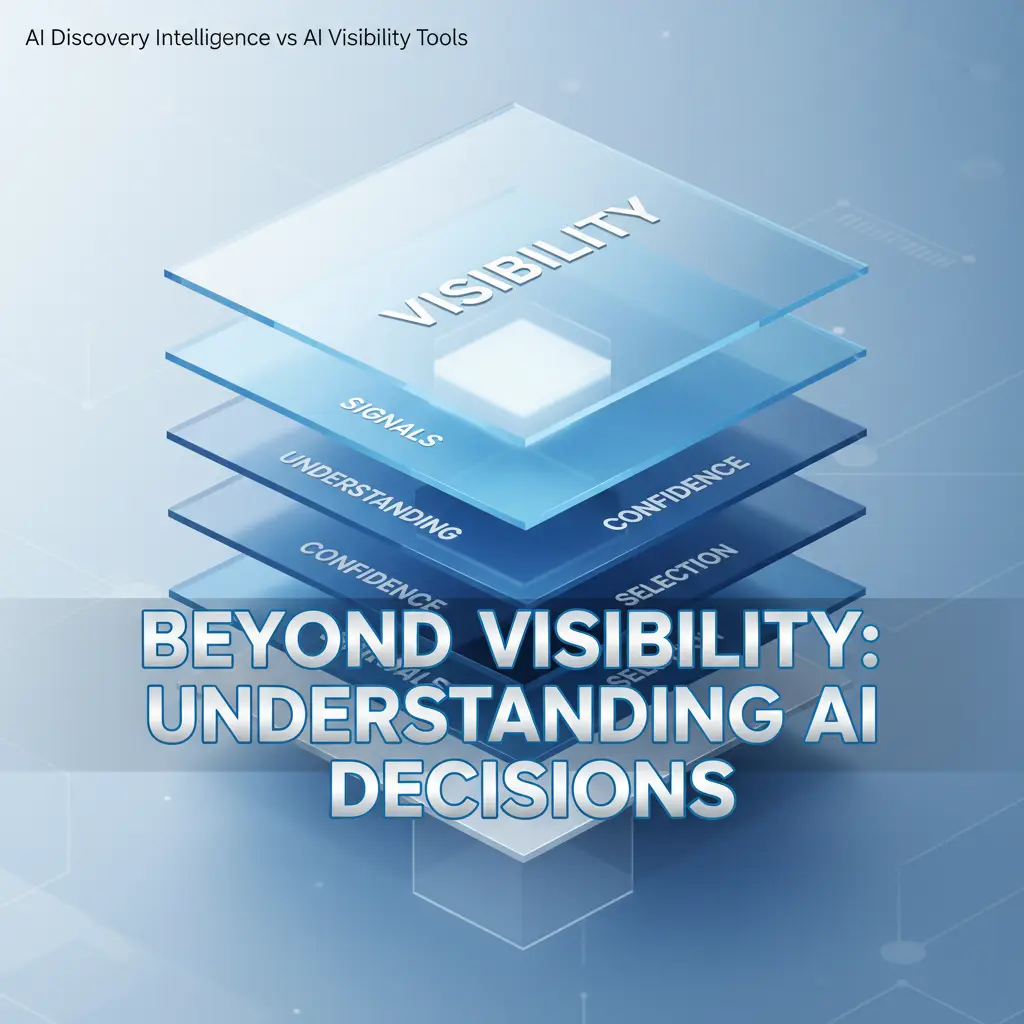
The AI Discovery Intelligence Framework
At its core, AI discovery systems follow a process:
- Signals (what information is available across the web)
- Understanding (does the system understand what this brand is?)
- Confidence (is this a reliable, coherent entity?)
- Selection (should this brand be recommended?)
- Visibility Momentum (does repeated selection reinforce its position?)
This layered understanding is what sets AI Discovery Intelligence apart.
The Key Difference
To clarify the distinction, let’s compare the two approaches side by side:
Area
AI Visibility Tools
AI Discovery Intelligence
Focus
Outputs (mentions, citations)
Full decision system
Scope
Monitoring
Analysis + explanation
Insight
What appears
Why it appears
Depth
Surface-level
System-level
Outcome
Reporting
Diagnosis + prediction
AI visibility tools focus on the final layer—what gets shown in the results. AI Discovery Intelligence dives deeper to understand every step leading to that outcome.
Why This Distinction Matters
AI systems are quickly evolving from search engines into decision engines. This shift changes the competitive landscape entirely.
Here’s the difference:
- Search Engines
Even if you weren’t ranked first, you still had a chance to attract traffic. - AI Systems
Selection is binary. You’re either chosen… or you’re not.
This makes understanding why AI systems recommend certain companies far more critical than simply tracking mentions.
Organizations relying solely on visibility tools risk:
- Misinterpreting why they’re appearing (or not appearing).
- Focusing on symptoms instead of underlying causes.
- Missing opportunities to influence how AI systems evaluate their brand.
How the Market Is Evolving
AI visibility tools represent the first generation of solutions in this space. They help organizations monitor their mentions and share of voice.
However, the growing demand for deeper insights is pushing the market toward more sophisticated solutions. These new platforms focus on:
- Causal analysis of why AI makes specific recommendations.
- Entity diagnostics to refine how brands are interpreted.
- Prediction models to assess inclusion probability.
- Optimization strategies based on AI system behavior.
This evolution defines the emerging category of AI Discovery Intelligence.
Where Axis Suite Fits
Axis Suite is at the forefront of AI Discovery Intelligence.
Rather than just tracking mentions or citations, Axis Suite analyzes:
- How AI systems interpret your brand across sources.
- Where signal inconsistencies exist in your content.
- How confidence is built by AI models during retrieval.
- Why competitors are selected over your business.
- What actions you can take to increase your recommendation probability.
By providing insights into the full decision process, Axis Suite transforms AI visibility from a reporting function into a measurable and optimizable system.
Final Thought
AI visibility tools are valuable for showing you the outcome. But understanding why that outcome occurs requires AI Discovery Intelligence.
When AI platforms decide what to recommend, the brands that excel will be those that master the decision-making system itself.
With tools like Axis Suite, businesses won’t just track mentions. They’ll uncover actionable insights to position themselves as the trusted choice in AI-generated answers.
It’s time to move from measuring what’s visible to understanding what’s driving those results. The future of competitive advantage lies in being not just seen—but thoroughly understood.