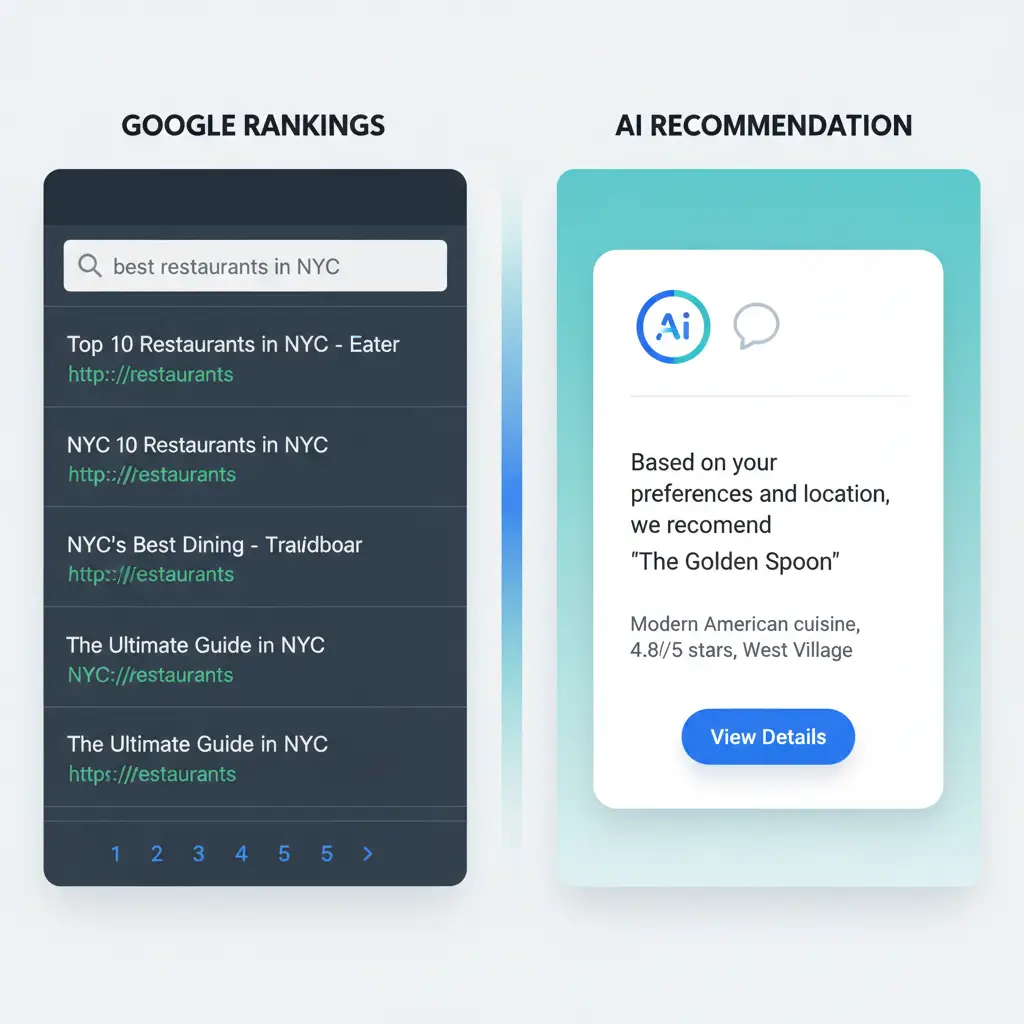
For years, businesses have relied on Google’s search rankings to drive visibility and growth. The playbook was familiar: optimize for keywords, earn backlinks, and secure a top spot on page one. But now, a major shift is underway, and it’s changing how customers find and evaluate brands.
AI assistants like ChatGPT, Bard, and Claude are not just transforming search; they are rewriting the rules altogether. Instead of long lists of options, these AI tools provide curated recommendations—often just one or two. With this shift, the question becomes not “Where are we ranked?” but “Are we included in the answer at all?”
This blog explores how AI recommendations differ from traditional Google rankings, why these changes matter, and why businesses need to rethink their approach to visibility to thrive in this new landscape.
From Search Results to AI Answers
The heart of the shift lies in how information is presented.
1. Lists vs. Single Recommendations
When you search for something on Google, you’re served a ranked list of links. For example, searching “best Italian restaurant near me” might return 15-20 relevant options, with varying levels of visibility depending on where they fall on page one.
AI doesn’t work this way. Instead of offering a list of links, tools like ChatGPT analyze your query and present the best-fit recommendation in a conversational response. The result isn’t a range of options; it’s a single, definitive answer like, “Trattoria Bella is highly rated for authentic Italian cuisine near your location.”
Why this matters:
- For users, it simplifies decision-making.
- For businesses, the stakes are higher. Being slightly lower on Google’s page one may retain some clicks. With AI, you’re either included in the answer or you’re not.
2. Ranking vs. Selection
Google rankings are built on an algorithm that evaluates factors like keyword use, domain authority, and backlinks. The emphasis is on ranking businesses on a competitive playing field, where multiple entries can still perform well.
AI assistants take a different approach. They focus less on ranking and more on selection. When assembling answers, they prioritize entities deemed most relevant, trustworthy, and contextually aligned with the query.
To illustrate this shift:
- Ranking (Google): Your position determines visibility. Even spot #8 on page one can generate clicks.
- Selection (AI): There’s no second-place answer. Either your brand is chosen, or it fades into invisibility.
Why Certain Brands Get Picked
This brings us to the central question for businesses today: What does it take to be part of an AI assistant’s answer?
While the specifics of AI algorithms vary by platform, certain common factors determine which brands are selected.
1. Entity Clarity
AI systems prioritize entities that are well-defined and easy to interpret. If your brand isn’t clearly positioned and distinguishable in your industry, it’s harder for AI to include you in recommendations.
Example:
- Clear Entity: “Bella Roastery, a local coffee shop specializing in fair-trade dark roasts.”
- Unclear Entity: “A coffee brand with various products.”
2. Trustworthiness
AI places a premium on credible sources. Brands that are frequently cited, endorsed, or reviewed by trusted platforms have a competitive edge. Think of these as “authority signals” that demonstrate reliability to the AI system.
Example:
- A tech brand mentioned in trusted reviews on sites like CNET or TechRadar is more likely to appear in answers for “best laptops for students.”
3. Contextual Relevance
Relevance to the user’s question is paramount. AI evaluates whether your content, products, or services directly address the specific query—not just tangentially but comprehensively.
Example:
- For “eco-friendly cleaning brands,” providing detailed information about how your products meet sustainability criteria (e.g., biodegradable packaging, ethical sourcing) can set you apart.
4. Structured Data
Machine-readable data, like schema markup, makes it easier for AI systems to interpret and recommend your content. Without structured data, even high-quality information can go unnoticed.
Why Traditional SEO Alone Is No Longer Enough
Search engine optimization (SEO) is still relevant, but it’s no longer the sole strategy for getting visibility. AI discovery has fundamentally shifted the landscape, making AI-specific visibility just as critical.
Consider this:
- SEO boosts rankings, but it doesn’t guarantee AI recognition.
- AI tools evaluate broader signals—including authority, context, and consistency—that may fall outside the typical SEO playbook.
- Without optimizing for AI visibility, brands risk becoming invisible in AI-driven answers, even if they have strong Google rankings.
This shift underscores the need for businesses to adapt their strategies to include both SEO and AI-focused initiatives.
The Bridge Between SEO and AI Visibility
This is where Axis Suite comes into play. Axis Suite is designed to help businesses close the gap between traditional SEO and AI visibility, ensuring your brand is not just ranked but selected.
How Axis Suite Helps:
- PulseAxis
Monitors your brand’s visibility across AI platforms, highlighting where you’re being included in recommendations and where you’re not. - TrendAxis
Identifies emerging trends, allowing you to create content that aligns with what both users and AI systems care about. - SparkAxis
Helps execute visibility improvements by turning insights into actionable strategies that optimize your growth potential. - AxisGoals
Tracks measurable outcomes, ensuring that both SEO and AI visibility efforts lead to tangible results for your business.
The Result
With Axis Suite, you’re not just competing in search rankings; you’re aligning with the future of discovery, where AI-driven answers play an increasingly dominant role.
The Takeaway
The world of online discovery is shifting rapidly. The rise of AI assistants is redefining customer search behavior, transitioning from static lists of options to dynamic, curated recommendations.
For businesses, this shift means:
- Visibility is no longer guaranteed by SEO alone.
- AI visibility requires optimizing for signals like entity clarity, trustworthiness, and structured data.
- Being part of AI answers will determine not just discoverability but relevance in the years to come.
And here’s the critical piece:
This shift is why AI visibility matters more than traditional SEO alone.
Axis Suite was built to help businesses thrive in this new era. If you’re ready to make sure your brand not only ranks but also gets included in AI answers, now’s the time to take action.
Don’t wait for AI-driven discovery to leave you behind. With the right approach, you can ensure that your brand remains part of the conversation. Explore Axis Suite today to start building your AI visibility strategy.