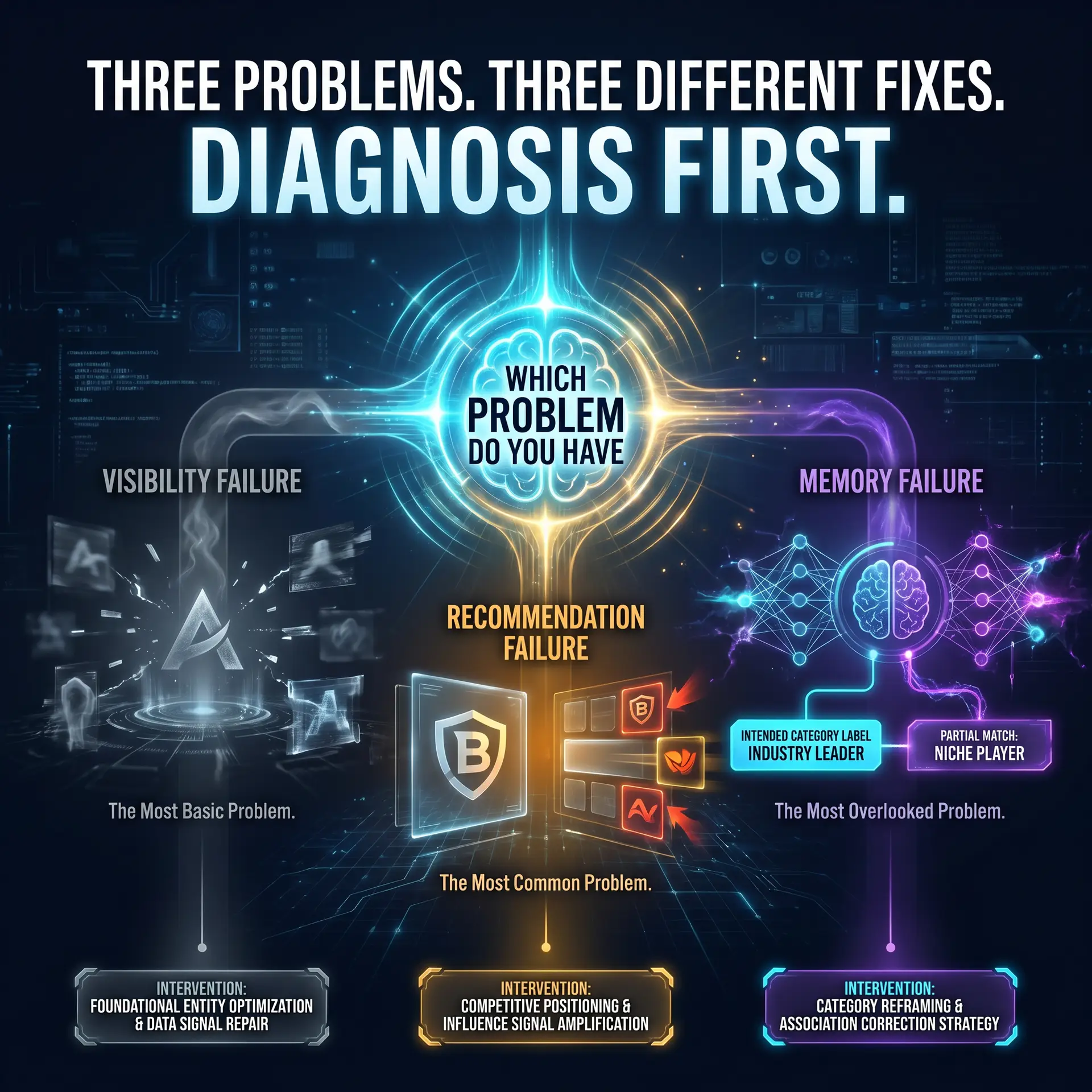
Most marketing teams think they have an AI visibility problem.
Many actually have a recommendation problem.
And some have a memory problem they have never thought to measure.
Those are three completely different situations requiring three completely different responses.
The mistake most businesses are making right now is treating all three as the same problem and applying the same generic fix to each of them.
That is why the fix is not working.
The Three Problems That Look the Same From the Outside
From the outside all three problems produce a similar symptom.
Your brand is not performing as expected in AI systems. Pipeline feels thinner than it should. Competitors seem to be getting recommended more consistently. Something is off but the standard dashboards do not reveal what.
That shared surface symptom is why businesses keep applying the wrong interventions.
Each problem has a completely different cause underneath.
Problem One: Visibility Failure
AI cannot reliably find or describe your brand.
This is the most basic problem and the one most AI visibility tools are built to detect. Weak entity signals. Inconsistent external presence. Missing schema markup. Poor retrieval infrastructure.
A brand with this problem needs more signal. More consistent external presence. Stronger entity clarity. Better structured information across trusted sources.
Problem Two: Recommendation Failure
AI knows your brand perfectly and still recommends competitors.
This is the most common problem affecting B2B brands right now and the one most businesses are not measuring.
AI can describe your brand accurately. Retrieve it reliably. Reference it in informational answers. And still systematically exclude it when buyers ask who to choose.
That gap between AI knowing you and AI choosing you is the Discovery Gap. And it is entirely invisible to traditional visibility metrics.
A brand with recommendation failure does not need more signal. It needs different signal. Category association. Co-citation with trusted alternatives. Comparison context presence. Buyer-intent language patterns that map to how buyers actually ask their questions.
Applying a visibility fix to a recommendation problem produces nothing. The brand becomes more visible and still gets excluded from shortlists.
Problem Three: Memory Failure
AI has filed you under the wrong category and has been carrying that impression for months.
This is the problem most businesses have never considered measuring because the tools to measure it have not existed until recently.
AI can recommend you occasionally and still have formed durable incorrect impressions about what you are, who you compete with, and how confident it should feel describing you.
We saw this recently in testing. A brand set its intended category as one thing. AI was consistently filing it under a partial match. A narrower and less strategic category. Every comparison, every shortlist, every recommendation scenario the brand entered was filtered through that wrong category lens for months.
The brand was not invisible. It was consistently misrepresented.
And none of their visibility metrics showed it.
Memory failure requires longitudinal intelligence. A single scan gives you a snapshot. The durable pattern that is actually driving AI behavior reveals itself across repeated measurements over time.
A brand with memory failure needs to understand what AI durably believes about it before it can correct the underlying impression.
Why the Fix for One Does Not Work for Another
This is the practical consequence most businesses are not thinking about.
If you have recommendation failure and you invest in entity clarity work you will improve your visibility scores. Your retrieval metrics will strengthen. And you will still be excluded from buyer shortlists because you addressed the wrong layer.
If you have memory failure and you invest in recommendation signal building you may improve your shortlist presence temporarily. But AI will continue carrying the wrong category impression into every competitive context. The underlying misrepresentation persists.
The intervention has to match the failure mode.
The businesses that diagnose correctly before acting will move significantly faster than the ones applying generic AI visibility tactics to specific failure modes they have never actually identified.
How to Tell Which Problem You Have
Three quick tests. Under ten minutes total.
Test for Visibility Failure:
Ask AI across ChatGPT, Perplexity, and Claude what your brand does. If AI cannot describe you accurately you have a visibility problem.
Test for Recommendation Failure:
Ask AI who to recommend for your category without mentioning your brand. If you do not appear you have a recommendation problem.
Test for Memory Failure:
Ask AI what category your brand belongs in and who it competes with. Compare those answers to how you actually describe yourself. If AI is filing you under a partial match or wrong category you have a memory problem.
Most brands will find at least two of these three problems present simultaneously.
The one that matters most for pipeline is almost always recommendation failure.
The one that causes the most invisible long-term damage is almost always memory failure.
FAQ
Why do most businesses mistake recommendation failure for visibility failure?
Because both produce a similar surface symptom. Your brand is not performing as expected in AI systems. But visibility metrics only measure whether AI can find and describe you. They cannot detect whether AI includes you when buyers ask who to choose. A brand can score well on visibility metrics and still have significant recommendation failure because the two measurements capture completely different behaviors.
How common is memory failure among B2B brands?
Based on what we observe in scans it is more common than most businesses expect. The most frequent form is category lock-in where AI has filed a brand under a partial match or outdated category. This is particularly common for brands that have evolved their positioning over time. AI may have formed its category impression during an earlier phase of the brand and not updated it despite changes to the brand’s actual positioning.
Can a brand have all three problems simultaneously?
Yes and most do to varying degrees. The practical question is which failure mode is having the biggest impact on pipeline right now. For most B2B brands that is recommendation failure. But memory failure often compounds recommendation failure because being filed under the wrong category affects which buyer-intent queries the brand is even eligible to appear in.
How long does it take to correct memory failure?
Memory failure is the most longitudinal of the three problems. Changing durable AI impressions requires consistent corrective signals across trusted sources over time. Unlike narrative failure which can improve quickly once specific corrections are made, memory failure reveals itself and resolves itself across repeated measurement cycles. Expect four to twelve weeks of consistent signal work before durable impression changes become measurable.
What is the difference between memory failure and narrative failure?
Memory failure is observational and longitudinal. It reveals what AI has durably come to believe about your brand across many interactions over time. Narrative failure is immediate and correctable. It is what AI says about your brand right now in a specific response that can be actively defended and improved. A brand can have narrative failure without memory failure if the inaccuracy is recent. But a brand with memory failure will typically show consistent narrative failure as a downstream symptom.
How does Axis Suite help diagnose which problem you have?
Axis Suite runs buyer-intent queries across ChatGPT, Perplexity, and Claude to measure recommendation presence. It tracks category placement and description consistency across platforms to identify memory failure patterns. And it monitors real-time AI descriptions to surface narrative failure. The combination gives you a complete picture of which failure mode is actually affecting your brand at each layer.
Start diagnosing your specific failure mode here: Axis Suite