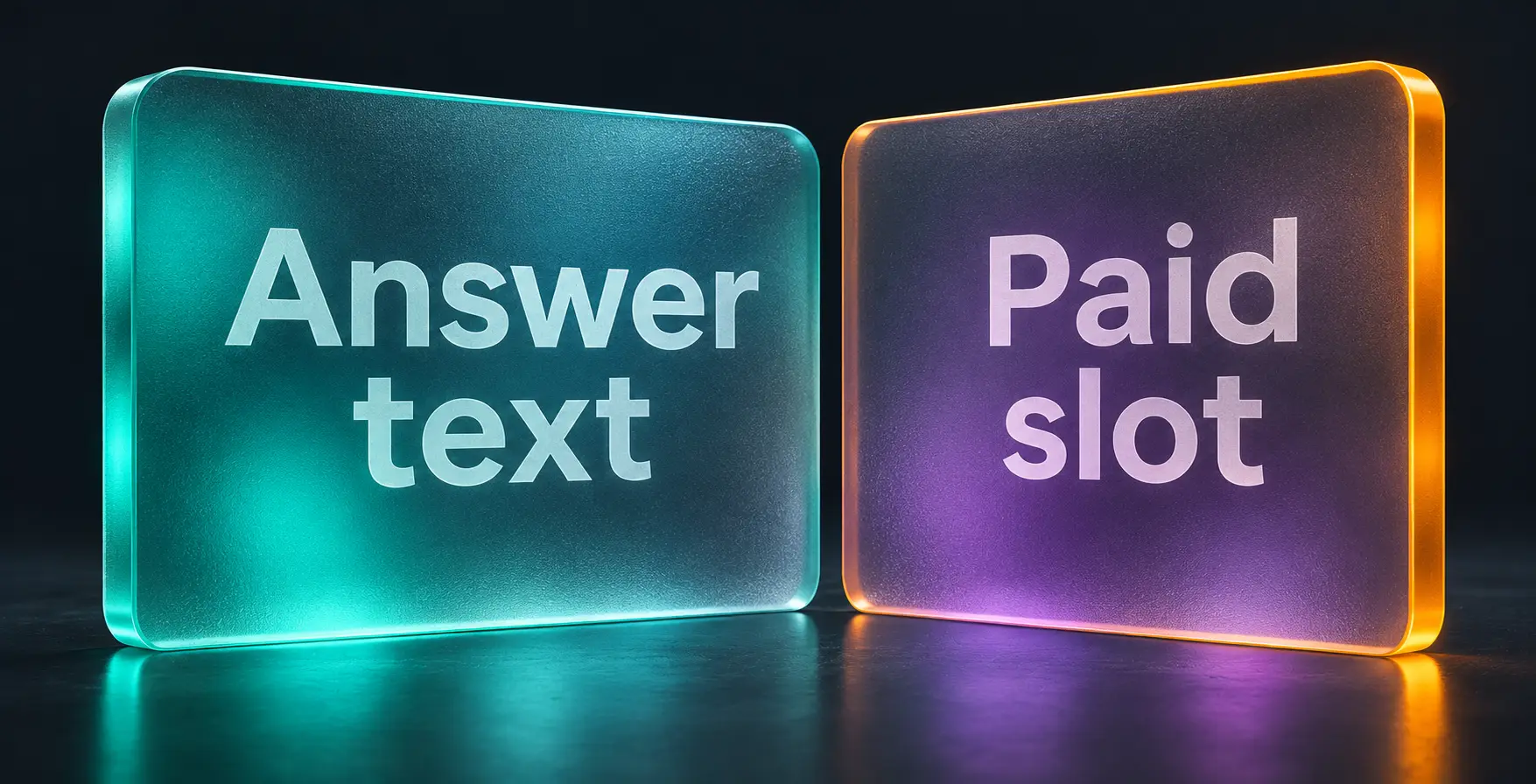
On November 19, Microsoft Advertising announced what it calls ads in AI Overviews on Bing. According to the announcement, the ads are available in all markets except China and run through campaigns advertisers already use, including Performance Max and AI Max, with no separate set-up. Microsoft describes them as appearing next to AI-powered answers when an offer is relevant, and its own example is a hotel ad beside a travel itinerary. This article relies only on that announcement.
For anyone who reads AI visibility reports, the announcement raises a practical question. If a report says a brand “appeared in AI Overviews,” what exactly appeared? The word “appeared” can describe at least three different things, and a leadership team that cannot tell them apart will draw the wrong conclusion.
The first is that the answer text named the brand. The assistant’s own words mentioned it, described it or compared it with others. The second is that a source in the answer pointed to the brand, such as a link or citation to one of its pages. The third is that a paid slot beside the answer carried the brand’s ad. Only the first two describe the answer itself. The third describes the page around it.
It is worth saying what the announcement does not say. It does not say how the ads are labeled or distinguished from the answer. It does not say whether advertisers opt in or can exclude these placements. And it does not say whether an ad influences the answer or the organic sources that appear in it. Those are open questions in this source, and a report should not settle them by guessing in either direction. Assuming ads shape the answer would overstate what we know, and assuming they never do would also overstate it.
The Mentioned, Cited, Recommended and Chosen ladder in our framework is a useful way to hold this. An answer that names a brand is a Mention. A source in the answer that points to the brand is a Citation. An answer that favors the brand for a buyer’s situation is a Recommendation, and a buyer picking it is a Choice. A paid slot is none of these by itself. It is a separate kind of presence, bought through a campaign. Counting it as a Recommendation would credit the assistant with a judgment the assistant did not make.
That matters for three decisions. The first is how the report is built. If one line says “appeared in AI Overviews” and it mixes answer text, sources and paid slots, a rise in the line could come from the team’s own ad spend and still be read as growing trust from the assistant. Splitting the line makes the source of any change visible. The second is how a team describes its own results. A brand whose only presence is in the paid slot can truthfully say its ad appeared next to an answer. It should not say the AI recommended it. The third is budget. A team deciding whether to put more money into paid placement or into the work that earns a place in the answer is comparing two different things, and a combined line hides the comparison.
Here is how a split line changes a conversation. Suppose a report shows a brand appearing more often in AI Overviews this month than last. If the line is combined, the room may credit the assistant, or the brand’s content, for the rise. If the line is split, someone can see whether the increase is in answer text, in sources or in the paid slot, and can ask whether ad spend also changed over the same period. Even then, the report cannot say why the answer text changed, only where the change showed up. That is a smaller claim, and it is one the evidence can carry.
So a report can record three fields for each answer it reports on. First, the surface and the date, so the observation can be found again. Second, the placement type, which is answer text, source link or paid slot, recorded separately and never merged. Third, what the answer text itself said, if anything, about the brand. If a brand shows up only in the paid slot, the third field reads “not named in the answer text,” and the report says exactly that.
What about the other assistants? The same separation applies anywhere a paid placement and an answer can share a screen, whether the assistant is ChatGPT, Claude, Gemini or Perplexity. This article does not claim which surfaces carry ads or how they work. It describes only Microsoft’s announcement for Bing and gives a way to keep the record clean.
A few limits keep the claim honest. This is a vendor’s announcement about a product, not a measured result. Its statistics are Microsoft’s own and mostly concern other products, so none are used here. And the question of influence is simply unanswered in the source. What a report can do is record each presence for what it is, so that if more is learned later, the earlier observations are still usable.
When someone says “we’re showing up in AI Overviews now,” the useful reply is a question: in the answer, in a source, or in the ad slot? The answer tells you which decision the observation can support.
FAQ
What did Microsoft announce? Microsoft Advertising announced ads in AI Overviews on Bing, available in all markets except China. The ads run through existing campaigns, including Performance Max and AI Max, with no separate set-up.
Does the announcement say how the ads are labeled? No. It also does not say whether advertisers opt in, or whether ads influence the answer or its organic sources. A report should not assume an answer to any of these.
Is a paid placement a Mention, a Citation or a Recommendation? Not by itself. Record it as a paid slot, and count a Mention, Citation or Recommendation only where the answer text or its sources do the work.
Does an ad appearing mean the AI answer favors the brand? The source does not say so. Treat the ad and the answer as separate presences until more is known.
What should a report record for each answer? The surface and date, the placement type (answer text, source link or paid slot), and what the answer text said about the brand. Keep the placement types on separate lines.
Is this article reporting a result from Axis Suite? No. It describes a vendor announcement and a way to read reports. It does not report an Axis Suite result.
About Axis Suite Axis Suite is the independent intelligence layer that tracks what AI says about your brand and the observable evidence behind it, retrieval, narrative, recommendation, and corroboration signals, across engines including ChatGPT, Claude, Gemini, and Perplexity. Built by TrendAxis, Axis Suite works from a framework that separates Mentioned, Cited, Recommended, and Chosen. Axis Suite is measurement infrastructure, not a marketing quick fix. Explore the Proof Center.