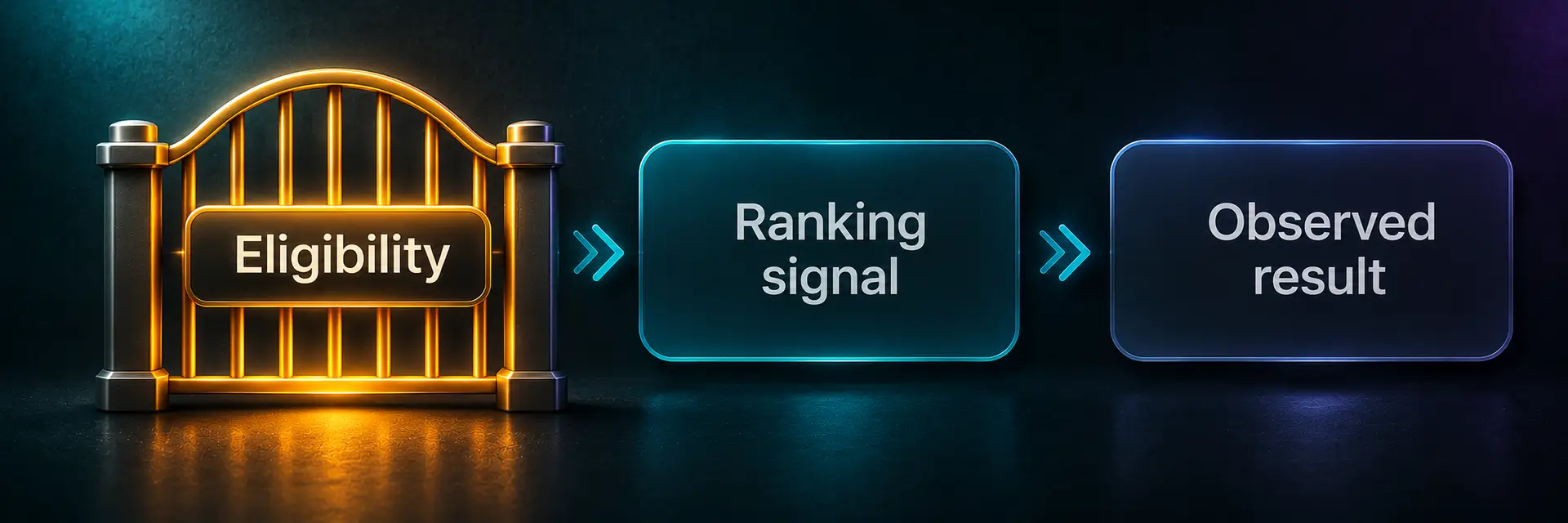
Consider a hypothetical wholesale supplier. It runs a Shopify store that sells only to business customers, and its owner has been reading about AI shopping experiences. An agency proposes a project: rewrite the product descriptions so the products appear in shopping experiences powered by Shopify Catalog. The proposal is reasonable on its face. Product copy matters, and sharper descriptions are rarely wasted. Before anyone pays for it, though, there is a prior question: can the channel include this store at all?
Shopify’s Catalog requirements page answers part of that. It lists stores restricted to B2B customers as ineligible, and it names turning off the B2B-only option as the fix. For a wholesale supplier, that fix would change how the business sells. Better product copy will not remove the restriction. The rewrite might still be worth doing for other reasons, but it would not address the gate.
The scope of that statement matters, so it is worth being exact about it. This is one catalog’s rule. It does not mean B2B companies are shut out of AI discovery. It says nothing about whether ChatGPT, Claude, Gemini, or Perplexity can describe a B2B business, find its pages or recommend it when a buyer asks. Those are separate questions, with separate evidence. The only claim here is that a specific channel publishes specific inclusion rules, and that those rules should be read before money is spent on optimizing for that channel.
The requirements page covers more than the B2B restriction. It lists services and product add-ons as excluded, along with private or password-protected stores. It lists a set of product categories that are not included. It asks that each product have a title, at least one image and a price above zero, and an identifiable product URL. It also sets account and operating-history expectations, such as verified accounts, genuine sales to real customers and low chargebacks. The page says eligibility is reviewed over time, and that the types of products that are ineligible can change at Shopify’s discretion. It shows no date, so a reader cannot tell when any of it was written.
That mix is useful to notice. Some requirements are settings a team can change in an afternoon, such as a missing product image. Some are facts about the business, such as who the store sells to. Some are history that takes time to build. A content rewrite could plausibly help with the first kind, and it has little to say about the second and third. Sorting the requirements into those groups shows which ones a content project can touch.
This is also where an agency’s proposal and an eligibility check differ in what they can tell you. A proposal describes something to do. An eligibility check describes whether doing it can matter in that channel. Both are needed, and the order is the point: the check comes first, because it is cheap.
Shopify announced on October 28 that a new admin view shows whether a store qualifies for Catalog and links to fixes for anything blocking eligibility. It is a vendor announcement, and whether the view is available to every store is not established here. Where a platform offers its own eligibility view, it is the natural first place to look.
None of this settles whether being included would help the supplier. Eligibility is a different kind of fact from Mentioned, Cited, Recommended, and Chosen in our framework. It describes whether a channel can include a business, and it says nothing yet about whether any answer mentions it. A store can be eligible and never be shown to a buyer. A store that is ineligible for one catalog could still be described by an assistant that gets its information elsewhere.
A useful test of any proposal is whether the agency can answer, in plain terms, three things: which channel the work targets, where that channel’s inclusion rules are published, and what observation would show the work had an effect. An agency that can answer all three has already done the sequencing. An agency that cannot is proposing work whose target is unclear, and the supplier is entitled to ask before paying. None of this implies bad faith. Proposals are written quickly, and eligibility rules are easy to overlook.
Three questions keep the sequence clear. Which channel? Name the specific route, not “AI” as a whole. Are we eligible there? Find the published rules, note the page and any date it shows, and check your setup against them. And what would show a change once the gate is satisfied? Last week’s four fields apply at that point: the buyer question, the decision it informs, the evidence that would change the decision, and the stop or recheck condition.
If the first two questions cannot be answered, the third should wait. A rewrite aimed at a channel that cannot include the store is a cost with no observable path to a result. A rewrite aimed at a channel that can include it still needs a plan for what to observe afterward. The point of reading the rules first is simply to know which situation you are in.
FAQ
What does it mean for a channel to “include” a business? It means the channel’s published rules allow the business’s products or pages to be part of what the channel offers. In this example, that is Shopify’s rule about which stores can be in Shopify Catalog. Being included is not the same as being shown, ranked or chosen.
Does the B2B-only exclusion mean B2B companies cannot be found in ChatGPT, Claude, Gemini, or Perplexity? No. It is one catalog’s eligibility rule, and it says nothing about whether those assistants can describe or recommend a B2B business. Each of those questions needs its own evidence.
Should a B2B-only store turn off the restriction to qualify? That is a business decision, not a content fix. Weigh it on its own merits, and do not change how the business sells only to satisfy one channel’s rule.
Where do I find a platform’s eligibility rules? Look for the platform’s published help or documentation pages, and use any eligibility view it offers inside the admin. Note the page, the date you read it, and whether the page shows its own date.
Are a platform’s eligibility rules fixed? Not necessarily. Shopify’s Catalog page says eligibility is reviewed over time and that ineligible product types can change at its discretion. A check is only as current as the date you made it.
Is this article reporting a result from Axis Suite? No. The supplier and the agency are hypothetical, and the article describes a way to read a channel’s rules without reporting a result for any brand.
About Axis Suite Axis Suite is the independent intelligence layer that tracks what AI says about your brand and the observable evidence behind it, retrieval, narrative, recommendation, and corroboration signals, across engines including ChatGPT, Claude, Gemini, and Perplexity. Built by TrendAxis, Axis Suite works from a framework that separates Mentioned, Cited, Recommended, and Chosen. Axis Suite is measurement infrastructure, not a marketing quick fix. Explore the Proof Center.