Sooner or later someone asks the question: did we block AI? It comes from leadership, from a customer, from an agency or from a colleague who read a headline. The question is short, and the accurate answer is not. A one-word reply tends to claim more than anyone can support, and it can stay in a deck long after the facts underneath it have changed. This article offers a way to answer that stays accurate, and it uses Microsoft’s October 30 announcement of separate AI training and AI grounding preferences as the working example.
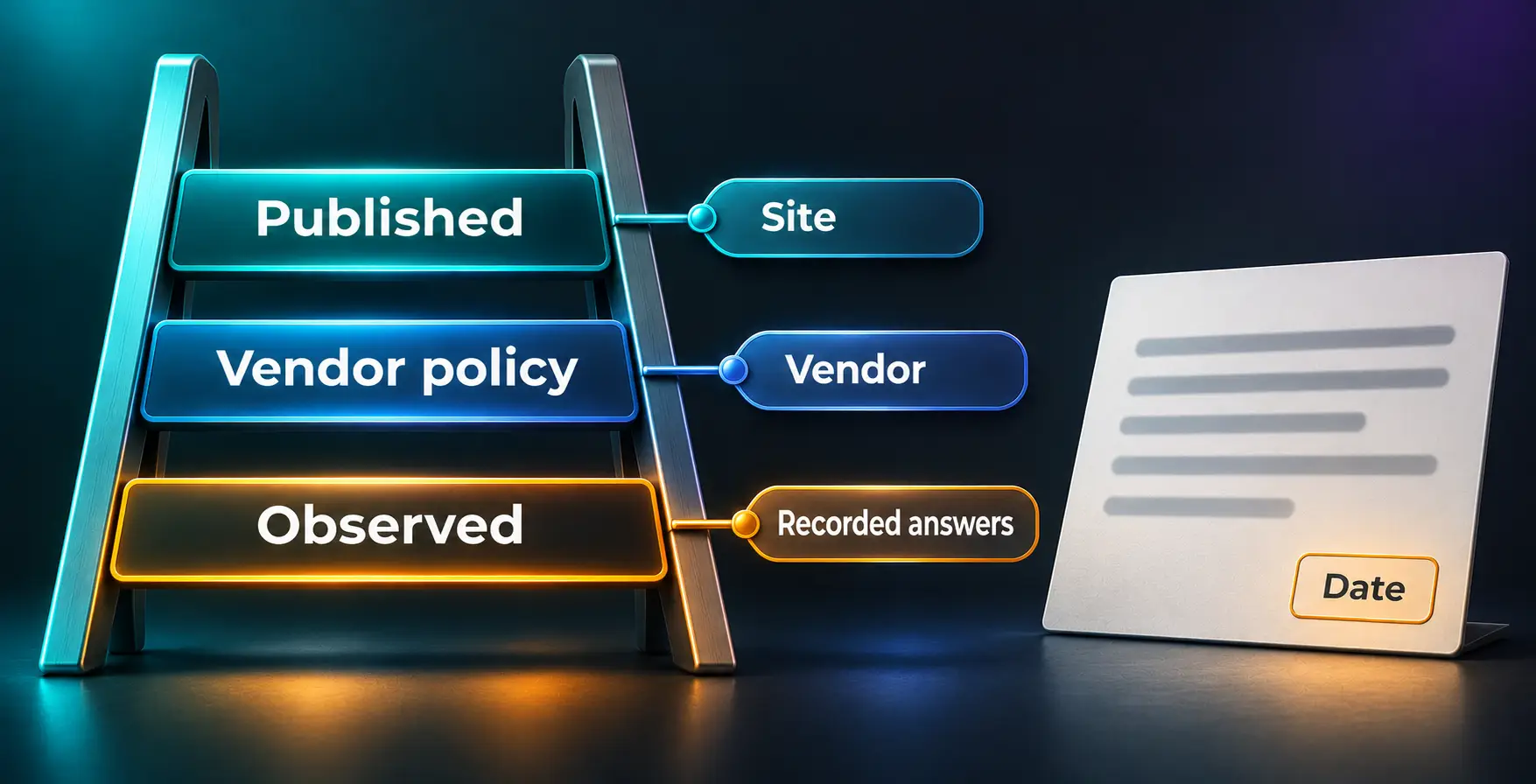
The method has three parts, and it is our own framing, not a standard. The first is what was published. This is a statement about the site itself: which preference it has expressed, for which use, and on what date. It is the easiest part to verify, because the site’s owner controls it. The second is the vendor’s policy: what the vendor says it does with a published preference, and from when. Microsoft says it will honor the new preferences as it crawls, starting February 1, 2027, and that publishing a setting is not the same as activating it. This part is the vendor’s own description, with the vendor’s dates, and a site can quote it but cannot confirm it. The third is what has been observed: what appeared in answers to fixed buyer questions, recorded on named dates. Many companies will have nothing at this level yet, and “nothing recorded yet” is a legitimate thing to say.
Each part rests on a different source, and a sentence should say which one it uses. Consider three situations, each with a hypothetical sentence.
In the first, a site has published nothing. The accurate answer is that no preference has been published. Microsoft describes its new preferences as defaulting to allow when no applicable preference is published, which applies once it begins honoring them, with a separate transition for sites that use the older tags. The answer should not be “we haven’t blocked it,” because that phrase can be heard as an oversight or as a decision. The record should show what was checked, and when.
In the second, a site has published a training preference but the date has not arrived. The accurate answer is that the site has published a preference as of a stated date, that Microsoft says it will honor it starting February 1, 2027, and that nothing has been recorded. “We have blocked AI training” overstates this, because it describes the vendor’s behavior as already established.
In the third, the date has passed and a baseline exists. The answer can add an observation, scoped carefully: for these questions, in these places, on these dates, here is what appeared compared with the baseline. Observed answers can document visibility. They cannot verify whether content was excluded from training, and a before-and-after difference alone does not establish that the preference caused anything.
The same facts need different lengths for different askers. Leadership usually wants a short answer, such as: “We have published a training preference and Microsoft says it will honor it from February 1, 2027. We are not yet claiming any effect on what buyers see.” A customer who asks about content use may need one more sentence naming the vendor and the use, and a note that this concerns Microsoft’s products only. An agency or a technical owner is better served by the full dated note, with the page read, the preference published, the vendor’s stated dates and any recorded observations. The facts stay the same. Only the amount of detail changes.
Two habits keep every version accurate. Name the vendor, because Microsoft’s announcement says nothing about how ChatGPT, Claude, Gemini, or Perplexity treat the same content, and a sentence that says “AI” without a vendor claims a position the source does not support. And name the use, because search eligibility, training and grounding are separate questions, and Microsoft says the new preferences do not change eligibility for traditional Bing search results.
A few phrases are worth retiring. “We have blocked AI” blends several uses and several vendors. “AI can’t use our content” claims an outcome nobody can observe. “We opted out” skips the date and the vendor. “We are excluded from AI” confuses a preference with eligibility. Each can be replaced by a sentence with a use, a vendor and a date.
Keep a dated record behind the answer. If a team publishes a preference and later changes it, the record should keep both entries with their dates, so a statement made in November is not judged against a setting from January. Microsoft’s own plans can change as well, which is another reason to write down the day you read the announcement.
The goal is not to hedge every sentence. It is to make each one say what it can support, with a date and a vendor attached, so it is still true when someone repeats it.
FAQ
What are the three parts of a careful answer to “Did we block AI?” They are what was published, what the vendor says its policy is, and what has been observed. Each rests on a different source, so a sentence should say which one it uses. This three-part split is our own framing, not an industry standard.
What is the accurate thing to say if a site has published no preference? That no preference has been published. Microsoft describes its new preferences as defaulting to allow when no applicable preference is published, which applies once it begins honoring them. It is not accurate to describe that as having blocked anything.
Why name the vendor in every statement? Microsoft’s announcement concerns Microsoft’s products and services. It says nothing about ChatGPT, Claude, Gemini, or Perplexity, which have their own documentation and controls.
Can observed answers show that content was excluded from training? No. Observed answers can document visibility, meaning what a buyer sees. They cannot verify whether content was excluded from training, and a before-and-after difference alone does not establish cause.
Is “nothing recorded yet” an acceptable answer? Yes. Many companies will have no observations at the third level, and saying so is accurate. Recording a baseline and a recheck date is the sensible next step.
Is this article reporting a result from Axis Suite? No. It describes a way to phrase an answer and reports no result for any brand.
About Axis Suite Axis Suite is the independent intelligence layer that tracks what AI says about your brand and the observable evidence behind it, retrieval, narrative, recommendation, and corroboration signals, across engines including ChatGPT, Claude, Gemini, and Perplexity. Built by TrendAxis, Axis Suite works from a framework that separates Mentioned, Cited, Recommended, and Chosen. Axis Suite is measurement infrastructure, not a marketing quick fix. Explore the Proof Center.