Clearing an eligibility gate answers one question. It says a channel can include a business. It does not say where the business will appear once included, and it does not say what any buyer saw. Those are two further questions, and a platform’s ranking language is where they are most often blurred. Shopify’s Shop Promise program, which it updated in its October 28 Fall ’26 Edition, is a good example to read closely because the company’s own wording is specific.
Shopify describes Shop Promise as a free program for eligible US stores. When a store qualifies and turns it on, a badge appears on qualifying products, naming benefits such as trusted delivery and returns. In its announcement, Shopify says badged products may rank higher in the Shop app search and in Shopify Catalog data. Its help page puts it a little differently: badged products can receive a ranking signal in the Shop app and other shopping experiences powered by Shopify Catalog. Both versions use hedged language. A product that qualifies may rank higher, or can receive a signal. Neither says it will.
The help page adds details that change what a store can conclude. Each product qualifies for benefits separately, so one product can show the badge while another does not. The trusted-delivery benefit depends on how quickly orders in the product’s category reach the carrier, and the returns benefit depends on the store’s return rules. Products without a qualifying benefit do not show the badge. The program is for stores in the United States, and the badge is shown to US customers. The updated program is rolling out gradually, so availability depends on the store.
Read together, those details describe a signal, and a conditional one. It applies to some products, in some stores, in some shopping experiences, for some customers. Whether a particular product receives it depends on facts the store controls only in part.
Now consider what the language does not say. It does not give the signal’s weight, or the size of any effect on position. It does not say how often a badged product is shown instead of an unbadged one. It does not say that any assistant, including ChatGPT, Claude, Gemini, or Perplexity, uses the signal when answering a buyer. Shopify says AI agents get product information from Catalog, and that is a statement from the platform about its own system. From outside, no one can see which source shaped a given answer, so the connection between a badge and a recommendation has not been shown.
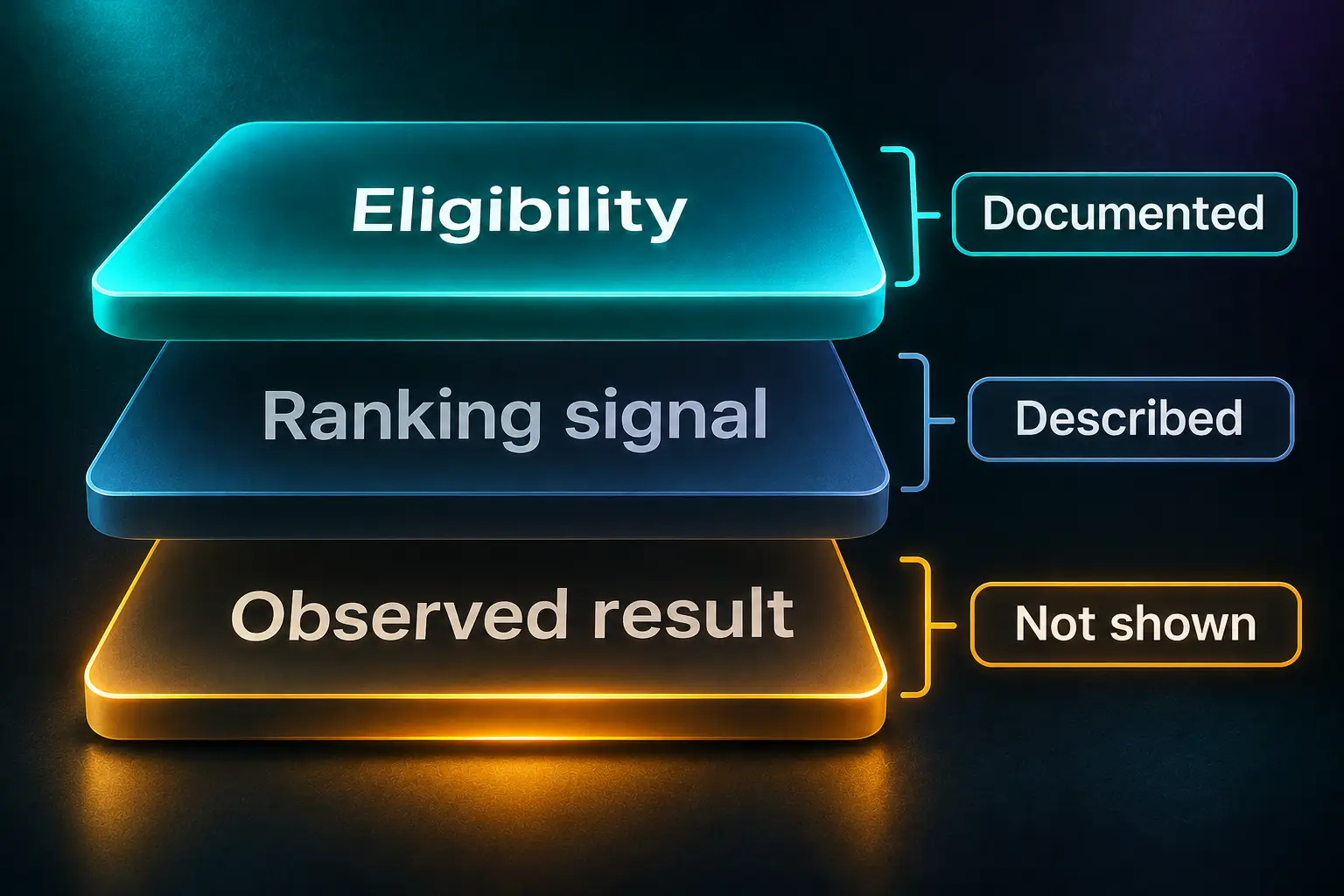
That leaves a clean three-way split. Eligibility is a documented rule, and it can be checked against a store’s setup. A ranking signal is a described mechanism, and what it does in practice is not established. An observed result is what actually appeared in an answer to a real buyer question under recorded conditions. Each needs its own evidence, and having the first or second does not supply the third.
A store can check some of this directly. It can see which of its own products show the badge, and compare the others against the conditions the help page lists, such as delivery speed for the product’s category and the store’s return rules. That is an observation about the store’s own data. It is separate from any claim about visibility, and it should be recorded as such.
This matters for decisions about cost. Qualifying for a badge may mean changing shipping speed or return rules, and those are operational changes with real costs. A team deciding whether to pursue them is weighing a described signal against a business cost, and the signal has not been measured here. A reasonable approach is to treat the change as an intervention: decide beforehand what observation would show an effect, such as the store’s products appearing in answers to a fixed set of buyer questions on named engines, and then repeat the same set later. Changed wording or new questions are a different test, not a repeat. A before-and-after difference alone does not establish that the badge caused it, because other things move at the same time.
It is also worth keeping the product-level detail in view. Since each product qualifies separately, a store-wide statement such as “our store has the badge” is usually too broad. The record should say which products, on which date, and what the page or admin showed.
The framework distinction applies here too. Mentioned, Cited, Recommended, and Chosen are separate levels, and a ranking signal sits on the platform’s side of the line, as a mechanism it describes. Whether any assistant mentioned the product, cited a source or recommended it is an observation about an answer. Whether a buyer then chose it is a separate outcome that the answer alone does not show.
None of this means the signal is unimportant. It means the evidence for its importance has to come from somewhere other than the platform’s description.
FAQ
What is Shop Promise, according to Shopify? Shopify describes it as a free program for eligible US stores that adds delivery and returns badges to qualifying products. Shopify says badged products may rank higher in the Shop app and in Catalog data.
Does the Shop Promise badge guarantee better ranking? No. Shopify’s own wording is conditional: badged products may rank higher or can receive a ranking signal. The weight of the signal and its effect on position are not established.
Does a ranking signal mean ChatGPT, Claude, Gemini, or Perplexity will recommend the product? Not on its own. Which sources an assistant uses in a given answer is not observable from outside, so a platform signal should not be assumed to carry over. Only observed answers can show what appeared.
Why does it matter that each product qualifies separately? A store-wide statement such as “we have the badge” can be too broad, since one product may qualify while another does not. Record which products, and the date you checked.
How should I decide whether to change shipping or return rules to qualify? Treat it as an intervention with a cost. Decide beforehand what observation would show an effect, repeat the same questions on the same engines later, and remember that a before-and-after difference alone does not establish cause.
Is this article reporting a result from Axis Suite? No. It reads a platform’s published wording and reports no result for any specific brand.
About Axis Suite Axis Suite is the independent intelligence layer that tracks what AI says about your brand and the observable evidence behind it, retrieval, narrative, recommendation, and corroboration signals, across engines including ChatGPT, Claude, Gemini, and Perplexity. Built by TrendAxis, Axis Suite works from a framework that separates Mentioned, Cited, Recommended, and Chosen. Axis Suite is measurement infrastructure, not a marketing quick fix. Explore the Proof Center.