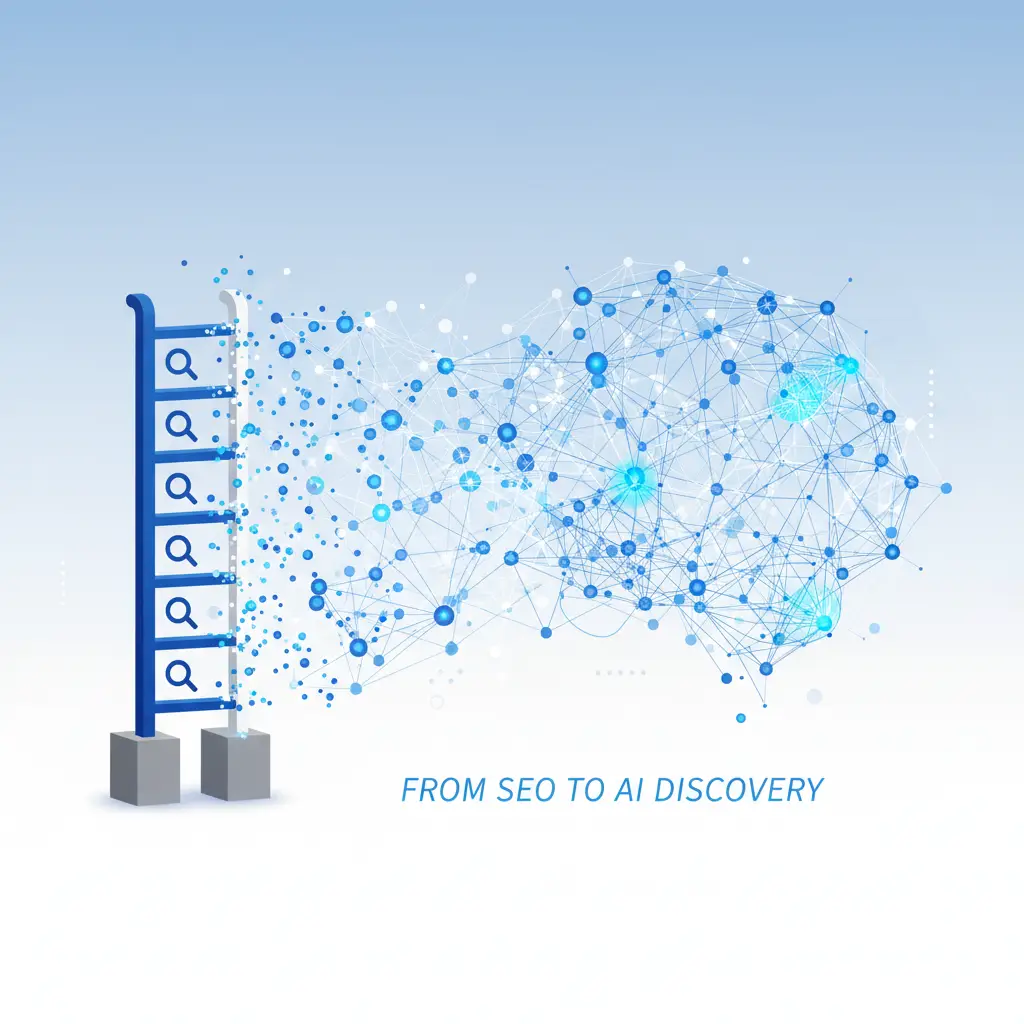
For over a decade, businesses have fine-tuned their strategies to climb the proverbial ladder of search engine rankings. SEO professionals have obsessed over keywords, backlinks, and ranking factors, and for good reason. Higher rankings in search engine results made businesses more visible, more click-worthy, and ultimately more successful. But with the rise of AI-powered discovery systems, the digital visibility game has changed dramatically.
AI discovery systems, unlike traditional search engines, don’t just prioritize keywords and ranking signals. They demand clarity, structured data, and consistency to determine not just where your content appears, but whether it gets selected. This shift is reshaping digital strategies and pushing businesses to redefine how they stay visible.
Traditional SEO vs. AI Discovery
What SEO Taught Us
The traditional SEO playbook revolved around a few core principles:
- Keyword Optimization: Selecting the right keywords and phrases that align with user searches.
- Backlink Building: Earning authoritative links from external sites to improve credibility and rank.
- On-Page Factors: Tailoring content and metadata around keywords to match search engine crawlers’ expectations.
This approach was essentially about ranking high on a list. If you played by the search engine’s rules, you could secure a top position and enjoy prolonged visibility, even with periodic updates to industry best practices.
Enter AI Discovery
With AI discovery, the focus has shifted from position to selection. AI systems, such as those powering chatbots, personal assistants, and content aggregators, now act as gatekeepers to your content being retrieved. They don’t just rank content but evaluate its relevance and trustworthiness in real time.
The core differences between SEO and AI discovery include:
- From Keywords to Entities
AI systems process entities rather than just keywords. Instead of “pizza restaurant New York,” they aim to identify “Joe’s Pizzeria,” an established entity with clear, structured data that matches a user’s query. - From Rankings to Selection
Position matters less than whether your specific content is chosen in response to a query. AI systems value clarity and accuracy to determine this. - From Static Listings to Dynamic Re-Evaluation
Unlike traditional rankings that could hold steady for months, AI discovery continuously assesses your clarity and relevance. Visibility can fluctuate depending on how well your information aligns with updates and user intent.
Why This Matters for Businesses
The rise of AI discovery systems means businesses can no longer rely on the old playbook. Instead, success requires mastering entirely new skills tailored to the environment of AI-driven visibility.
1. Clarity Rules Everything Around You
AI seeks precision. Vagueness in your descriptions or inconsistency across platforms increases the likelihood of being passed over. Businesses should:
- Ensure Entity Clarity
Be precise in describing your offerings. Replace ambiguous phrases with specific facts. For example, don’t just say “fast food”; specify “meal deals under $10 at our burger joint.” - Use Concise, Machine-Readable Language
AI systems process structured, direct language more effectively than creative-but-complex language. Simplify your metadata, FAQs, and product descriptions.
2. Consistency Builds Trust
AI distrusts inconsistencies. If your business hours differ on your website and your Google Business Profile, or if your product catalog isn’t up to date, AI systems may deprioritize your presence.
- Synchronize Across Platforms
Align your information across websites, social media accounts, and directory listings. - Audit for Contradictions
Regularly check for outdated info that might confuse AI systems (and your prospects).
3. Freshness Counts, Always
Stale content fades from visibility faster than you’d think. AI prioritizes new and updated content because it signals relevance.
- Update Content Frequently
Refresh long-standing pages and blogs with current statistics or new perspectives. - Generate Timely, Topical Content
Address trending topics or updates in your industry to stay in the AI discovery loop.
4. Structured Data Holds the Key
AI systems rely on structured data to understand content. Without it, even the most compelling messages may go unnoticed.
- Utilize Schema Markup
Implement schema.org microdata on your site to communicate product details, reviews, events, and more. - Create Organized FAQs
Break down complex information into digestible, categorized answers.
5. Cross-Platform Alignment is Non-Negotiable
Gone are the days when you could focus solely on optimizing your website. AI discovery looks at your entire digital presence.
- Ensure Uniform Digital Representation
Align your key messages, visuals, and data across platforms like your website, Google Business Profile, and social media accounts. - Demonstrate Activity Everywhere
AI systems notice active platforms. The more you engage across forums, directories, and channels, the stronger your foothold in the discovery process.
Adapting to the New Rules
Navigating this shift requires a mindset change. Businesses must transition from trying to game rankings to building a solid foundation of clarity, consistency, and relevance.
Develop an AI-First Strategy
- Identify Key Entities
Understand what specific entities your business represents (e.g., product names, service categories) and how they align with user needs. - Invest in Structured Data
Make your content as digestible for machines as it is for humans. - Think Beyond Keywords
Shift your focus to answering questions, meeting user intent, and presenting concise, actionable information.
Educate Your Team
SEO specialists and marketing teams need to upskill in areas such as schema implementation, cross-platform audits, and AI-driven analytics. Training sessions can help bridge the knowledge gap.
Monitor, Measure, Optimize
AI discovery is a constant feedback loop. Use analytics tools to track visibility changes and adapt. Metrics like click-through rates, conversions, and even your presence in AI-assisted tools (e.g., chatbots) can provide insight into what’s working.
A New Era of Digital Visibility
The evolution from traditional SEO to AI discovery is more than just a technological shift; it’s a fundamental rethinking of how businesses present themselves online. Those who succeed in this new landscape are not necessarily the biggest or the loudest but those who are the clearest, most consistent, and most aligned across platforms.
The takeaway is simple but ambitious: to thrive in the world of AI discovery, businesses must transition from chasing rankings to earning trust. And trust, as we know, is not given; it’s earned, re-earned, and tested continuously.
Are you ready to adapt? The time to rethink your digital strategy is now.