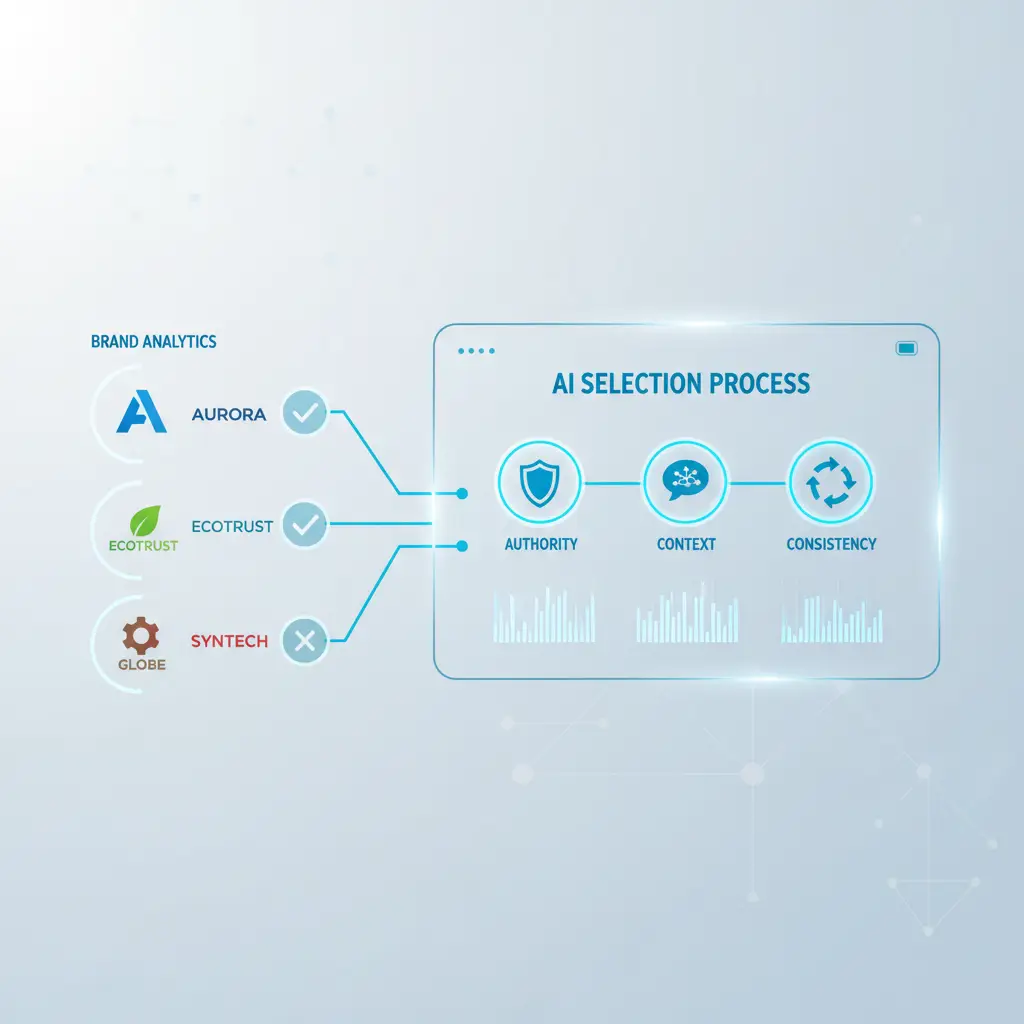
Understanding how AI decides what to recommend can feel like unraveling a mystery. To many founders, marketers, and business leaders, it seems like a complex black box. But if you break it down, AI decision-making is simpler (and more logical) than it appears.
AI-powered assistants like ChatGPT, Perplexity, and Gemini have transformed how users search for, find, and trust information. Instead of just ranking results, these systems strive to deliver contextually relevant and reliable recommendations. And if you’re a brand that wants to show up in these recommendations, it’s crucial to understand how AI makes its decisions.
This blog will demystify the process, explaining how AI answers questions, what signals it evaluates, and why some brands get picked while others remain unseen. More importantly, it’ll show how businesses can use tools like Axis Suite to optimize their visibility, relevance, and trustworthiness in this new AI-first economy.
How AI Answers Questions
Traditional search engines rely heavily on keywords, matching what users type to indexed web pages. AI assistants, on the other hand, take a deeper, more conversational approach to answering questions.
Here’s a simplified step-by-step breakdown of how AI determines its responses:
- Understanding the Question
AI analyzes the user’s query to identify intent. For example, a user asking “What’s the best CRM for small businesses?” is likely looking for a comparative recommendation, not just definitions. - Gathering Relevant Data
AI pulls from multiple sources, including knowledge databases, structured datasets, and real-time internet content. This ensures it considers a wide range of information rather than relying on a single page or platform. - Filtering and Ranking
AI evaluates the available data based on context, relevancy, and trustworthiness. It doesn’t just regurgitate results; it assembles answers based on authority and alignment with user intent.
AI’s overarching goal is not to return “all” possible answers but to recommend the most logical and valuable ones based on the query.
What Signals AI Looks For
Unlike traditional SEO, where keywords and backlinks dominate, AI evaluates a broader set of signals. These signals define which entities (e.g., brands, products, or services) are deemed credible and relevant enough to be recommended.
1. Entities Over Keywords
AI assistants focus on entities, not just standalone words. Entities are things like brands, businesses, products, or any identifiable concepts that AI understands in context.
For example, instead of optimizing solely for the keyword “best CRM,” focus on building authority for being a recognized CRM solution. To do this, your brand must clearly and consistently position itself within its industry.
2. Authority Signals
AI systems value credible sources. Authority signals come from factors like:
- Publishing well-researched, up-to-date content.
- Gaining citations or mentions from other trusted sources.
- Building strong user reviews or endorsements.
Think about it this way: If AI is choosing between two brands, it’ll lean toward the one with deeper industry expertise and broader recognition.
3. Contextual Relevance
AI weighs whether your content is contextually relevant to the query. Specific, actionable answers perform better than general information.
For example, a blog titled “Top 5 CRM Tools for Small Businesses in 2026” is more likely to appear for a specific AI query than a generic article about CRM trends.
4. Cross-Source Consistency
AI checks for consistency across multiple sources. If it finds conflicting data about the same entity, it may lower trust in that entity altogether.
Brands that maintain up-to-date and consistent messaging on their blogs, social media, directories, and third-party reviews send a strong signal of reliability.
5. Structured Data
Technical signals like rich snippets, schema metadata, and FAQs allow AI to better understand and recommend your content. If your website lacks structured data, it becomes harder for AI to place you into relevant conversations.
Why Some Brands Get Picked While Others Don’t
If you’ve been left wondering why certain competitors consistently show up in AI recommendations while your brand doesn’t, here’s why:
Winning Brands…
- Are proactive: They publish content optimized for conversational queries, not just keywords.
- Focus on trust: They invest in credibility through thought leadership, positive reviews, and consistent presence across platforms.
- Leverage smart tools: They use systems that track and improve their visibility in AI-driven ecosystems.
Struggling Brands…
- Rely on outdated methods: They cling to traditional SEO tactics like keyword stuffing or only building backlinks.
- Overlook trust signals: Their lack of external endorsements or reviews undermines credibility.
- Don’t adapt fast enough: They fail to measure or respond to shifts in how AI systems understand their business.
The bottom line? AI recommends brands that stand out as reliable sources of value. Businesses that fail to communicate authority and relevance risk being invisible to these systems.
The Bridge to AI-Optimized Discovery
This is where Axis Suite comes in.
Axis Suite was built to solve the challenges of modern AI discovery, enabling businesses to not only measure, but actively improve the factors that lead to AI recommendations.
Here’s how it works:
- PulseAxis
Monitors your brand’s visibility across AI platforms like ChatGPT, Claude, Perplexity, and Gemini. It identifies gaps in your authority signals, consistency, and AI ad readiness. - TrendAxis
Discovers emerging trends before they hit the mainstream, giving businesses an edge in creating relevant, timely content that aligns with user intent. - SparkAxis
Turns insights into action by connecting visibility improvements directly to campaigns and execution. It ensures you’re always moving the needle. - AxisGoals
Ties these activities back to outcomes, showing you how discovery enhances measurable business priorities like leads, conversions, and brand growth.
Why it matters:
Axis Suite bridges the gap between how AI makes decisions and how brands can influence those decisions in their favor.
The New Playbook for Business Discovery
AI decision-making isn’t magic, and success isn’t a matter of chance. It’s about positioning your brand within the specific signals that AI values most.
Here’s how to start optimizing today:
- Audit your current AI visibility with tools like PulseAxis.
- Build trust signals through consistent, high-quality content.
- Ensure your messaging is clear, structured, and contextually relevant.
- Adapt proactively by tracking emerging trends and aligning your strategy.
AI favors structure, clarity, and credibility. Brands that align with these principles will thrive, while those that stick to outdated tactics will fade into obscurity.
And here’s the bridge:
This is exactly what Axis Suite measures and improves.
If your goal is to unlock visibility, grow as a trusted entity, and stay ahead in an AI-driven world, now’s the time to rethink your approach.
The choices AI makes are logical. With the right structure, insights, and strategies, you can make sure your brand is always part of the conversation. Curious where you stand? Reach out today to explore how Axis Suite can help.