Understanding How AI Systems Recommend Businesses
Search engines helped people find information by ranking pages.
AI assistants are changing how discovery works.
Instead of presenting a list of links, systems like ChatGPT, Gemini, and Perplexity often generate direct answers and recommendations. When someone asks for tools, services, or solutions, the AI evaluates available information and chooses which businesses to include.
For organizations, this creates a new challenge.
It is no longer enough to rank well in search results. Businesses must also understand how AI systems decide which companies to recommend in generated answers.
This emerging discipline is what we call AI Discovery Intelligence.
What Is AI Discovery Intelligence?
AI Discovery Intelligence is the study and measurement of how AI systems understand, evaluate, and recommend businesses across the web.
Rather than focusing only on rankings or citations, AI Discovery Intelligence looks at the entire process through which AI systems build confidence in entities and decide whether to include them in responses.
This process is increasingly shaping how people discover products, services, and expertise online.
The AI Discovery Intelligence Framework
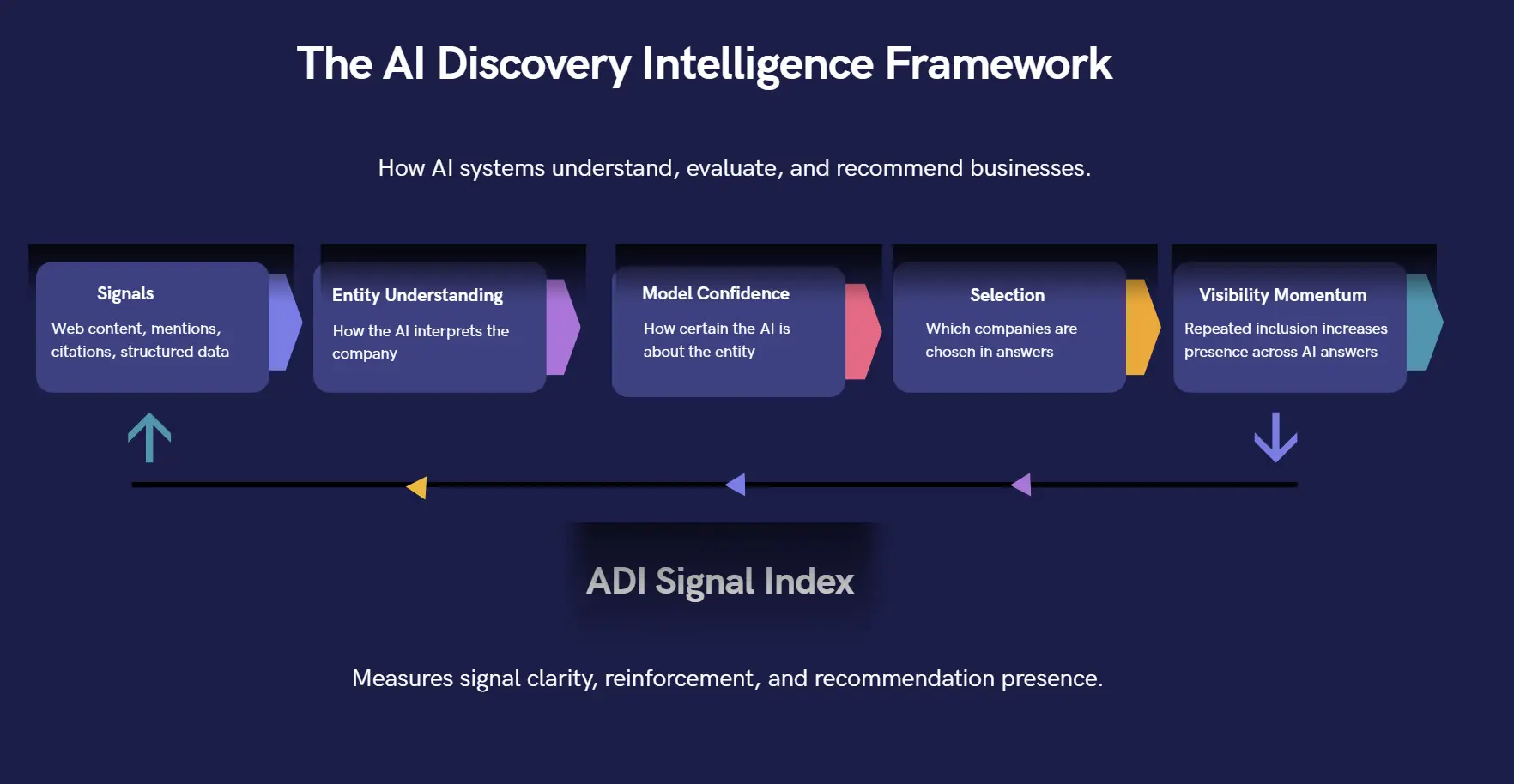
The AI Discovery Intelligence Framework describes the stages AI systems move through when selecting businesses to recommend.
The process begins with signals and moves through interpretation, confidence building, and selection.
1. Signals
Signals are the pieces of information AI systems gather from across the web.
These signals include:
- website content
- mentions across the internet
- citations in articles and directories
- structured data and metadata
- reviews and commentary
These signals form the raw material AI systems use to understand entities.
2. Entity Understanding
Once signals are gathered, the AI attempts to interpret what the company actually is.
This stage answers questions such as:
- What category does this company belong to?
- What does the business do?
- Who does it serve?
- How does it compare to similar companies?
If the signals describing a business are inconsistent or unclear, the AI may struggle to build a reliable understanding of the entity.
3. Model Confidence
After interpreting the entity, the AI builds confidence in that understanding.
Confidence increases when signals are:
- consistent across sources
- reinforced by multiple references
- aligned in how they describe the business
When the AI sees repeated, consistent signals about an entity, it becomes more confident that its interpretation is correct.
4. Selection
When a user asks a question, the AI must decide which entities to include in its answer.
This is the selection moment.
Instead of showing a list of links, the AI chooses a limited number of companies or resources to mention.
This means many businesses may have relevant information available online but are never selected in the final response.
Understanding how this selection process works is one of the central challenges of AI discovery.
5. Visibility Momentum
One of the most important dynamics in AI discovery is what we call Visibility Momentum.
When a business begins appearing in AI-generated answers, that repeated presence reinforces the model’s confidence in the entity.
Over time, the system becomes more likely to include that company again.
This creates a compounding effect.
Companies that are frequently selected continue gaining visibility, while those rarely selected may remain largely absent from AI answers.
This momentum effect explains why some organizations begin appearing repeatedly across AI responses while others remain invisible despite similar offerings.
Measuring AI Discovery: The ADI Signal Index
To better understand how organizations perform within this system, the AI Discovery Intelligence Framework includes a measurement layer called the ADI Signal Index.
The ADI Signal Index evaluates the strength of signals that influence AI discovery, including:
- signal consistency across sources
- clarity of entity positioning
- reinforcement from credible references
- differentiation from competitors
- presence in AI-generated recommendations
Together, these indicators help organizations understand whether the signals surrounding their business support or hinder AI selection.
Why AI Discovery Intelligence Matters
AI-driven discovery is changing how buyers research products and services.
Instead of browsing multiple websites, users increasingly ask AI assistants for direct recommendations.
This shift means that businesses must consider not only how they rank in search engines but also how they are interpreted and evaluated by AI systems.
Organizations that understand this process can begin to measure and influence their presence in AI-driven discovery environments.
Those that do not may find that their competitors become the entities AI systems consistently recommend.
The Future of AI Discovery
AI assistants will continue to evolve, and the systems that select and recommend businesses will become more sophisticated.
Understanding the signals that influence those decisions will become increasingly important.
AI Discovery Intelligence provides a framework for studying and measuring that process.
By examining signals, entity understanding, model confidence, selection behavior, and visibility momentum, organizations can begin to understand how AI systems evaluate the businesses they recommend.
About the Framework
The AI Discovery Intelligence Framework and the ADI Signal Index were developed as part of the Axis Suite research initiative exploring how AI systems interpret entities and generate recommendations across the web.
The goal of this research is to help organizations better understand how AI-driven discovery works and how businesses can adapt to this new environment.