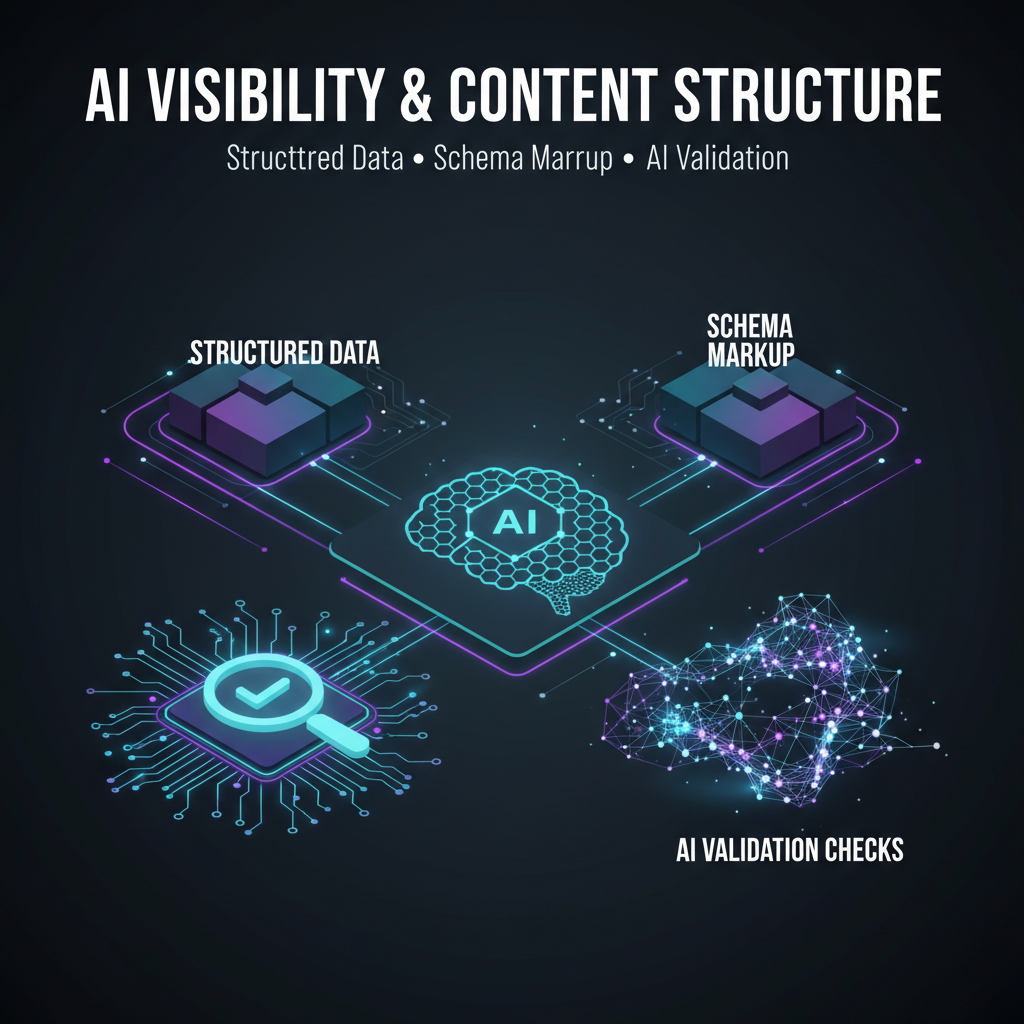
Imagine this scenario: Your business produces high-quality content, boasts a beautifully designed website, and consistently engages audiences across platforms. Yet, when AI platforms like ChatGPT, Claude, or Gemini process user queries, your business doesn’t show up—not even once.
Why? Because your business might be invisible to AI. Not because your content isn’t good, but because AI can’t validate who you are.
This post will break down why AI visibility matters, what it means for your business, and, more importantly, how you can fix it.
What Is AI Visibility, and Why Does It Matter?
AI visibility refers to how well artificial intelligence systems, like conversational agents or recommendation algorithms, can recognize, understand, and validate your business’ identity and content. Think of it as the digital equivalent of a credit score for being “findable” by AI.
Why does this matter? Because people are increasingly relying on AI systems for recommendations and decision-making. Whether someone is asking ChatGPT for the best product in your industry, querying Claude for business services, or interacting with AI-powered search engines, your visibility within these systems determines whether your brand becomes part of the conversation.
Need proof? Recent real-world scans show concerning results:
- 0 mentions across major AI platforms
- 0/100 visibility score
- 0% share of voice
These aren’t signs of flawed content or a lack of effort. Instead, the problem lies in structure, signaling, and consistency.
How AI Validates Businesses (and Why You May Be Overlooked)
AI platforms don’t rank pages the way traditional search engines do. Instead, they validate patterns. They’re more interested in checking reliability factors to ensure recommendations are accurate, consistent, and trustworthy. Before an AI system recommends your business, it looks for the following:
1. JSON-LD (JavaScript Object Notation for Linked Data)
JSON-LD is a structured data format that helps AI systems clearly identify entities like organizations, products, or people. Without this data, an AI doesn’t understand the context or relevance of your content, leading to ambiguity.
2. Schema Markup
Schema markup helps search engines and AI systems understand what your content is about. For example, if you offer SaaS solutions, schema ensures AI recognizes your role in that industry.
3. Clear Heading Structure
AI reads headings (H1, H2, H3) to understand the organization of your content. If your header hierarchy is inconsistent or unclear, you risk confusing the system.
4. Consistent Descriptions Across Platforms
AI often cross-references multiple sources to verify content. If your business description on LinkedIn doesn’t match your website or other platforms, AI won’t recommend you because of perceived inconsistencies.
5. Third-Party Mentions
Mentions and backlinks from credible, relevant sources boost trust. AI treats these as digital endorsements, validating your authority and expertise.
6. Machine-Readable Facts
Quick, structured snippets (such as “About” sections or FAQ blocks) simplify AI’s ability to extract key information. Ambiguous language or lack of these blocks makes it harder for AI to identify relevant details.
When these foundational elements don’t line up, AI errs on the side of caution. And that often means ignoring your business entirely.
Steps to Improve Your AI Visibility
If your business doesn’t appear on AI platforms, don’t panic. You can make systematic changes to ensure better visibility. Here are actionable steps you can take to address common visibility issues:
1. Optimize Your JSON-LD Implementation
Help AI frameworks understand your brand by implementing clean, accurate JSON-LD. Use tools like Google’s Structured Data Testing Tool to ensure your JSON-LD scripts are functioning properly. Elements to include:
- Organization name
- Logo and contact information
- Social links
- Products or services offered
2. Use Effective Schema Markup
Add schema that aligns with your industry. For example:
- LocalBusinesses: Provide location details if you operate physical stores.
- Article Schema: Tag your blogs and resources to help AI process your published content.
- Product Schema: Ensure product details like pricing and availability are clearly outlined.
3. Clean Up Your Header Hierarchy
Audit your content to ensure proper header tagging (e.g., H1 for primary topic, H2 for subtopics). Clear, organized headings make it easier for AI to process your information logically.
4. Ensure Platform and Content Alignment
Upload consistent descriptions across platforms like LinkedIn, your website, and industry directories. Conflicting profiles sow doubt in AI evaluation systems, reducing the chances of showing up in recommendations.
5. Improve Credibility with Third-Party Mentions
Look for strategic collaborations to improve your credibility. Get your business mentioned by thought leaders, blogs, or industry influencers to boost third-party validation.
6. Add AI-Readable Quick Facts
Populate FAQ sections, “About Us” boxes, or feature cards with machine-readable content. Tools like FAQPage schema are especially helpful for structuring these snippets.
7. Leverage LLMS.txt
Introduce a LLMS.txt file to guide AI systems on which parts of your website to reference or avoid, improving your content’s clarity and integrity. Follow similar principles to creating robot.txt files.
A Real Example of Problem-Solving
Here’s what implementing these changes might look like:
- Before: A business has no visible JSON-LD or schema markup. Its FAQ sections are written in paragraphs rather than easily extractable bullet points.
- After: JSON-LD markers clearly identify the business’ name, location, and offerings. FAQ blocks utilize structured formats, and third-party directories list the company consistently. Within weeks, the brand starts appearing in recommendations from AI systems.
What Happens If You Do Nothing?
If you don’t address AI visibility issues, your business will remain effectively invisible in AI-powered recommendations. Even producing stellar content won’t help if AI can’t confirm your identity or validate your relevance.
Without proper adjustments:
- Customers asking AI for industry recommendations will never hear your name.
- Competitors with optimized systems will dominate the visibility landscape.
- Your hard work will result in diminishing ROI as AI-powered decision-making becomes the norm.
Take Action Today
AI visibility is no longer optional; it’s a business necessity. Ensuring your structure, signals, and content alignment are optimized puts you ahead of the curve. The time to act is now.
If you want an AI visibility baseline scan for your business, send your URL or comment “SCAN” to hello@axissuite.ai. At Axis Suite we’re here to help you uncover visibility roadblocks and achieve sustainable, long-term impact.