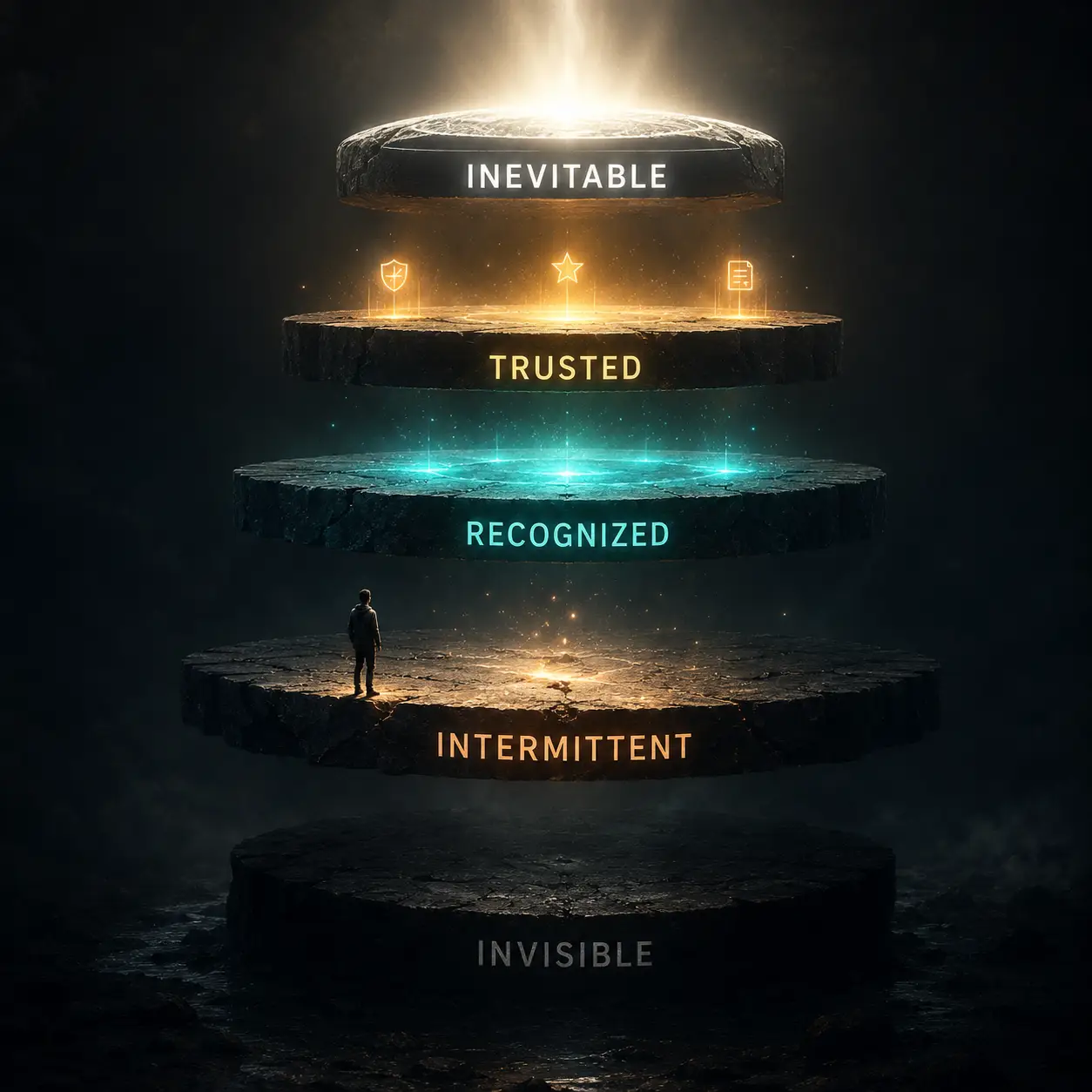
If recommendation is accumulated confidence, then every brand is somewhere on a curve.
At one end is invisible. AI cannot find you, cannot describe you, does not know you exist. At the other end is inevitable. AI remembers you as the category answer and keeps recommending you through every model update, evidence shift, and competitive change.
Most brands are closer to the invisible end than they believe. Research from AirOps found that only 30% of brands maintain consistent visibility across AI sessions. Seven in ten flicker in and out depending on the prompt, the platform, and the day.
That gap between where brands believe they are and where they actually are is why a maturity model is necessary. Not another framework. A mirror.
Level 1: Invisible (The Retrieval Layer)
AI cannot reliably find or recognize your brand. Ask ChatGPT, Claude, Gemini, or Perplexity about your category and you are simply not in the answer set.
Most brands at this level do not know they are here. They assume that having a website and publishing content means they are visible. But retrieval does not care about your website. It cares whether AI crawlers can access, parse, and categorize your content.
The most common causes of invisibility are structural. Client-side rendered websites that serve empty HTML to AI crawlers. Robots.txt configurations that block AI user agents. Server settings that reject automated requests. Each of these makes a brand completely invisible regardless of content quality.
The fix at this level is purely engineering. Confirm AI crawlers can access your pages. Test by asking each AI platform to describe your homepage. If they cannot, nothing else matters until this is fixed.
Level 2: Intermittent (The Recommendation Layer)
You show up sometimes. On ChatGPT but not Perplexity. For the broad prompt but not the specific one. You survive the first question but fall out when the buyer adds constraints.
This is where the 30% consistency statistic lives. Most companies that believe they are visible are actually here. They can find themselves in AI answers if they try enough prompts, but they do not appear reliably across platforms, queries, or sessions.
Intermittent visibility means AI has some retrieval confidence but not enough recommendation confidence to include you consistently. The evidence it has about your brand is sufficient for occasional inclusion but not strong enough to survive competition from brands with more consistent signals.
The fix at this level is building recommendation consistency across platforms. Ensure your category language is consistent across your website, directory listings, and third-party profiles. Close evidence gaps that cause some platforms to include you and others to skip you.
Level 3: Recognized (The Narrative Layer)
You are consistently included in AI answers, but the story is uneven. One platform frames you accurately. Another describes a capability you retired a year ago. A third misses the thing you are actually best at.
Being recommended for the wrong reason attracts the wrong buyer. That is its own kind of invisibility because the recommendation does not convert.
At this level, retrieval works and recommendation is consistent, but narrative confidence is uneven. AI has formed beliefs about your brand but those beliefs are not accurate across all platforms.
The fix at this level is narrative alignment. Audit how each AI platform describes you. Identify where descriptions are inaccurate or outdated. Trace the inaccuracy to specific sources AI is drawing from. Update those sources with consistent, current positioning language.
Level 4: Trusted (The Evidence Layer)
Now the recommendation is corroborated. Independent sources agree with the story your brand tells about itself. G2 reviews, analyst mentions, comparison articles, and customer testimonials from third-party platforms all reinforce the same positioning.
This matters more than most teams realize. Research from Ahrefs found that brand mentions correlate roughly three times more strongly with AI visibility than backlinks. Research from Muck Rack found that 82% of AI citations come from earned media and only 6% from paid or owned content.
Trust is built off your property, not on it. The brands at this level have invested in evidence outside their own website: review generation campaigns, analyst relations, comparison content presence, and customer advocacy programs.
The fix at this level is systematic evidence building. Identify where competitors have independent corroboration that you lack. Close those evidence gaps with targeted investments in the sources AI trusts most.
Level 5: Inevitable (The Memory Layer)
AI durably remembers you as the category answer and keeps recommending you through model updates, evidence shifts, and new competitors. You persist across sessions and platforms. You are not winning a prompt. You are holding a belief.
This is the level almost no one occupies. It requires accumulated confidence across all five layers: accessible content, consistent inclusion, accurate narrative, corroborated evidence, and durable memory. Each layer reinforces the others in a compounding cycle.
The brands at this level did not get here with one campaign or one fix. They built each layer systematically over time. They fixed retrieval first, then built recommendation consistency, then aligned their narrative, then invested in evidence, and then maintained all four through ongoing attention and adaptation.
Reaching Level 5 is not a destination. It is a maintenance discipline. The brands that stop maintaining their evidence, updating their content, and monitoring their narrative will eventually drift back down the curve as competitors advance and models update.
The Uncomfortable Truth
Most organizations rank themselves two levels higher than they actually are.
The 30% consistency number is not a story about other people. It is a statement about how far the gap runs between “we publish content” and “AI reliably recommends us.”
The only way to know your actual level is to test it. Ask ChatGPT, Claude, Gemini, and Perplexity about your category. Do you appear at all? Do you appear consistently? Is the description accurate? Does independent evidence support it? Do you persist through follow-up questions and model changes?
Where your brand drops out tells you which level you are actually on. And the level tells you what to work on next.
Frequently Asked Questions
What is the AI Visibility Maturity Model?
A five-level framework that maps where a brand stands on the journey from invisible (AI cannot find you) to inevitable (AI remembers you as the category answer through every update). Each level corresponds to a layer of accumulated confidence: retrieval, recommendation, narrative, evidence, and memory.
Why do most brands overestimate their maturity level?
Because finding yourself in one AI answer on one platform can feel like visibility. But research shows only 30% of brands maintain consistent visibility across sessions. Appearing sometimes is Level 2 (Intermittent), not Level 4 (Trusted). The gap between occasional appearance and reliable recommendation is larger than most teams realize.
How do I determine my actual maturity level?
Test across all four major platforms (ChatGPT, Claude, Gemini, Perplexity). Ask about your category. If you do not appear, you are Level 1. If you appear inconsistently, Level 2. If you appear consistently but are described unevenly, Level 3. If independent sources corroborate the recommendation, Level 4. If you persist through model updates and changing queries, Level 5.
Can I skip levels?
Typically no. Each level builds on the previous one. Fixing narrative accuracy (Level 3) requires that recommendation consistency (Level 2) is already working. Building evidence corroboration (Level 4) requires that narrative accuracy (Level 3) is already in place. Attempting to build Level 4 evidence while Level 1 retrieval is broken produces no results.
How long does it take to move between levels?
Level 1 to Level 2 can happen in days if the fix is structural (crawlability). Level 2 to Level 3 typically takes weeks as category alignment propagates. Level 3 to Level 4 takes weeks to months as independent evidence accumulates. Level 4 to Level 5 is an ongoing process measured in quarters as memory durability is tested through model updates.
Is Level 5 permanent?
No. AI systems update constantly. A brand at Level 5 that stops maintaining its evidence, updating its content, or monitoring its narrative will eventually drift down as competitors advance and models recalibrate. Inevitable is a maintenance discipline, not a permanent achievement.
Start here: axissuite.ai
Axis Suite by TrendAxis