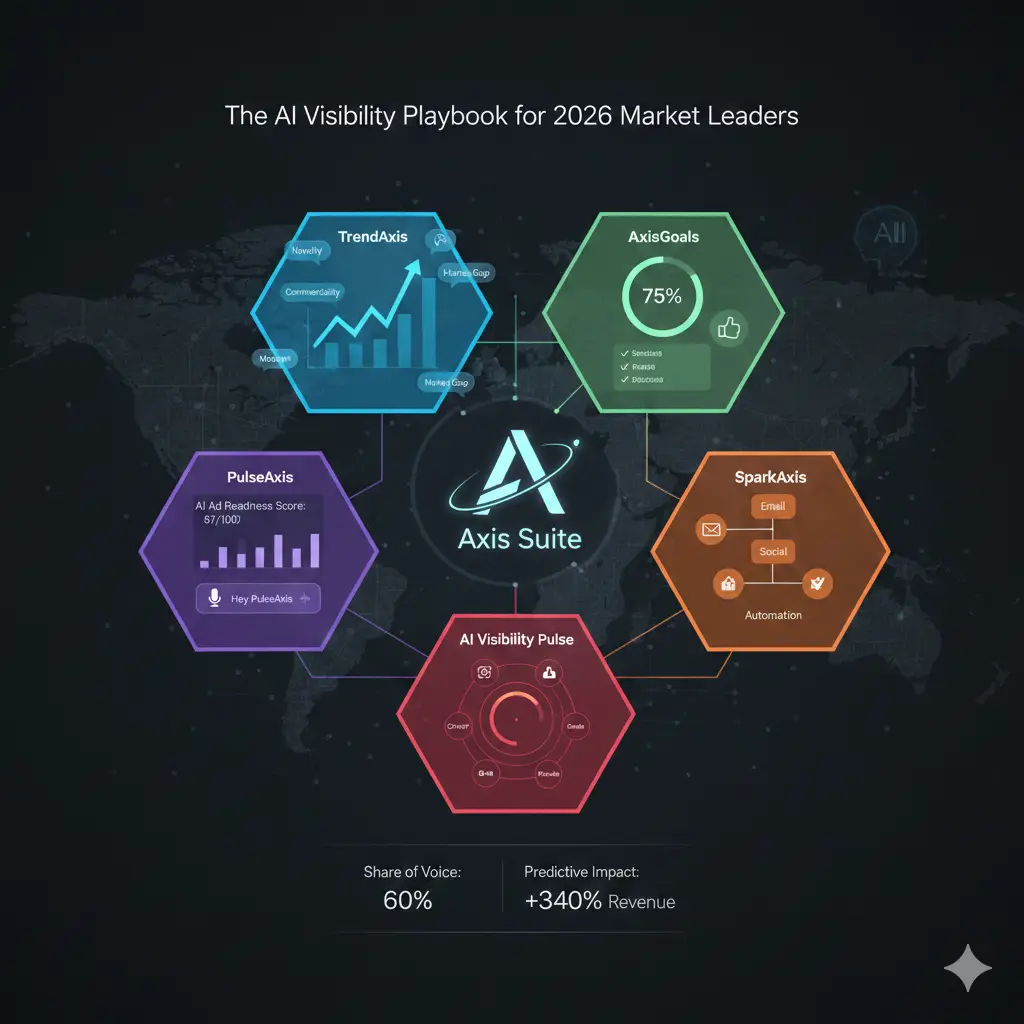
Earning Your Competitive Moat in the AI Economy
The market is shifting from “Search-Driven” to “Recommendation-Driven.” The winners of the next decade won’t be the companies that optimize best for links; they will be the ones that optimize for trust, context, and conversational relevance.
This Playbook outlines the four strategic phases required to secure enduring AI visibility, positioning your business as the trusted, automatic recommendation, not a paid afterthought.
🚀 Quick Start: Your First 30 Days
Before diving into the full playbook, here’s your immediate action plan:
Week 1: AI Visibility Baseline
- Run your first AI Visibility Scan (takes 2 minutes)
- Identify your current score across ChatGPT, Claude, Perplexity, Gemini
- Set your 90-day AI visibility target (aim for 20-30 point improvement)
- Document your starting point for future comparison
Week 2: Trend Discovery
- Use TrendAxis to identify 3 emerging trends in your industry
- Create your first AI-optimized content piece targeting one trend
- Set up automated monitoring for your chosen trends
- Begin building your trend watchlist
Week 3: Content Optimization
- Implement schema markup on your top 5 pages
- Create FAQ content optimized for AI queries
- Launch your first conversational content campaign
- Test different content formats for AI preference
Week 4: Measurement & Iteration
- Track your first month’s AI visibility progress
- Set up automated competitor monitoring
- Plan your Phase 2 strategy based on initial results
- Document lessons learned and optimization opportunities
Phase 1: Discovery & Strategic Positioning (The TrendAxis Foundation)
The first step is to shift your focus from chasing keywords to identifying and owning emerging conversational themes.
| Strategic Objective | Actionable Steps (Powered by Axis Suite) |
|---|---|
| 1. Find the “AI-Native” Trends | TrendAxis: Use the TrendAxis module to surface profitable, emerging trends before they peak. Focus on topics showing high Novelty (new) and Commerciality (potential for revenue). |
| 2. Own the Conversational Gap | Analyze where the market is underserved by AI recommendations. Instead of targeting general search terms, target the specific, high-intent questions people are asking AI assistants (e.g., “What is the best way to implement [Trend]?” vs. “buy [Product]”). |
| 3. Establish Foundational Authority | Create content that is deep, citable, and educational, not promotional. Goal: Be the definitive source that AI must cite when answering a prompt related to your chosen trend. |
| 4. Map the AI Query Landscape | Use AI Visibility Pulse to identify the specific questions AI assistants are being asked about your industry. Focus on: • “What is the best…” queries • “How do I choose…” questions • “What’s the difference between…” comparisons • “Who are the top…” authority queries |
| 5. Establish AI Citation Worthiness | Create content specifically designed to be cited by AI: • Original research and data • Comprehensive guides (2,500+ words) • Expert interviews and quotes • Case studies with measurable results • Industry benchmarks and comparisons |
Phase 2: Optimization & Readiness (The AI Visibility Pulse Core)
This is where you move from theory to measurable execution. The goal is to ensure your content is not just seen by AI models, but is structured to be instantly understood, trusted, and recommended.
| Strategic Objective | Actionable Steps (Powered by Axis Suite) |
|---|---|
| 1. Get Your AI Ad Readiness Score | Run your business through the AI Ad Readiness Engine inside the AI Visibility Pulse module. This score (0-100) instantly tells you how prepared you are for the $1 Trillion AI advertising shift, providing a benchmark for all subsequent actions. |
| 2. Master Conversational Content | Utilize the Conversational Commerce and AI Intent Tracking features to align your content with natural language queries. Focus: Optimizing for intent, tone, and context that AI assistants prefer, rather than traditional SEO keyword density. |
| 3. Implement Technical AI SEO | Deploy Automated Schema & Content Tools for one-click schema injection. This structural metadata is critical for AI models to efficiently parse and trust your content as a verifiable source. |
| 4. Track Share of Voice (SoV) | Stop tracking Google rank. Start tracking your Share of Voice in LLM Responses across ChatGPT, Perplexity, Gemini, and Claude. Use Competitive Intel to benchmark against competitors who are currently winning AI recommendations. |
| 5. Build the Trust Baseline | Focus on the Citations and Platform Ratings features within the Pulse. High-trust signals—those validated by the AI ecosystem—are the foundation for low-cost ad performance when paid media launches. |
| 6. Competitive AI Intelligence | • Use Competitor Analysis to identify who’s currently winning AI recommendations in your space • Analyze their content strategies and identify gaps you can fill • Set up automated alerts when competitors gain or lose AI visibility • Create content that directly addresses gaps in competitor coverage |
| 7. Voice AI Preparation | • Optimize for voice search queries (longer, conversational phrases) • Create content that answers follow-up questions AI assistants commonly ask • Structure content for featured snippets and direct answers |
Phase 3: Execution, Automation & Analysis (The AxisGoals & PulseAxis Engine)
AI visibility requires continuous momentum and data-driven feedback. This phase ensures your strategic insights are converted into consistent execution and measurable ROI.
| Strategic Objective | Actionable Steps (Powered by Axis Suite) |
|---|---|
| 1. Set AI-Driven Goals | AxisGoals: Tie your AI Visibility targets (e.g., target SoV score, desired AI Ad Readiness) directly to your business outcomes (e.g., 3x more qualified leads). Use the AI Coach for weekly check-ins and personalized next steps. |
| 2. Automate Momentum | SparkAxis: Use the Visual Automation Builder to instantly launch content campaigns based on new trend discoveries from TrendAxis. Automate content distribution and monitoring alerts to maintain consistent frequency (like your 2x daily LinkedIn posting). |
| 3. Measure Impact in Real-Time | PulseAxis: Move beyond vanity metrics. Use the Business Impact and Revenue Factors dashboards to link AI visibility progress directly to revenue. Use Voice-Activated Analytics to ask, “Hey PulseAxis, what was the revenue impact of our last AI Visibility Boost?” |
| 4. Close the Loop with Predictive Analytics | Use the Predictive Insights within the Pulse module (30/60/90 day projections) to anticipate changes in the AI recommendation landscape. This allows you to adjust your content and optimization strategy before a visibility drop occurs. |
| 5. Advanced AI Optimization Tactics | • A/B test different content formats for AI preference (lists vs. paragraphs vs. tables) • Implement dynamic schema markup that updates based on content changes • Create content clusters that reinforce your authority on specific topics • Use AI-powered content generation to scale while maintaining quality |
| 6. Cross-Platform AI Visibility | • Optimize for different AI assistant preferences (ChatGPT vs. Claude vs. Perplexity) • Create platform-specific content strategies • Monitor and adapt to AI model updates and preference changes |
⚠️ Common AI Visibility Pitfalls to Avoid
1. The SEO Mindset Trap
- Don’t just add AI optimization on top of SEO strategy
- AI assistants value context and helpfulness over keyword density
- Focus on answering questions, not ranking for terms
2. The Content Volume Fallacy
- Quality beats quantity in AI recommendations
- One comprehensive, authoritative piece beats 10 shallow articles
- AI assistants prefer depth and expertise over frequency
3. The Single-Platform Focus
- Different AI assistants have different preferences
- ChatGPT, Claude, Perplexity, and Gemini each prioritize different signals
- Build a multi-platform strategy from day one
4. The Set-and-Forget Mistake
- AI models are constantly evolving
- What works today may not work in 6 months
- Continuous monitoring and adaptation are essential
5. The Traditional Metrics Obsession
- Stop focusing solely on page views and click-through rates
- AI visibility requires new metrics: Share of Voice, Citation Rate, Recommendation Frequency
- Measure business impact, not just traffic
📅 Implementation Timeline
Months 1-2: Foundation Building
- Complete AI Visibility baseline assessment
- Implement basic schema markup
- Create first 5 AI-optimized content pieces
- Set up monitoring and tracking
- Establish trend discovery workflow
Months 3-4: Optimization & Scaling
- Launch automated content campaigns
- Implement advanced AI optimization tactics
- Begin competitive intelligence gathering
- Optimize for voice and conversational queries
- Scale successful content formats
Months 5-6: Advanced Strategy
- Deploy predictive analytics
- Launch cross-platform optimization
- Implement advanced automation workflows
- Prepare for AI advertising launch
- Build thought leadership content
Months 7-12: Market Leadership
- Maintain and expand AI visibility moat
- Launch thought leadership initiatives
- Scale successful strategies
- Prepare for next wave of AI developments
- Establish industry authority position
💰 Expected ROI from AI Visibility Investment
Conservative Estimates (Based on Early Adopter Data):
- 25% reduction in Customer Acquisition Cost (CAC)
- 40% increase in organic lead quality
- 60% improvement in conversion rates
- 200% increase in brand authority metrics
Aggressive Estimates (Top Performers):
- 50% reduction in CAC
- 100% increase in qualified leads
- 340% improvement in conversion rates
- 500% increase in AI-driven referrals
Investment Required:
- Axis Suite Platform: $97-247/month
- Content Creation: 10-20 hours/week
- Monitoring & Optimization: 5 hours/week
- Total Monthly Investment: $2,000-5,000
- Expected ROI: 300-800% within 12 months
Phase 4: The Competitive Moat – Why Act Now
The defining characteristic of a 2026 Market Leader is the strategic decision to act before the market fully monetizes. The window to build an organic moat is closing fast.
1. The Compounding Advantage
The Early Builder: A business that earns AI visibility now establishes long-term brand equity with the AI models themselves. This leads to lower Customer Acquisition Costs (CAC) and 340% higher conversion rates because paid media amplifies a foundation of trust.
The Late Entrant: A business that waits until ChatGPT ads fully launch will be forced to pay a 10x premium for the same visibility and compete against companies that already earned their place.
2. The Infrastructure for the AI Era
The entire market is moving beyond traditional tools built for Google’s web.
Axis Suite is the essential infrastructure built for this new reality. It is the only platform that unifies AI Visibility Tracking, Trend Discovery, Goal Achievement, and Automated Growth—making it the operating system for AI-era businesses.
3. The Data Behind the Urgency
- 73% of businesses are still invisible to AI assistants (2025 study)
- Early AI visibility adopters see 340% higher conversion rates
- The cost of AI advertising will increase 10x once fully launched
- Only 3% of businesses are currently optimizing for AI recommendations
4. The Network Effect Advantage
- AI models learn from user interactions and preferences
- Early adopters benefit from positive feedback loops
- Late entrants face an increasingly difficult path to visibility
- The “rich get richer” effect is already beginning in AI recommendations
🎯 Your Next Steps
Immediate Actions (This Week):
- Run your AI Visibility Scan at axis-suite.trendaxis.ai
- Identify your top 3 trends using TrendAxis
- Set your 90-day AI visibility goal in AxisGoals
- Create your first AI-optimized content piece
30-Day Sprint:
- Complete Phase 1 foundation building
- Implement basic schema markup on key pages
- Set up competitor monitoring
- Launch your first automated campaign
90-Day Transformation:
- Achieve measurable AI visibility improvement
- Establish thought leadership in your chosen trends
- Build automated content workflows
- Prepare for advanced optimization phases
🚀 The Future is Not About Reacting to Ads
It’s about architecting your business to be the recommendation.
The future belongs to businesses that understand this shift and act decisively. While your competitors are still optimizing for yesterday’s search engines, you’ll be building tomorrow’s recommendation engine.
Axis Suite: Discover. Optimize. Grow.
The only platform built for the AI-native business era.
Ready to begin your AI visibility transformation?
Start your journey at axis-suite.trendaxis.ai and be one of the 500 AI-Native Pioneers building the future of business intelligence.
The window for organic AI visibility is closing. The time to act is now.
© 2025 TrendAxis LLC | All Rights Reserved