There is a growing gap in marketing measurement that most teams do not know exists.
It is not a data quality problem. It is not a tracking configuration problem. It is not a technology gap that a new tool can close.
It is a structural gap created by the way AI systems now influence buying decisions before any marketing dashboard can see them.
The Invisible Buyer Journey
Traditional marketing attribution works because the buyer journey produces data at every step.
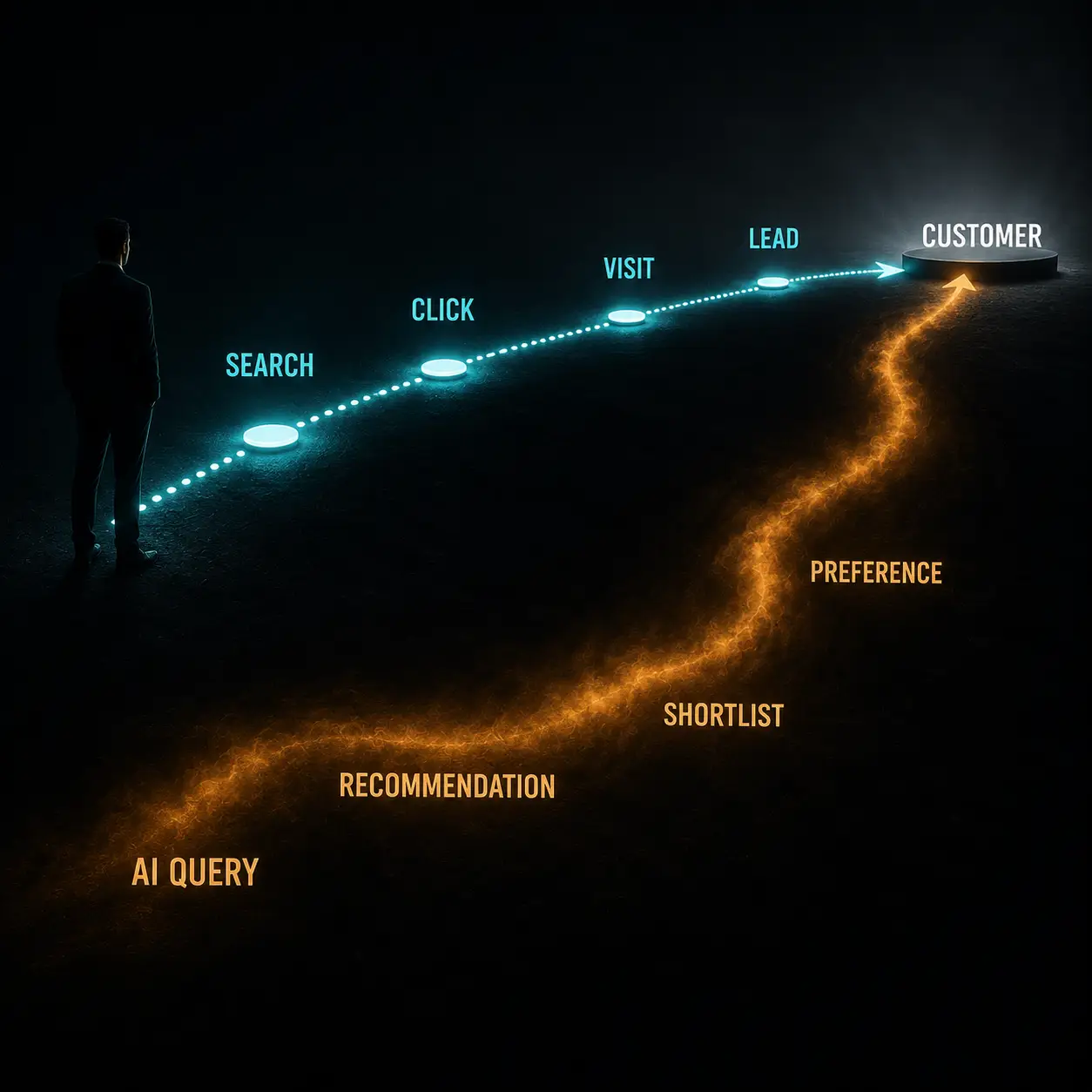
A buyer searches on Google. That produces a search query. They click a result. That produces a click event. They visit your website. That produces a session. They fill out a form. That produces a lead. Marketing traces the path backward from lead to click to query to channel and attributes the conversion.
Every step is visible. Every touchpoint is tracked. The entire journey lives on a dashboard.
AI introduces a step that produces no data at all.
A buyer asks ChatGPT to recommend platforms in your category. ChatGPT evaluates the evidence it has about your brand and your competitors. It builds a shortlist. The buyer reviews the shortlist. They form a preference. Then they open Google, type your brand name, and visit your website.
Marketing sees a branded search visit. The attribution model credits brand awareness. The quarterly report says brand marketing is working.
But the actual influence was an AI conversation that happened 20 minutes earlier. No click was generated. No referral source was captured. No campaign data was recorded. The AI conversation is invisible to every analytics tool the marketing team uses.
That invisible step is the attribution gap.
Why the Gap Is Growing
Three factors are making the attribution gap wider every quarter.
The first is adoption. More buyers are starting their research inside AI conversations. ChatGPT, Claude, Gemini, and Perplexity are becoming the first stop for vendor research, category exploration, and shortlist building. Every buyer who starts with AI instead of Google creates an attribution gap event.
The second is sophistication. AI recommendations are becoming more specific and more influential. Two years ago AI might return a generic list of vendors. Today AI builds evaluation frameworks, structures comparisons, and recommends specific solutions for specific use cases. The influence is deeper, which means the attribution gap is more consequential.
The third is platform fragmentation. A buyer who researches on ChatGPT gets different recommendations than one who uses Claude, Gemini, or Perplexity. Semrush’s 2026 AI Visibility Index found that ChatGPT cites approximately 15 sources per answer while Gemini cites approximately 3. Only 36 brands hold top-100 visibility across all four platforms. The influence surface is fragmented in ways traditional attribution cannot map.
What the Gap Looks Like in Practice
The attribution gap shows up in marketing data as patterns that are easy to misread.
Branded search increases without a clear cause. Marketing attributes it to brand awareness campaigns. But the actual driver may be AI recommendations that send buyers to Google to verify what AI told them.
Direct traffic grows from unknown sources. Marketing reports increased direct visits but cannot explain the origin. The origin may be AI conversations where buyers heard about your brand and typed your URL directly.
Pipeline quality improves but marketing cannot explain why. Leads convert at higher rates. Sales cycles shorten. But marketing cannot point to a specific campaign or channel that caused the improvement. The cause may be that AI pre-qualified buyers before they ever reached your website.
Competitor wins increase without visible competitive pressure. Deals that your team expected to close go to a competitor. No competitive intelligence explains the shift. But the shift may have happened because the competitor is recommended more consistently by AI platforms your buyers are using.
Each of these patterns has a traditional explanation. And each one may actually be driven by AI influence that no dashboard can detect.
The Measurement Problem
The attribution gap is not a problem that existing tools can solve by adding a new integration.
Traditional attribution tools measure touchpoints. Every interaction that produces a click, a visit, a form fill, or a conversion is a touchpoint. Attribution models distribute credit across touchpoints.
AI influence does not produce touchpoints. It produces beliefs. A buyer who asks ChatGPT for recommendations walks away with a belief about which brands are worth evaluating. That belief shapes every subsequent action. But the belief itself is not a trackable event.
This is why 45% of marketing leaders still cannot accurately measure AI visibility according to Semrush’s 2026 research. The measurement infrastructure was built for a world where influence produces data. AI influence produces decisions without producing data.
What CMOs Should Measure Instead
The attribution gap does not mean AI influence is unmeasurable. It means the measurement approach needs to change.
Instead of tracking touchpoints, measure recommendation presence. How often does your brand appear when buyers ask ChatGPT, Claude, Gemini, and Perplexity about your category? That baseline tells you whether AI is creating positive or negative influence before the dashboard.
Instead of attributing backward from conversions, diagnose forward from AI behavior. Which platforms recommend you? At what confidence level? For which specific queries? Against which competitors? That diagnostic data explains the influence your attribution model cannot see.
Instead of measuring channel performance in isolation, correlate AI recommendation changes with downstream metrics. When your AI visibility improves, does branded search increase? When it declines, do pipeline metrics shift? Those correlations reveal the attribution gap even when direct tracking is impossible.
Instead of asking “where did this buyer come from,” start asking “what influenced this buyer before they arrived.” That single question reframes the entire attribution conversation from path tracking to influence diagnosis.
Frequently Asked Questions
What is the attribution gap in AI marketing?
The attribution gap is the disconnect between AI’s growing influence on buying decisions and marketing’s ability to measure that influence. AI shapes buyer preferences through recommendations in ChatGPT, Claude, Gemini, and Perplexity, but those conversations produce no clicks, referrals, or campaign data for traditional dashboards to track.
How does AI create invisible influence on buyers?
When buyers ask AI to recommend vendors, compare platforms, or build evaluation frameworks, AI shapes their preferences before they ever visit a website. The buyer then searches for brands on Google or visits sites directly, and marketing attributes those visits to brand awareness or organic search rather than AI influence.
Why can’t traditional attribution tools measure AI influence?
Traditional attribution measures touchpoints like clicks, visits, and form fills. AI influence produces beliefs and preferences, not trackable events. A buyer who forms a preference inside a ChatGPT conversation generates no data that attribution tools can capture.
How big is the attribution gap?
Semrush’s 2026 AI Visibility Index found that 45% of marketing leaders cannot accurately measure AI visibility. ChatGPT cites approximately 15 sources per answer versus Gemini’s 3, and only 36 brands hold top-100 visibility across all four major AI platforms. The gap between AI’s influence and marketing’s ability to measure it is significant and growing.
What should CMOs measure instead of traditional attribution?
Measure recommendation presence across AI platforms, diagnose AI behavior for specific queries, correlate AI visibility changes with downstream metrics like branded search and pipeline quality, and shift from asking “where did this buyer come from” to “what influenced this buyer before they arrived.”
Can I close the attribution gap completely?
Complete closure is unlikely because AI conversations are private and untrackable by design. But the gap can be narrowed significantly by measuring AI recommendation behavior, diagnosing which layers drive visibility, and correlating AI changes with marketing outcomes over time.
Start here: axissuite.ai