Most marketing stacks were built for a buyer journey that is changing.
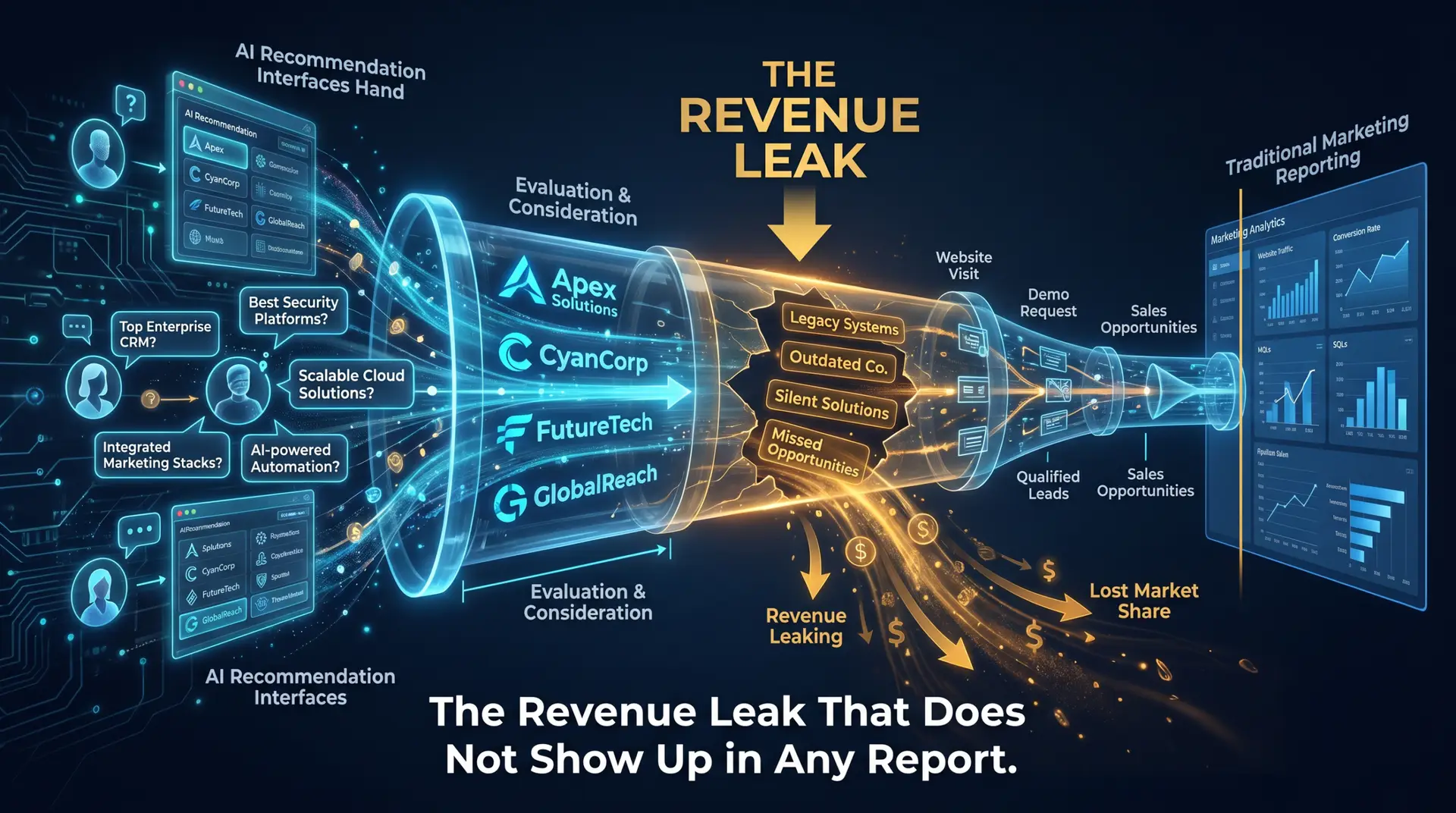
The old sequence looked like this: Google search, website visit, content consumption, demo request, evaluation, decision.
Every analytics platform, every conversion funnel, every attribution model was built around that sequence.
A new sequence is forming alongside it. And most companies have no measurement for it at all.
The New First Step
A buyer has a problem.
They open ChatGPT, Perplexity, or Claude.
They ask: “What are the best options for [category]?” Or: “Who do companies like ours typically use for [use case]?”
AI generates a response. A shortlist forms. Some brands are on it. Some are not.
The buyer takes that shortlist and begins evaluation. They visit websites. Book demos. Compare pricing.
But only for the brands AI included.
The brands AI excluded never enter the conversation.
No traffic drop. No alert. No dashboard signal.
Just absence from a conversation that determined who got considered.
Why This Is a Revenue Problem Not a Visibility Problem
Most businesses frame this as a marketing question.
Are we appearing in AI answers?
That is the wrong frame.
The right frame is a revenue question.
When buyers in your market research your category using AI, is your brand consistently on the shortlist that gets evaluated?
Because if not, you are not losing the sale during the evaluation. You are losing it before the evaluation ever starts.
And that loss is invisible to every analytics tool built before this shift began.
There is no bounce rate for a buyer who never visited. There is no exit signal for a consideration that never formed. There is no lost deal notification for an opportunity that never entered your pipeline.
The revenue leak is real. The measurement gap makes it invisible.
The Measurement Gap
Here is what most marketing teams are currently measuring:
Website traffic. Conversion rates. Demo requests. Pipeline velocity. Content engagement.
All of those metrics assume the buyer reached your website. None of them capture what happened before that visit.
Whether AI included your brand when the buyer asked who to consider. Whether your brand appeared on the shortlist or not. Whether competitors were recommended instead.
That pre-funnel moment is where recommendation intelligence lives.
And most businesses have never measured it.
The Strategic Questions Worth Asking Now
If AI systems are influencing vendor shortlists before buyers reach your website, two questions matter immediately.
First: Is your brand consistently making that shortlist?
Second: If not, how many evaluation conversations are you missing before they start?
Those are not visibility questions. They are revenue questions. And they require a different kind of measurement than anything in a standard marketing stack.
The answers are not in your CRM. They are not in your analytics platform. They are not in your attribution reports.
They are in the AI systems your buyers are using to form their shortlists right now.
A Quick Test Worth Running This Week
Ask these three questions across ChatGPT, Perplexity, and Claude without mentioning your brand:
“What are the best options for [your category]?”
“Who do companies like mine typically use for [your use case]?”
“What should I consider when evaluating [your category]?”
Note whether your brand appears. Note which competitors appear instead. Note how confidently AI describes the brands that do appear.
The gap between your current analytics and what you find in those queries is your pre-funnel revenue leak.
That fifteen minute exercise will reveal more about your actual pipeline risk than most quarterly marketing reviews.
The Bigger Picture
The most dangerous revenue leak is the one that does not show up in any report.
AI-generated shortlists are creating exactly that.
Opportunities that never enter your funnel because your brand was absent from the moment that determined who gets considered.
This is not a temporary disruption in buyer behavior. AI-assisted vendor research is becoming a standard part of how buyers form shortlists. The volume of pre-funnel decisions being shaped at this stage is growing.
The marketing teams that build measurement infrastructure for this stage now will have a significant intelligence advantage over those that wait.
FAQ
What is a pre-funnel revenue leak?
A pre-funnel revenue leak occurs when your brand is absent from AI-generated vendor shortlists during the buyer research stage. Buyers who receive a shortlist from AI typically only evaluate the brands included. If your brand is not on the list the opportunity never enters your funnel and your analytics never show you what you missed.
How is this different from a standard visibility problem?
A standard visibility problem means buyers cannot find you when they search. A pre-funnel revenue leak means buyers can find you but AI systems are not including you when buyers ask who to consider. You can have strong search visibility and still be systematically absent from AI-generated shortlists.
Why do standard analytics not capture this?
Standard analytics platforms measure behavior that begins at your website. When a buyer forms a shortlist inside ChatGPT or Perplexity and does not include your brand, no signal reaches your analytics. There is no bounce rate, no exit signal, and no lost-deal notification for an opportunity that never arrived.
What does measuring pre-funnel recommendation presence actually look like?
It involves running buyer-intent queries across major AI platforms without mentioning your brand, tracking how consistently you appear, identifying which competitors are being recommended instead, and understanding how your brand is described relative to alternatives. This measurement needs to happen repeatedly over time to reveal patterns and changes.
How does Axis Suite help close this measurement gap?
Axis Suite monitors AI recommendation presence across ChatGPT, Perplexity, and Claude using buyer-intent prompts that mirror real buyer research behavior. It tracks recommendation consistency over time, benchmarks against competitors, and identifies the signal gaps that explain why brands are excluded from certain buyer queries.
How long before changes in AI signals affect shortlist presence?
Based on patterns we observe in scans, signal improvements typically show measurable results within four to eight weeks of consistent corrective action. The timeline varies based on category competitiveness and how significant the signal gaps are.
Use Axis Suite to start measuring your pre-funnel recommendation presence. Find out whether your brand is making the shortlist, how consistently, and what it would take to hold that position across the AI systems your buyers are using right now.