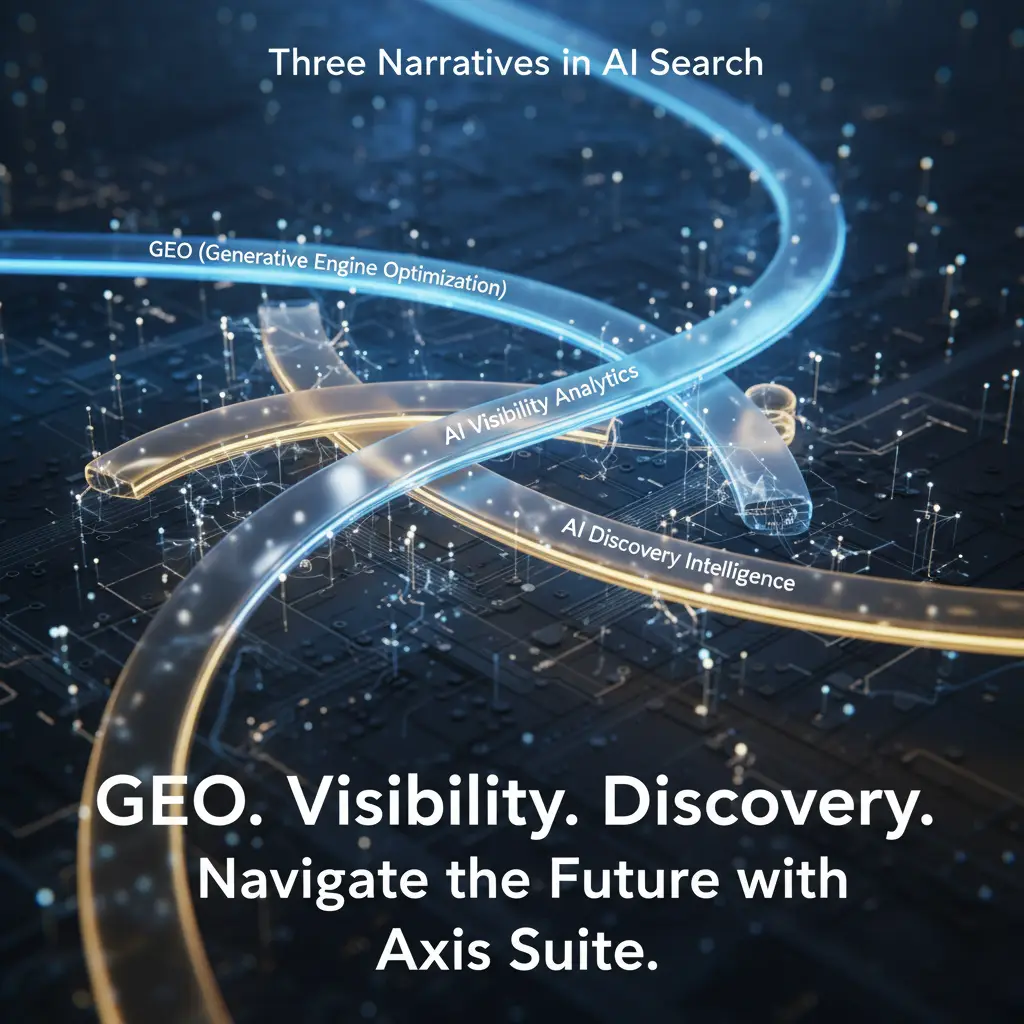
AI is reshaping how discovery happens. From the way customers find products to how businesses earn trust, artificial intelligence is redefining the rules. But if you’ve been following the conversation closely, you’ll notice that the race to adapt is splitting into three distinct narratives:
- GEO (Generative Engine Optimization)
- AI Visibility Analytics
- AI Discovery Intelligence
Each narrative represents a different approach to the same fundamental shift. But which one will shape the future? Below, we’ll break down these ideas, explore their strengths and challenges, and explain how Axis Suite ties it all together as the platform designed to prepare you for whatever comes next.
You can learn more about the tools we’ll discuss at axissuite.ai.
Narrative 1: GEO (Generative Engine Optimization)
If you’ve worked in SEO, the concept of GEO may feel familiar. Soon after generative AI’s capabilities exploded into public view, marketers raced to optimize their content for these new systems. GEO hinges on one goal: getting generative AI systems to cite your business in their answers.
This means:
- Ensuring your content is AI-friendly.
- Identifying the keywords and context that AI models are more likely to recognize and select.
- Structuring content in ways that favor retrieval and inclusion in outputs.
Why it Matters
GEO can create short-term wins for businesses by increasing inclusion in AI-generated answers. Many growth teams and SEO agencies have doubled down on this approach as a direct extension of traditional SEO.
The Challenge
Optimization alone creates a fragile foundation. You might secure visibility for SOME queries, but without insight into the mechanics of AI discovery systems, your position in AI-generated responses can shift without warning.
The focus here remains narrow, and GEO alone doesn’t explain the deeper why behind success or failure.
Narrative 2: AI Visibility Analytics
The second narrative focuses less on optimization and more on measurement. AI visibility analytics tools aim to answer questions like:
- How often is my brand mentioned in AI-generated responses?
- What’s my share of voice in key verticals or conversations?
- Are platforms like ChatGPT, Gemini, or Bard citing me at all?
With this approach, the focus is purely on data. Visibility analytics allows businesses to track whether they appear, offering valuable insight into current positioning.
Why it Matters
Knowing if you rank matters. Visibility analytics can help brands understand how AI assistants perceive them in the present and provide benchmarks for improvement.
The Challenge
While measuring mentions and citations is helpful, it’s not enough to build a winning strategy. AI visibility analytics stops at surface data. It doesn’t provide the systems-level insights needed to influence why your brand is being referenced or understand what risks may affect long-term inclusion.
Narrative 3: AI Discovery Intelligence
This is where the conversation gets bigger. AI Discovery Intelligence (ADI) looks beyond mentions or optimization. Instead, it focuses on understanding the entire decision-making process behind AI systems, exposing the layers that drive recommendations.
ADI asks deeper questions:
- How do AI systems retrieve data and sources?
- How do they interpret a brand’s identity based on entities and information?
- What reasoning mechanisms connect a brand to a query?
- What credibility factors determine inclusion in recommendations?
With ADI, visibility isn’t just a short-term goal; it becomes one signal within a much larger discovery system.
Why it Matters
AI assistants are becoming go-to tools for discovering products, answers, and recommendations. Whether you sell software, services, or sneakers, being discoverable in these AI systems means more than just showing up–it means consistently being chosen.
Understanding how AI systems retrieve, reason, and recommend doesn’t just boost visibility; it future-proofs your business.
The Role of Axis Suite in AI Discovery Intelligence
This is exactly where the Axis Suite comes into play. Available at axissuite.ai, this platform was designed to equip businesses with what they need to master discovery intelligence. While tools for GEO and visibility analytics focus on narrow aspects of AI interaction, Axis Suite offers a comprehensive approach for navigating the full discovery system.
With TrendAxis as its intelligence layer, Axis Suite provides:
- Retrieval Insights: Analyze where AI systems are sourcing data and how to ensure your signals are present.
- Entity Understanding Tools: Understand how AI identifies your brand and refine your digital footprint to align with discovery logic.
- Reasoning Chain Mapping: Identify gaps or biases in the reasoning models that could be excluding you.
- Recommendation Optimization: Gain clarity into the credibility factors AI systems rely on to elevate brands in answers and suggestions.
Axis Suite isn’t just about knowing whether you appeared. It’s about empowering businesses to understand and influence the process behind those appearances.
Which Narrative Defines the Future?
The division of these three strategies (GEO, AI Visibility Analytics, AI Discovery Intelligence) raises an important question for businesses: Are we solving the right problems?
If AI assistants are truly becoming a dominant discovery layer for information, businesses, and products, focusing solely on mentions or content tweaks is simply insufficient. The reality we must prepare for is dynamic, with AI decisions shifting based on retrieval systems, reasoning models, and entity recognition.
Axis Suite supports forward-thinking businesses by offering tools to not only measure success but to identify, decode, and act on the deeper systems at play in AI architectures. By exploring all three narratives and going beyond them, businesses using Axis Suite will position themselves not just for visibility—but for lasting relevance in an AI-first world.
What’s Next?
If your focus has been on GEO or visibility analytics alone, it’s time to ask some important questions:
- How well do you understand AI’s discovery systems?
- Are you optimizing your brand’s digital signals to align with changing algorithms?
- Do you have tools in place to analyze why AI systems include or exclude you?
Getting started is easier than you think. Visit axissuite.ai to explore the full platform and learn how you can future-proof your business against the evolving landscape of AI discovery.
The question isn’t just “Did you appear?”
It’s “What made you chosen?”