Most businesses think AI visibility works like traditional SEO. You optimize keywords, build authority, and wait for higher rankings to translate into more traffic. For years, this formula worked well enough. But AI-generated answers are fundamentally different, and they’re changing the rules of the game.
SEO fundamentals are still important. They help your content get retrieved. But retrieval is only one piece of the puzzle. It’s not the same as being selected by AI systems.
We’ve observed cases where two companies have nearly identical SEO strategies:
- Similar content
- Comparable domain authority
- Equivalent visibility
And yet, in AI-generated answers, only one brand consistently gets included. The other gets left out. Why? The answer lies in the selection layer, and that’s where things start to get complicated.
Retrieval vs. Selection in AI Systems
To understand the gap between retrieval and selection, we need to break down how AI systems process and generate answers.
Retrieval: The First Step
Retrieval is the process of gathering information from the web. This is where SEO principles like keyword relevance, structured data, and page optimization still play a critical role. AI systems scan:
- Website content
- Social media profiles
- Reviews and mentions
- Authoritative sources
The goal at this stage is to assemble a pool of relevant data that the AI can use to construct an answer. Think of it as building a library of potential sources.
Selection: Where the Real Competition Happens
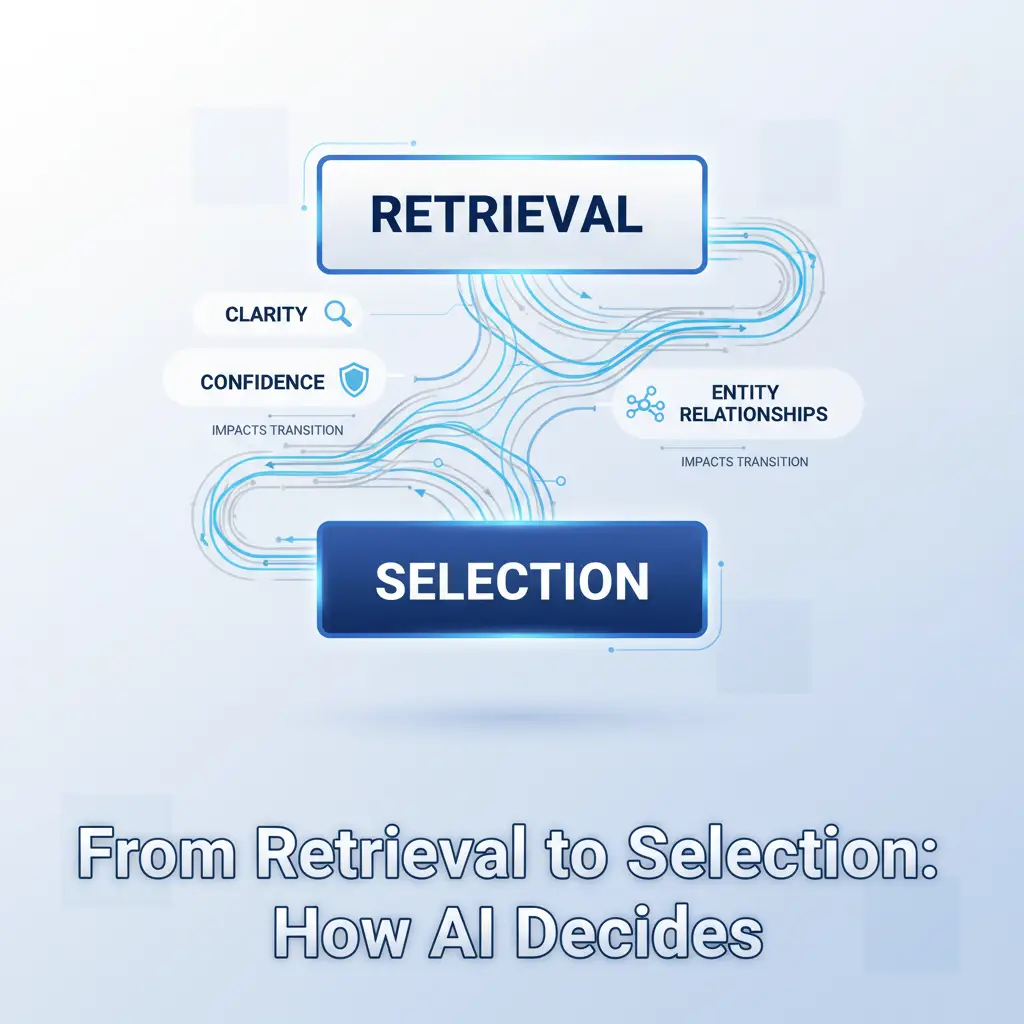
Once the data is retrieved, the AI doesn’t just regurgitate the top-ranking results. Instead, it evaluates which entities (brands, products, companies) should be part of its final answer.
This selection process doesn’t rely solely on SEO metrics. It examines deeper factors, such as:
- Clarity of the content and messaging across all platforms.
- Structure of the information to ensure it aligns with user queries.
- Entity relationships that define how a brand connects to a specific category or use case.
- The confidence level the AI has in using your content to form accurate responses.
At this stage, businesses are no longer competing for position on a ranked list. They’re competing to be selected for inclusion, and there’s no second page to save them.
Why Selection Is a New Challenge for Businesses
The shift from rankings to selection creates a significant diagnostic gap for businesses.
Most marketing teams are used to measuring performance through:
- Search rankings
- Organic traffic
- Click-through rates
But these metrics don’t tell the whole story in an AI-driven environment. Here’s where the blind spots emerge:
- When comparisons happen: Teams can’t see when their brand is compared to another during the selection process.
- When they’re excluded: It’s unclear why a competitor might appear while they don’t.
- What factors influenced selection: Businesses can see they weren’t picked but lack insight into the underlying reasons.
It’s starting to feel like a new kind of problem around understanding AI discovery itself. And as AI systems become the norm for search and recommendations, this gap will only widen.
How Factors Like Clarity and Confidence Impact Selection
AI systems prioritize entities that are easy to interpret and trustworthy. A few key factors play an outsized role in selection decisions:
1. Signal Consistency
If your brand appears fragmented across platforms, AI systems may hesitate to select you. For example:
- Is your messaging consistent on your website, social channels, and third-party mentions?
- Do your use cases and differentiators remain clear across all content?
The more consistent your signals, the more confident AI systems will be in including your brand.
2. Entity Relationships
AI systems use entity-based connections to determine relevance. For instance:
- Are you clearly positioned within a specific category (e.g., “financial software for small businesses”)?
- Is your content optimized to align with frequent user queries?
A lack of clarity here can make your brand less discoverable during the selection process.
3. Confidence Formation
AI systems give preference to entities they can represent confidently. Confidence grows when:
- Your content structure supports precise answers (e.g., well-organized headings and metadata).
- Trusted sources reinforce your brand’s credibility.
- Consistent descriptions appear across all references to your business.
4. User-Focused Content
AI models aim to provide the best possible answer to the user’s question. Content that:
- Addresses user intent clearly
- Offers structured, actionable insights
- Reinforces reliability through authoritative sources
is far more likely to be selected.
The Role of AI Discovery Intelligence
Addressing these challenges requires stepping beyond traditional SEO and into AI Discovery Intelligence. Unlike visibility tools that only track whether your brand appears, AI Discovery Intelligence focuses on the entire decision-making process, including:
- How signals are gathered and interpreted
- How entities are constructed and positioned
- What factors influence confidence and selection
This holistic approach allows businesses to not only diagnose performance issues but also implement targeted strategies to improve how AI systems evaluate and recommend them.
Where Axis Suite Fits
Axis Suite was designed to help businesses bridge the gap between retrieval and selection. Unlike tools that focus solely on visibility metrics, Axis Suite dives deeper into the discovery process.
It provides insights such as:
- Identifying weak or inconsistent signals that impair selection.
- Measuring visibility across platforms like ChatGPT and Gemini.
- Diagnosing why competitors may be selected more often.
- Optimizing entity clarity to align with AI confidence thresholds.
With Axis Suite, businesses don’t just track mentions or rankings. They gain actionable tools to influence every stage of AI discovery, from signal collection to visibility momentum.
Final Thoughts
AI systems are changing the way brands are discovered and recommended. While SEO fundamentals remain essential, they’re just the starting point.
The real opportunity lies in understanding how to influence the selection layer. By focusing on clarity, consistency, and confidence, businesses can position themselves as the answer AI systems trust.
Don’t just aim to be retrieved. Plan to be selected. Explore how Axis Suite can help your brand succeed in this new era of AI-powered discovery.