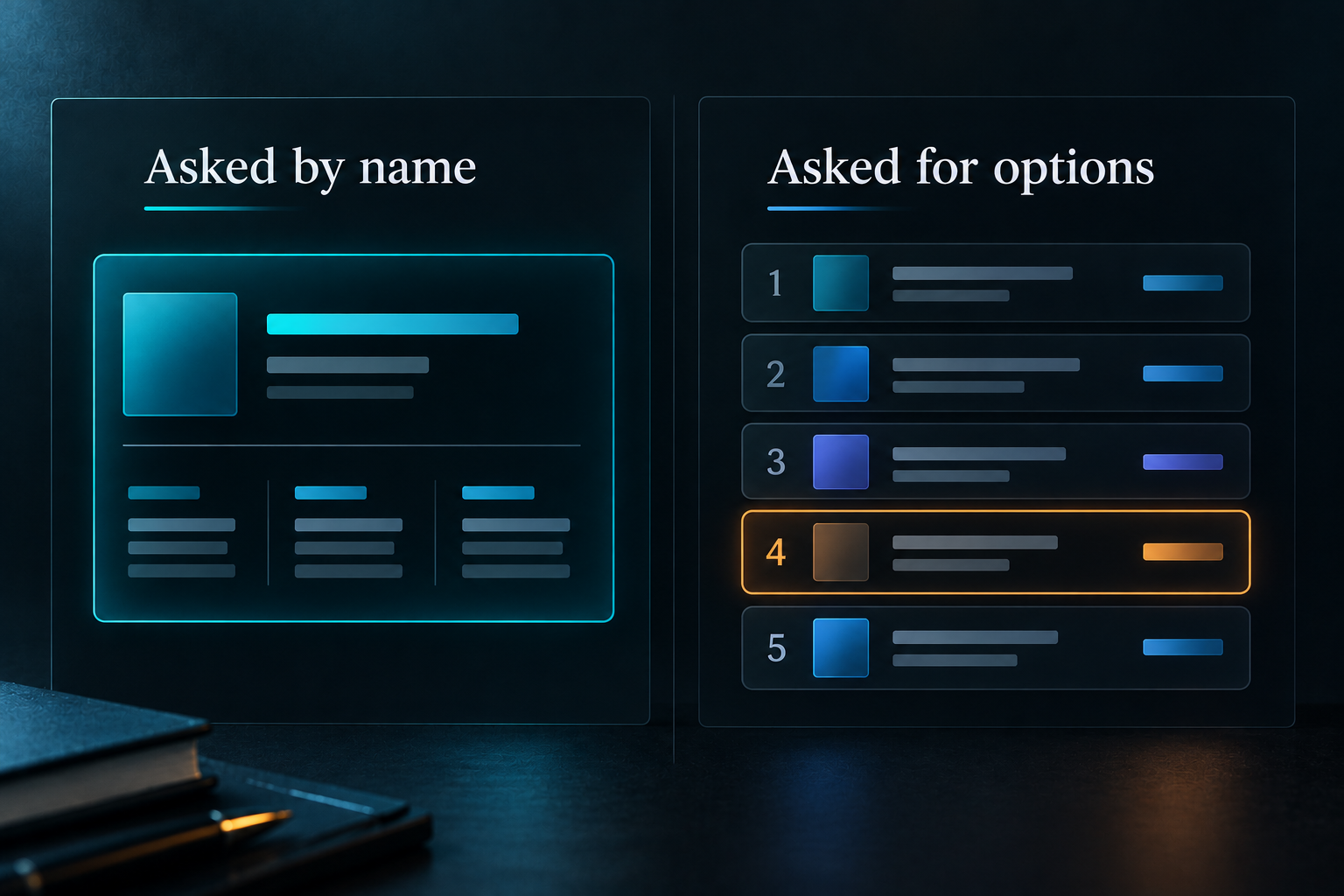
Consider a hypothetical buyer. She runs operations at a mid-sized company and needs a particular kind of software. She doesn’t know any vendor names yet, so she opens ChatGPT, Claude, Gemini, or Perplexity and describes what she needs: the use case, the size of her company, a rough budget, and one or two constraints. The assistant answers with a short list of options. Whether your brand is on that list is the question this article is about.
It is a different question from the one that is easiest to check. A natural first step is typing your own company name into an AI assistant and reading what comes back. That check is useful. It shows whether the assistant can describe a brand it has been handed, and whether the description is accurate. But the buyer in our scenario never runs it, because she doesn’t have your name. She is asking the assistant to decide which brands to talk about, and that decision happens before your name is typed by anyone.
This is why a healthy result on the named check can mislead. When you ask ChatGPT, Claude, Gemini, or Perplexity about your company by name, you have already supplied the hardest part of the answer, which is who to discuss. An accurate description of a brand the assistant was asked about shows that it can produce a description of the brand. If the assistant searches the web, that description may come from a live search and not from what the model itself learned, and either way it isn’t evidence that the brand surfaces when nobody asks for it by name.
An unbranded check starts from the buyer’s position. The first step is to define the questions in advance. Buyers describe the same need in different words, so a single phrasing is a sample of one. A reasonable panel varies the use case, the company size, and the constraint that matters most, and it is written the way a buyer would write it, without your company name or your internal vocabulary. The panel is then run across the engines a buyer might use.
Writing the panel is harder than it sounds, because it is easy to write questions that already contain your own vocabulary. A buyer rarely uses a company’s product category name, its feature labels, or its internal framing. She describes a problem: what she needs to get done, what isn’t working, and what she can’t change. A useful exercise is to write the questions from the buyer’s side first, then check whether any of your own terms leaked in. If they did, the check has partly turned back into a named check.
It also helps to keep the results for each engine separate. ChatGPT, Claude, Gemini, and Perplexity can each build a different list from the same question, so a combined figure can hide a brand that appears on one engine and is absent on another. Reporting each engine separately adds little work and keeps a blended number from standing in for what a buyer on any one engine would see.
Recording the result takes two layers. The first is the conditions: which questions were planned, which responses succeeded, and which engines answered. Some responses can fail or go missing during collection, and those must stay separate from valid answers that did not mention the brand. If the two are counted together, a collection problem can look like a finding about the brand. A few missing responses don’t automatically undermine a result, so the working check is whether enough of the planned responses succeeded to support the number being reported. The second layer is the outcome: whether the brand appeared in the valid answers, and how it was presented.
How the brand appears matters as much as whether it appears. An answer can list a brand without comment, list it with a caveat, mention it after naming another vendor as a better fit, or recommend it with a reason tied to what the buyer asked for. These are different things for a buyer to read. In our framework, Mentioned, Cited, Recommended, and Chosen are separate levels. Appearing among options sits near the first. Recommendation is an outcome the AI produces. Choice is an outcome the buyer produces afterward. A brand can move on one level without moving on the next, and a count of mentions can’t tell you which.
What can the result support? A narrow statement: on these engines, for these questions, at this time, the brand did or didn’t appear, and this is how it was presented. It does not support a cause. A brand could be absent because an engine had little to work with, because the question was worded in a way that favored other vendors, because answers differ between runs, or for reasons nobody outside the model provider can observe. It also doesn’t support a claim about revenue. A single observation hasn’t shown that appearing leads to buying.
A zero-mention result is still useful, as long as it is read as a pointer. It tells you where to look next, such as what the engines can say about the brand, how they categorize it, and what supports it. It doesn’t tell you why the brand was missing. Repeating the same panel later shows whether the result holds. The buyer who doesn’t know your name is exactly the buyer a named check can’t see, and that is the reason to run this one.
FAQ
What is the difference between asking AI about my company and asking AI for options?
Asking about your company by name tests whether an engine can describe a brand it has been given. Asking for options without your name tests whether your brand appears in a list the engine builds on its own. The two checks answer different questions.
Why isn’t a named-company check enough?
A named check supplies the one thing a new buyer lacks, which is your name. A good result there says the engine can describe you, whether from what it learned or from a search it ran. It doesn’t say you surface when a buyer asks for options.
Which AI engines should an unbranded check cover?
A buyer might use ChatGPT, Claude, Gemini, or Perplexity, and each can answer differently. A result from one engine doesn’t describe the others. Repeating the same panel is how stability is assessed, while changed wording or new questions are a different test, not a repeat.
If my brand doesn’t appear, does that mean AI has no information about it?
Not necessarily. A zero-mention result in a set of questions on certain engines at a certain time is an observation, not a diagnosis. It can reflect the wording of the questions, differences between runs, or reasons that can’t be observed from outside the model provider.
Does appearing among options mean AI recommends my brand?
No. A brand can be listed without comment, listed with a caveat, or listed after another vendor is described as a better fit. Recommendation is a separate outcome from being named.
Does Axis Suite run this kind of check?
In its measurement work, Axis Suite keeps coverage of a planned question panel separate from how often a brand appeared among the successful answers. This article describes a method and doesn’t report a result for any specific brand.
About Axis Suite
Axis Suite is the independent intelligence layer that tracks what AI says about your brand and the observable evidence behind it, retrieval, narrative, recommendation, and corroboration signals, across engines including ChatGPT, Claude, Gemini, and Perplexity. Built by TrendAxis, Axis Suite works from a framework that separates Mentioned, Cited, Recommended, and Chosen. Axis Suite is measurement infrastructure, not a marketing quick fix. Explore the Proof Center.