Imagine this scenario. A customer opens ChatGPT or Perplexity and types, “What’s the best software for managing remote teams?” Moments later, the AI assistant provides a succinct list of recommendations—but your brand isn’t on it. Ever wonder why?
AI-powered platforms are reshaping how consumers discover and evaluate brands. Unlike traditional search engines that rely on keyword rankings, AI systems consider a broader range of signals, including authority, context, and structured data. If your business isn’t optimized for these modern credibility markers, you’re at risk of becoming invisible in an AI-driven world.
This blog unpacks why some brands consistently appear in AI-generated answers while others miss the mark. Along the way, we’ll explore hypothetical examples and introduce strategies to increase your ability to show up where it matters most.
How AI Decides What to Recommend
AI engines like ChatGPT, Bard, and Gemini operate differently from traditional search engines. Instead of solely evaluating isolated keywords or backlinks, AI systems weigh decision-making factors such as trust, clarity, and cross-source reliability. Here’s a simplified look at what happens when an AI assistant receives a question:
- Context Analysis
The AI evaluates the user’s query to determine intent. For example, is the user seeking reviews, pricing details, or expert advice? This establishes the foundation for what type of answer to generate. - Entity Recognition
AI identifies entities within the query. These are brands, products, or concepts explicitly named (or implied) in the question and search sources. - Data Aggregation
The assistant pulls data from multiple trusted sources, such as product descriptions, industry reports, and user reviews, to form a comprehensive response. - Answer Construction
AI evaluates and prioritizes the data based on key signals. Relevant entities with high trust scores and clear, consistent messaging are likely to appear in the final answer.
This methodology rewards businesses that invest in entity optimization, clarity, and credibility—but punishes those that disregard these factors.
—
Visible vs. Invisible Brands
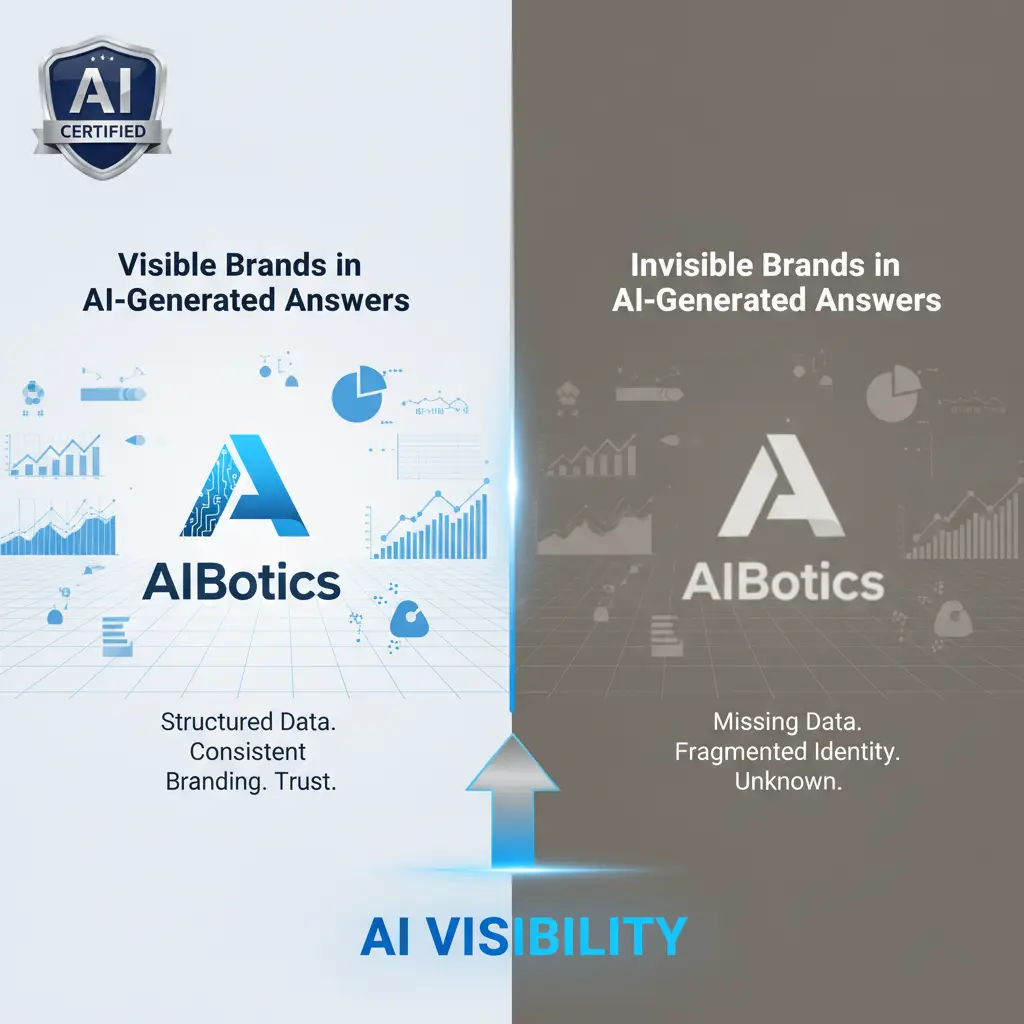
At this point, you may be wondering, “What separates brands that show up in AI recommendations from those that don’t?” Here’s a side-by-side comparison:
| Visible Brands | Invisible Brands |
|---|---|
| Consistently cited as experts across platforms. | Lack mentions, citations, or appearances on reliable sources. |
| Use structured data like schema markup to signal relevance. | Offer vague, unstructured information that AI struggles to interpret. |
| Maintain consistent messaging across websites, reviews, and social media. | Present conflicting or unclear information across platforms. |
| Publish high-quality, relevant content optimized for user intent. | Rely on outdated keyword-stuffed blogs with little substance. |
A Hypothetical Example
Consider two CRM providers, Brand A and Brand B.
- Brand A: Actively maintains a blog with use-case scenarios, publishes reviews on industry-specific sites, and uses schema metadata to detail their features. Their message is consistent across their website, directory listings, and social profiles.
- Brand B: Offers the same product but has a bare-bones website with minimal details about features. They rarely post updates and provide disjointed information on third-party sites.
When a user asks, “What CRM is best for startups?” AI assistants like Perplexity will lean toward Brand A—not because Brand B’s product is inherently inferior but because Brand A’s signals position it as the more trustworthy option.
—
Key Factors AI Considers When Choosing Brands
If visibility in AI-generated answers is critical for your business, understanding what AI prioritizes is key. Here are the main factors:
1. Citations and Social Proof
AI values external validation. If your brand is frequently mentioned or cited by reputable sources, it strengthens your authority in the eyes of AI.
Example: A boutique clothing brand that earns mentions in fashion blogs, reviews on popular shopping platforms, or accolades from influencers is more likely to appear in AI queries like “sustainable clothing brands.”
2. Entity Clarity
A critical aspect of visibility is ensuring your brand is recognized as a distinct and authoritative entity within its industry.
Action Step: Use clear and detailed descriptions of your products or services across all platforms. Tools like schema.org markup make it easier for AI to interpret your content.
Hypothetical example:
– Query: “Best project management tool for agencies.”
– Clear entity signals (like “trusted for agencies” highlighted on webpages) make your tool eligible, whereas unclear branding disqualifies your competitor.
3. Structured Data
AI systems are programmed to process structured, machine-readable data like schema markup and FAQs. Google’s rich snippets are a good example of how structured data makes specific information easily discoverable.
Takeaway: If your webpages lack structured elements, you’re likely missing out on visibility.
4. Cross-Platform Consistency
AI notices conflicting details. For instance, if your pricing is listed differently on your website and third-party retailers, that inconsistency weakens trust, causing AI to deprioritize you in recommendations.
5. Regular Engagement
AI favors up-to-date, engagement-driven content. Blogs, customer Q&As, and recent reviews keep your brand relevant without requiring significant ongoing resources.
Quick Win: Answer current trending questions in your space. Turn them into evergreen blogs, increasing your discoverability among AI systems.
—
How Axis Suite Helps You Become Part of AI Answers
Appearing in AI-generated answers isn’t accidental. It’s a culmination of strategy, structure, and optimization. That’s where Axis Suite comes in.
Axis Suite focuses on improving the exact criteria that determine your inclusion probability in AI recommendations, like:
- PulseAxis
Tracks your visibility across AI platforms such as ChatGPT and Gemini. Identifies gaps in your authority, consistency, and presence. - TrendAxis
Analyzes emerging trends, empowering you to create content aligned with what users and AI are searching for. - SparkAxis
Links insights with action by delivering clear, step-by-step recommendations and tools to optimize your campaigns. - AxisGoals
Ties everything back to measurable outcomes, ensuring your visibility efforts align with business priorities, like customer acquisition or revenue growth.
—
The Takeaway
AI’s evolution from search engines to recommendation engines changes the rules of engagement. Brands that want to stay relevant need to evolve their approach to visibility by focusing on entity optimization, credibility, and consistency.
It’s no longer enough to stuff blogs with keywords or stack backlinks without strategy. Instead, successful brands build ecosystems of trust through consistent engagement, structured data, and cross-platform alignment.
And here’s the critical piece:
Axis Suite is designed to increase your inclusion probability in these answers.
If your brand is ready to go from invisible to indispensable in AI-driven discovery, now’s the time to act. Schedule a demo of Axis Suite today and take the first step toward AI visibility that drives growth.
You don’t have to leave your visibility to chance. With the right tools and strategy, you can ensure your brand is always part of the conversation.