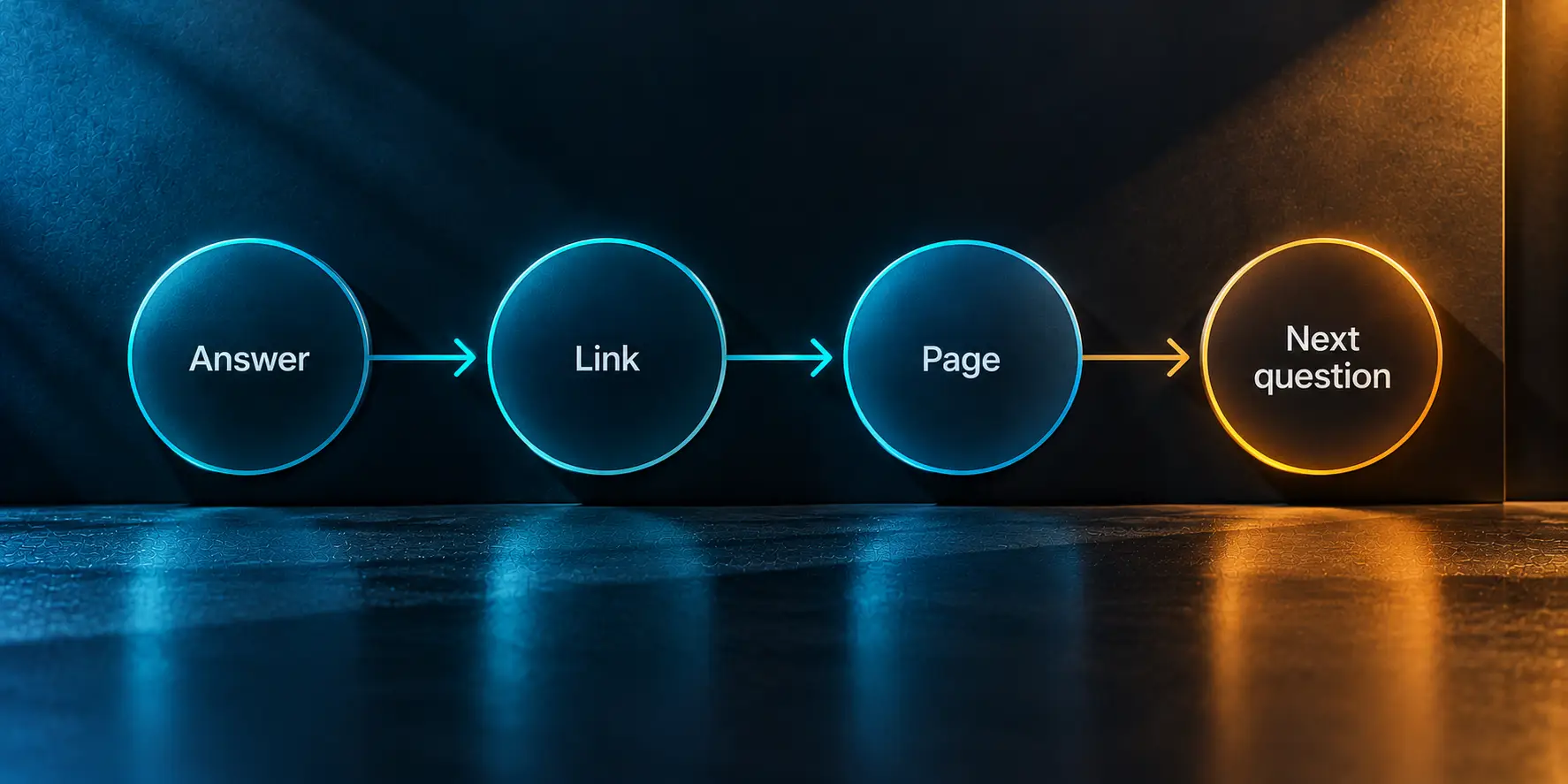
Consider a hypothetical scheduling software company and a hypothetical buyer who asks ChatGPT, Claude, Gemini, or Perplexity about it. The answer describes the company accurately and, in this case, includes a link to the company’s homepage. The company is named correctly and the link works. By the usual checks, the answer is fine.
The buyer, though, has a next question. She runs operations at a company with several locations, and she wants to know whether the software handles teams that work across sites, and how to start a conversation about it. That question is practical, and it is not the one the answer addressed. So she follows the link and looks for the answer on the page.
This is a separate check from whether the company was described correctly. Naming a company accurately and sending a buyer somewhere useful are different things. A link can be correct, and the page behind it can still fail to answer the question that decides whether the buyer goes any further. This article only applies when an answer includes a link. Not every answer does, and what an engine shows can differ between ChatGPT, Claude, Gemini, and Perplexity.
Three checks help. The first is whether the page answers the buyer’s task. Write down one concrete question a buyer would ask after reading the answer, in the buyer’s words. Open the page the answer links to, and see whether the information is there or only a mention of the category. A homepage that says the software “supports growing teams” has not answered a question about multiple locations. The second is whether the page is current. Look for the date on the information, or signs it describes an older version of the product, an old pricing structure, or a retired feature. The third is whether the page shows a next step. A buyer who finds the answer still has to do something: request a demo, contact sales, read a more specific page. If the next step is hidden, or the page does not make clear who handles which kind of request, the page answers the question but stops the buyer anyway.
A page can also fail in quieter ways. It might answer the question only in a downloadable document, or in a section several clicks deep, or only for a different size of customer. Those are different observations from a page that does not address the question at all, and the record should say which one it is. The aim is to describe what a buyer arriving cold would find, not what the company intended the page to say.
Whose page it is matters. If the link goes to the company’s own site, the company controls the content, and any gap is something it could change. If the link goes to a third-party page, such as a directory entry, a review or a news article, the company may not control the content at all. The check is the same, but what follows from it is different. A gap on the company’s own page is something the team can look at directly. A gap on an independent page is a description of the company that sits outside its control, and the first job there is simply to read what it says.
It also helps to keep the observation separate from the explanation. If the page does not answer the buyer’s next question, that is a finding about the page. It is not a finding about why the engine linked to it. What happens inside an engine is not visible from outside, and one linked page on one engine on one date does not describe how any engine chooses where to send a buyer. The record supports a narrow statement: for this question, on this engine, on this date, the linked page did or did not answer the buyer’s next question.
The record itself is short. Write down the engine, the buyer’s original question and the date. Record the link the answer provided and whose page it is. Write the buyer’s next question, then note whether the page answers it, whether the information is current, and what next step the page offers. Finish with what you could not tell. Repeat the same questions later on the same engines if you want to see whether the result holds. Changed wording or new questions are a different test, not a repeat.
None of this establishes that a better destination page leads to more buyers choosing the company. Recommendation is an outcome the AI produces, and choice is an outcome the buyer produces afterward. A page check shows neither one. What it does show is whether a buyer who follows a link has a reasonable chance of finding what she came for.
The check takes a few minutes. It asks a team to stop looking at the link as a sign of success, and start looking at what a buyer would do when she arrives.
FAQ
Why is the right company with a working link not enough?
Naming a company correctly and sending a buyer to a page that answers the next question are separate checks. A correct link can still lead to a page that does not help with the buyer’s next step.
How do I choose the buyer’s next question?
Write one concrete question a buyer would ask after reading the answer, in the buyer’s words, such as whether the product works across several locations. Use the same question each time you check, so results can be compared.
What should I look for on the linked page?
Check whether the page answers the question, whether the information is current, and whether it shows the buyer a next step. A page can pass one of these and fail another.
Does every answer from ChatGPT, Claude, Gemini, and Perplexity include a link?
No. What an answer shows can differ by engine, question and date, so this check only applies when a link is present. Record the engine and date with every result.
If the linked page falls short, does that explain why the engine linked to it?
No. A finding about the page is not a finding about the engine’s reasoning, which is not visible from outside the provider. It is one observation under specific conditions.
Is this article reporting a result from Axis Suite?
No. The scheduling company and the answer are hypothetical, and the article describes a method without reporting a result for any brand.
About Axis Suite
Axis Suite is the independent intelligence layer that tracks what AI says about your brand and the observable evidence behind it, retrieval, narrative, recommendation, and corroboration signals, across engines including ChatGPT, Claude, Gemini, and Perplexity. Built by TrendAxis, Axis Suite works from a framework that separates Mentioned, Cited, Recommended, and Chosen. Axis Suite is measurement infrastructure, not a marketing quick fix. Explore the Proof Center.