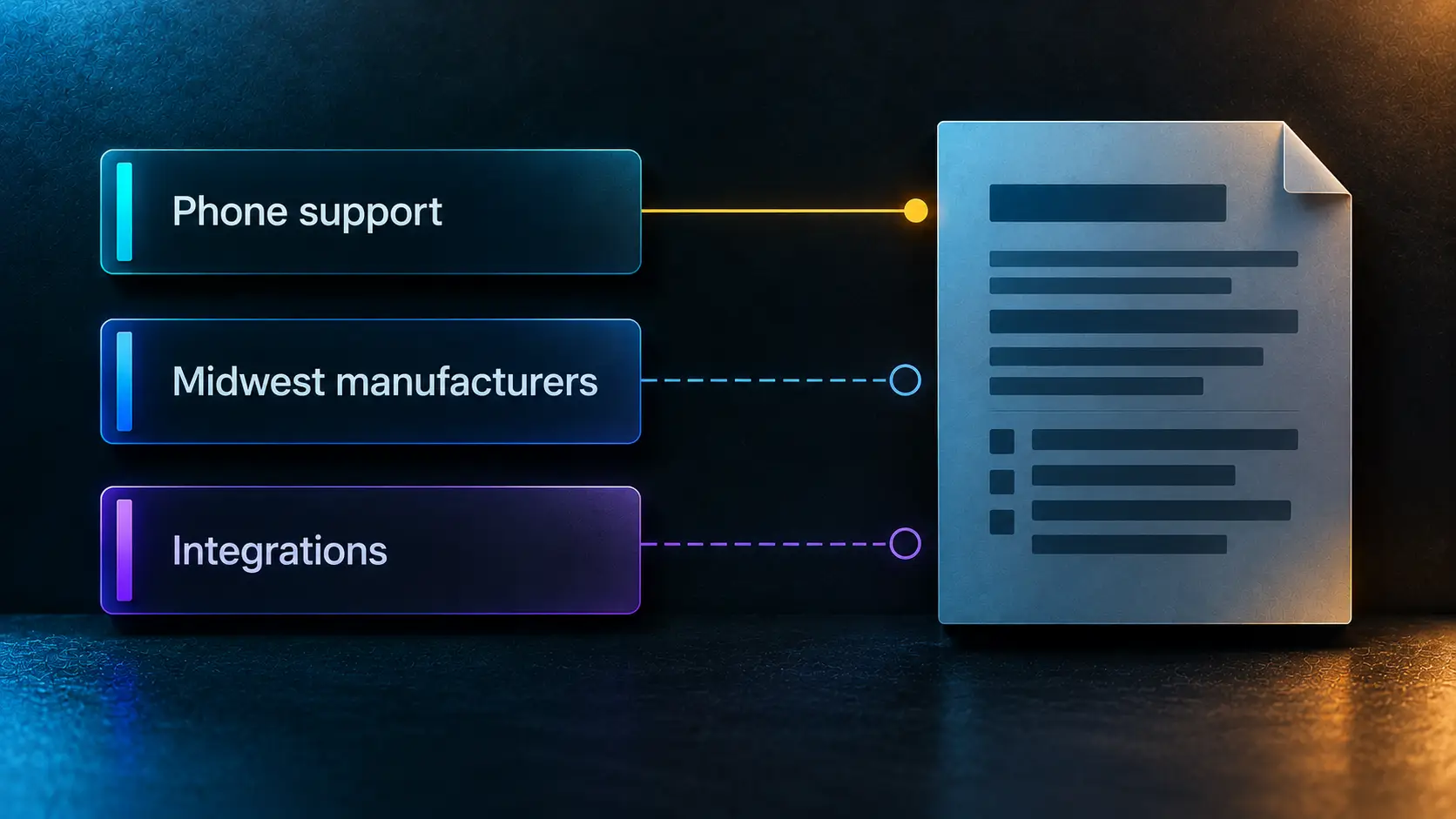
Take a hypothetical payroll software company and a hypothetical answer from ChatGPT, Claude, Gemini, or Perplexity. A prospective buyer asked about the company, and the answer says it serves Midwest manufacturers, offers 24/7 phone support, and integrates with major accounting platforms. The answer includes a link to the company’s support page. Neither the company nor the answer is real, and nothing here is a finding. The example exists to show how a source can relate to a claim in more than one way.
The first move is to split the answer into its three claims. The page is then read against each one, not against the answer as a whole. Reading it as a whole invites a single verdict, such as “the source checks out,” and that verdict hides the differences between the claims.
Say the support page does mention phone support. It lists weekday business hours, though, and says nothing about around-the-clock availability. The claim “offers 24/7 phone support” is then only partly supported. Phone support has a basis on the page. The 24/7 part does not, and the hours listed point the other way. For a buyer, the difference is not academic. If she plans her own support coverage around an assumption of 24/7 availability, the gap between weekday hours and around-the-clock service is the part that matters to her. Recording this as “supported” would overstate the page. Recording it as “contradicted” would also overstate it, because the page may simply describe one support tier and a different page may describe another. The accurate record is narrower: this page supports phone support, lists weekday hours, and does not support 24/7.
It helps to write each entry in a fixed shape: the claim, the page, what the page says, what it does not say, and what remains open. For the phone support claim, that reads: claim, 24/7 phone support; page, the company’s support page; page says, phone support with weekday hours; page does not say, around-the-clock availability; open, whether another page or support tier describes different hours. Written this way, the entry can be read by someone who has not seen the page.
Say the page does not mention manufacturers at all, and does not mention accounting integrations. For these two claims, the source offers nothing either way. The right entry is “not supported by this source.” That is a statement about the page. It is not a statement about the company, and it is not a statement about whether the answer is right.
This distinction is the one most worth protecting. A claim with no support on one page may be accurate, and may be supported on another page of the company’s own site, or by an independent source. Customer stories, partner pages, directory listings and review sites are natural places to look next. A claim can also be out of date, or true of a different product line. None of those can be told apart from a single unsupportive page. Unsupported is a finding about the evidence, not a verdict about the truth.
Whose page it is matters too. The support page is the company’s own. A claim that matches it shows the AI repeated what the company says, which is useful, and it is also the company agreeing with itself. If the manufacturer claim turned up on a customer’s page or in a trade publication, that would be independent corroboration. It would answer a different question: does anyone besides the company say this? A team that records which kind of support it found is in a better position than one that records only that support exists.
There is a limit on how far to read all of this. A visible link is not a complete record of where an answer came from, and the engines do not show their internal process. The fact that a page partly supports a claim does not show the page is why the answer says what it says. And search-assisted correctness is not proof that an engine knows the company without searching. The record supports a narrow statement: for this claim, in this answer, on this engine, on this date, the cited page supports this part and not that part.
What follows from a result like this? It depends on what was found. If a claim is wrong, that calls for different work than a claim that is accurate but unsupported anywhere findable, or one that is out of date. If the team decides to change something, such as adding a clearer description to a page it controls, that change is an intervention. It helps to say beforehand what observation would show it had an effect, then repeat the same question on the same engines afterward. A before-and-after difference alone does not establish that the change caused it.
Sometimes the right result is to note the gap and keep watching. In our framework, WATCH is a legitimate result when the evidence does not yet justify an intervention. It means continuing to observe, setting a date to check again, and writing down what would change the decision.
The habit this builds is small. A source can support half a sentence, and the record should say which half.
FAQ
Can an AI answer cite a real page and still overstate what it says?
Yes. A cited page can support part of a claim, such as the existence of phone support, and not the rest, such as 24/7 availability. Reading the page against each claim separately shows the difference.
How should I record a claim that a source only partly supports?
Write down exactly which part the source supports and which part it does not. Avoid recording the whole claim as supported or as contradicted when the page only addresses one piece of it.
Does “not supported by this source” mean the claim is false?
No. It is a statement about the page, not about the company or the answer. The claim may be accurate and supported elsewhere, or it may be out of date or true of a different product.
Where should I look if one page does not support a claim?
Look at other pages on the company’s own site, then at independent sources such as customer stories, partner pages, directory listings and reviews. Note which kind of support you find, since a company’s own page and independent corroboration answer different questions.
Do ChatGPT, Claude, Gemini, and Perplexity all show their sources the same way?
Not necessarily, and what happens inside any engine is not observable from outside. Record the engine, the question and the date for each answer, and treat a result on one engine as a result for that engine.
Is this article reporting a result from Axis Suite?
No. The payroll company and the answer are hypothetical, and the article describes a method without reporting a result for any specific brand.
About Axis Suite
Axis Suite is the independent intelligence layer that tracks what AI says about your brand and the observable evidence behind it, retrieval, narrative, recommendation, and corroboration signals, across engines including ChatGPT, Claude, Gemini, and Perplexity. Built by TrendAxis, Axis Suite works from a framework that separates Mentioned, Cited, Recommended, and Chosen. Axis Suite is measurement infrastructure, not a marketing quick fix. Explore the Proof Center.