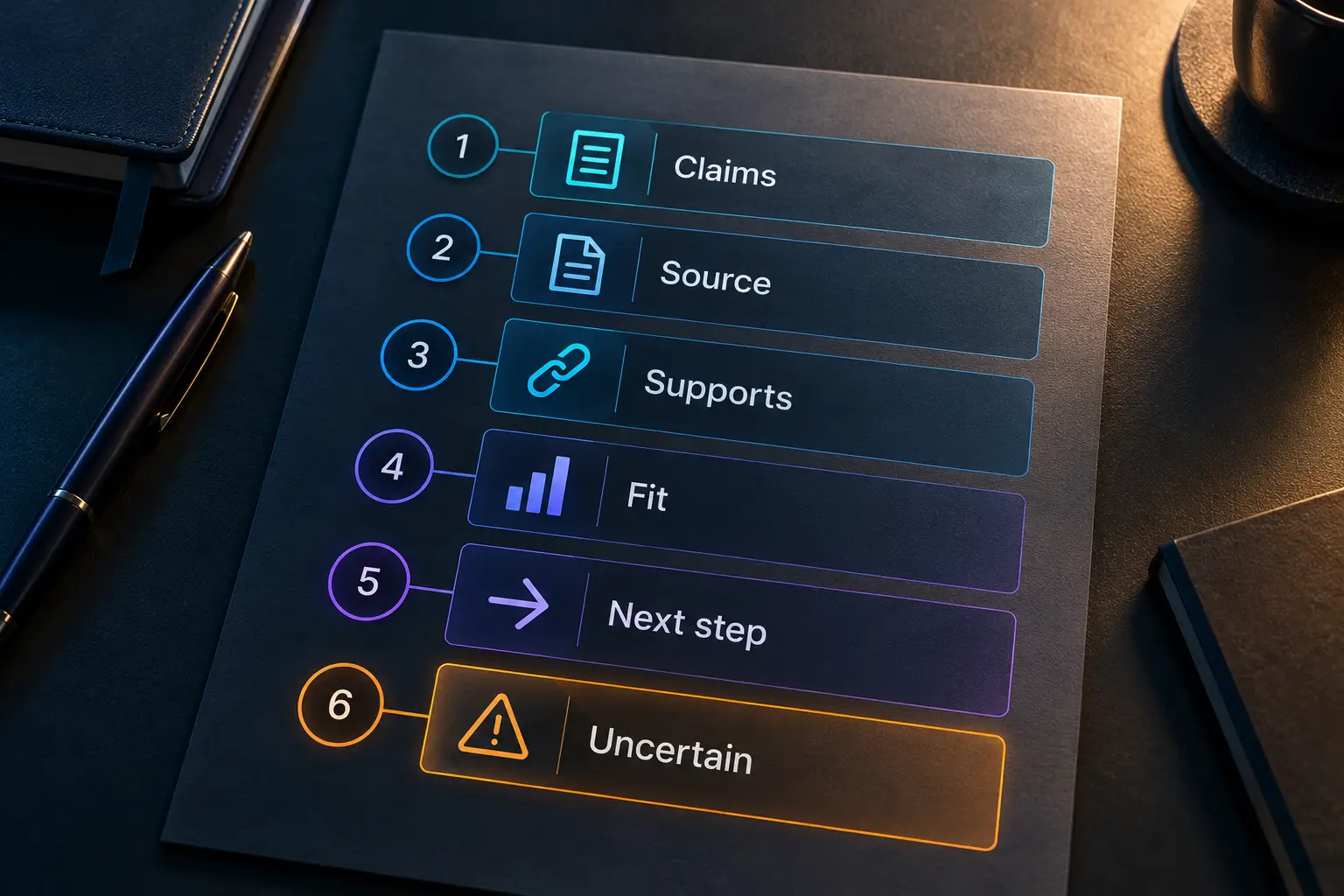
A team that has read an AI answer about its own company and wants to say something useful about it needs a way to record what it found. The answer might come from ChatGPT, Claude, Gemini, or Perplexity, and it might describe the company’s services, customers and capabilities in a confident tone. A checklist keeps the review from becoming a matter of impressions. This one fits on a page, and it is meant to be filled in the same way every time.
The first step is to split the answer into single claims. A description of a company is usually several statements joined together: what it offers, who it serves, what it can do, where it operates. Write each on its own line. Judging a paragraph produces one impression. Examining individual statements produces a record.
The second step is to find the source for each claim and note whose page it is. If the answer includes a link or names a source, open it. If it does not, look for a page that could support the claim, and write down that you do not know it is what the engine used. Then note the kind of page. A company’s own page makes the same claim the company makes about itself, which shows whether the AI repeated it accurately. Independent corroboration, such as a review, directory entry, analyst note or news article, comes from someone else. The two answer different questions, and the record should say which one you found.
The third step is to read what the source actually supports. There are three outcomes for each claim: the source supports all of it, supports part of it, or says nothing about it. Partial support is common, and the record should name which part. A claim with no support on one page is not necessarily false. It may be accurate and supported elsewhere, out of date, or true of a different product. Write “no support found” for that, and keep it separate from “false.”
The fourth step is to check the fit. Does the source concern the right company, the right offering and the right time period? Similar names, retired products and old announcements can make a source look relevant when it is about something else. Check the name, the product and the date on the page itself.
The fifth step applies only when the answer includes a link: ask whether the page answers the buyer’s next question. Write one concrete question a buyer would ask after reading the answer. Open the linked page, and see whether the information is there, whether it is current, and whether the page shows a next step. The record should also note whose page it is, since that decides what can be checked and what can be changed.
The sixth step is to write down what remains uncertain, along with the conditions of the observation: the engine, the exact question and the date. Answers differ between engines and between runs, so a result belongs to the conditions under which it was seen. Repeating the same questions on the same engines later shows whether the result holds. Changed wording or new questions are a different test, not a repeat.
When the page is filled in, read it for what it supports and what it does not. A completed record supports a narrow statement: for these claims, in this answer, on this engine, on this date, here is what the sources show and where they fall short. It does not show that the answer is correct across the board. Search-assisted correctness is not proof that an engine knows the company without searching. A visible link is not a complete record of where an answer came from, and what happens inside an engine is not visible from outside the provider. A source that supports a claim has not been shown to be the reason the answer contains it. And unsupported is a finding about evidence, not a verdict about truth.
The record is also useful as a plain way of talking about progress. A team that can say two claims have support on its own pages, one has independent corroboration, and one has no support found, is describing something specific. A team that says the answer looked fine is not. The same page helps when a vendor claims progress, because it shows what an observation would have to contain to count.
If the team decides to change something as a result, such as adding a clearer description to a page it controls, that change is an intervention. State beforehand what observation would show an effect, then repeat the same questions later. A before-and-after difference alone does not establish that the change caused it. And when the evidence does not yet justify a change, WATCH is a legitimate result in our framework: keep observing, set a date to check again, and write down what would change the decision.
A convincing description is where the checking starts. A page like this one is how it gets finished.
FAQ
What should an evidence checklist for an AI answer about my company include?
It should include the individual claims, the source for each, whose page it is, what the source supports, whether it fits the right company and time period, and what remains uncertain. Record the engine, question and date too.
How often should I run this check on ChatGPT, Claude, Gemini, and Perplexity?
There is no single correct schedule. Repeat the same questions on the same engines at intervals you set in advance, so you can see whether a result holds. Changed wording or new questions count as a different test.
Can the checklist show that an AI answer about my company is accurate?
Not by itself. It shows what the sources support for each claim, under specific conditions. Search-assisted correctness is not proof of unaided knowledge, and unsupported does not mean false.
What should I do with a claim that has no support?
Record it as “no support found” and keep it separate from “false.” Then look at other pages on the company’s site and at independent sources before deciding whether any action is justified.
Is a visible link a complete record of where an answer came from?
No. A link shows where to look, and the page still has to say what the claim says. What happens inside an engine is not observable from outside the provider.
Is this article reporting a result from Axis Suite?
No. It describes a way to record and read an evidence check and reports no result for any specific brand.
About Axis Suite
Axis Suite is the independent intelligence layer that tracks what AI says about your brand and the observable evidence behind it, retrieval, narrative, recommendation, and corroboration signals, across engines including ChatGPT, Claude, Gemini, and Perplexity. Built by TrendAxis, Axis Suite works from a framework that separates Mentioned, Cited, Recommended, and Chosen. Axis Suite is measurement infrastructure, not a marketing quick fix. Explore the Proof Center.