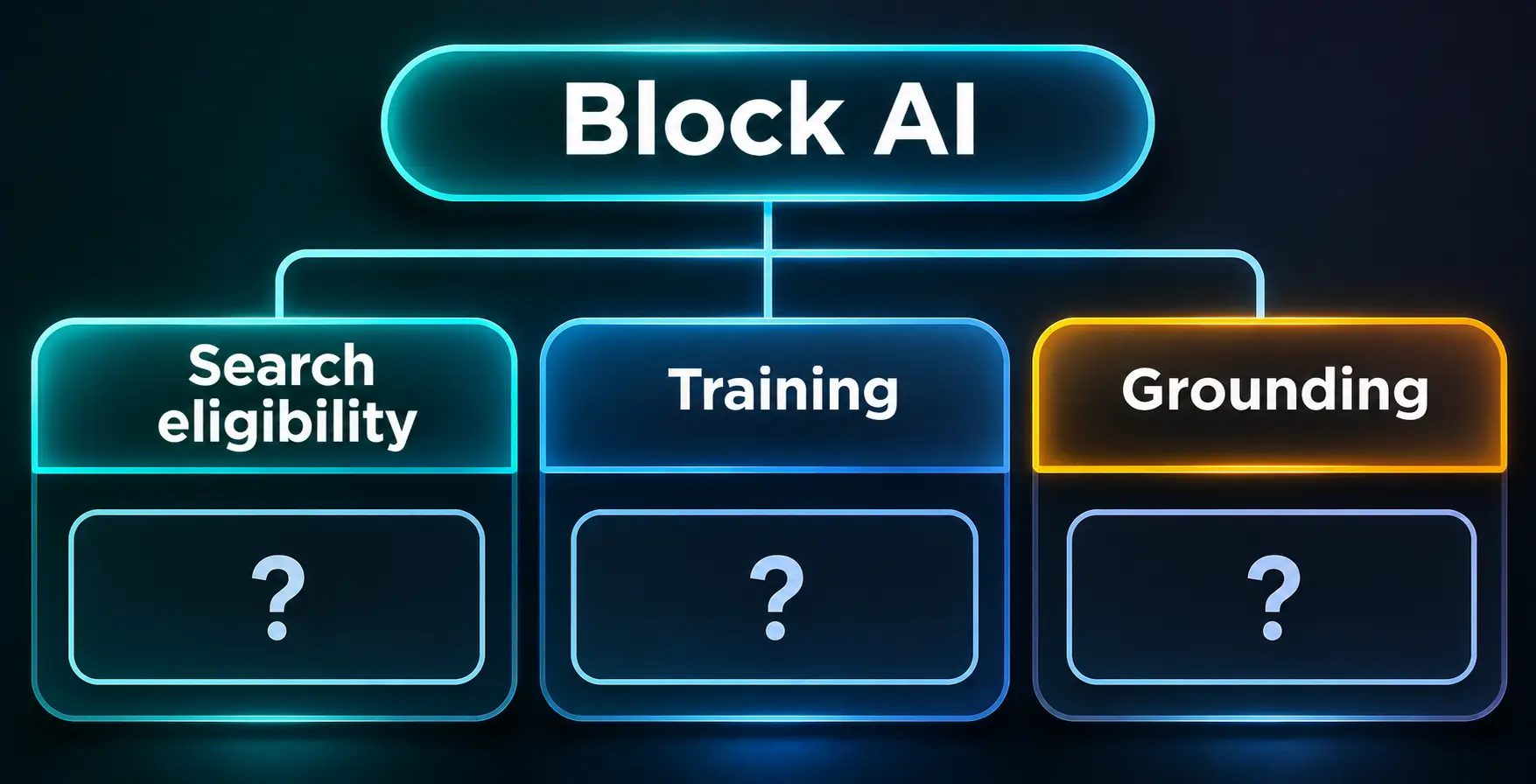
Picture a software company that publishes detailed explainers about its product. Leadership likes the idea of those pages helping inform AI answers when a buyer asks a question. Leadership does not like the idea of them helping train a generative model. In the meeting, someone says, “Let’s just block AI,” and the room nods. The company in this example is hypothetical, and nothing here is a finding about any real business. The point is that the sentence everyone agreed to contains more than one decision.
On October 30, Microsoft announced separate preferences for AI training and AI grounding. Microsoft defines AI training as using an asset to modify the learned parameters of a generative AI model. It defines AI grounding as using content as input to help inform AI-generated responses, and it says indexing and ranking pages in traditional search results is not grounding. Microsoft describes both new preferences as defaulting to allow when no applicable preference is published.
The timing matters as much as the definitions. Microsoft says that starting February 1, 2027, it will honor the new preferences as it crawls. That makes this an announced future policy, not a change in effect today. Sites that use the older NoArchive and NoCache tags have a separate transition, with a deadline of March 1, 2027, and a site it applies to should read Microsoft’s announcement directly.
Two limits in the announcement are worth keeping in view. Microsoft says the preferences do not change eligibility for traditional Bing search results, which remain subject to normal crawl and indexing requirements. It also says the settings govern use of content, not crawl access. A preference states how a page may be used. It is not a way of keeping a page out of search, and it is not a way of keeping a crawler away.
Return to the software company. Under this approach, it could restrict training while keeping its public explainers eligible to inform Microsoft’s generated answers. Microsoft does attach a stated cost to the other side: it says that restricting grounding reduces brand visibility in AI experiences. One combination fits what leadership said it wanted. Another carries a cost that Microsoft itself names, and that cost is a vendor statement of unspecified size.
It helps to count the separate questions that sit inside “block AI.” Can the page appear in ordinary search results? That depends on crawling, indexing and other requirements, and Microsoft says the new preferences do not change it. May the page be used to train a model? May the page be used as input to an answer? Those are three distinct questions about discovery and content use. What a buyer actually sees when asking an assistant is a fourth question, and no setting supplies the answer. It has to be observed.
Separating the questions makes the meeting more productive. Instead of one yes or no, the team can write one line per use. For the software company, a first draft might read: search discovery, yes for all public pages; training, restrict; grounding, allow for the product explainers, undecided for everything else. That draft is an illustration, not a recommendation. Its value is that each line can be questioned, assigned to an owner and changed on its own.
Before the meeting, a short pre-read helps. It needs Microsoft’s announcement, a list of the kinds of public pages the company publishes, and the name of whoever owns the site’s technical setup. With those three things in the room, the conversation can move from “should we block AI” to “what do we want for each use, and for which pages,” and the person who would carry out any change is present when the decision is made.
Scope deserves a plain statement. Microsoft’s announcement concerns Microsoft’s products and services, and it names Bing, Copilot and Microsoft 365 among them. It says nothing about how ChatGPT, Claude, Gemini, or Perplexity treat the same content, and each of those has its own documentation and its own mechanisms. A company that publishes a Microsoft preference has stated a Microsoft preference. It should not describe that as a position on AI in general, and it should check each other vendor’s published controls separately.
A published preference supports only a narrow statement: this site has said this about how its pages may be used, and the platform says it will honor it from a stated date. It does not show which pages a platform used in any answer, and it does not show what buyers saw.
Before anyone changes a preference, four questions keep the decision honest. What do we want for each use? For which pages? What tradeoff do we accept, and who reviews it? And what would we observe afterward, and when, starting with a baseline recorded before any change? If a team cannot answer the first, the sound move is to hold off. “Block AI” sounds like one decision. It is several, and each can be answered on its own.
FAQ
What is the difference between AI training and AI grounding in Microsoft’s announcement? Microsoft defines training as using an asset to modify the learned parameters of a generative AI model. It defines grounding as using content as input to help inform AI-generated responses. The two are separate preferences.
Is Microsoft’s change in effect now? No. Microsoft says it will honor the new preferences as it crawls, starting February 1, 2027. This is an announced future policy.
Does restricting AI training remove my pages from Bing search results? Microsoft says the preferences do not change eligibility for traditional Bing search results, which stay subject to normal crawl and indexing requirements. It also says the settings govern use of content, not crawl access.
Does restricting AI grounding have a cost? Microsoft says restricting grounding reduces brand visibility in AI experiences. The announcement does not give the size of that effect, and it is a vendor statement, not a measured result.
Does a Microsoft preference apply to ChatGPT, Claude, Gemini, or Perplexity? No. The announcement concerns Microsoft’s products and services. Each of the other engines has its own documentation and controls, which should be checked separately.
Is this article reporting a result from Axis Suite? No. The software company is hypothetical, and the article summarizes a vendor announcement without reporting a result for any brand.
About Axis Suite Axis Suite is the independent intelligence layer that tracks what AI says about your brand and the observable evidence behind it, retrieval, narrative, recommendation, and corroboration signals, across engines including ChatGPT, Claude, Gemini, and Perplexity. Built by TrendAxis, Axis Suite works from a framework that separates Mentioned, Cited, Recommended, and Chosen. Axis Suite is measurement infrastructure, not a marketing quick fix. Explore the Proof Center.