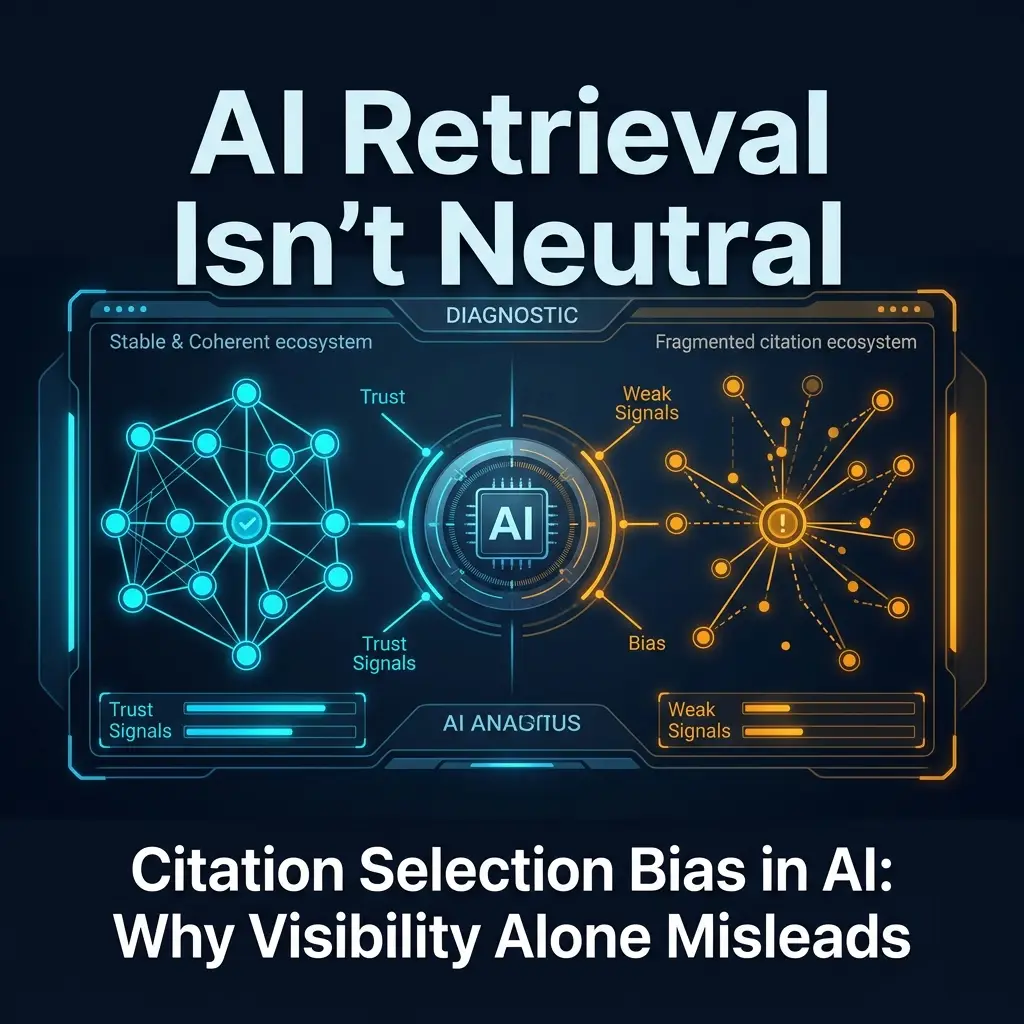
AI search and answer systems look objective from the outside.
A user asks a question. The system retrieves information. The answer appears to reflect the best and most relevant sources. Many businesses assume that if they are not showing up, they simply need better content or more visibility.
That assumption is too simple.
AI systems do not retrieve information in a neutral or purely merit-based way. They show clear patterns in what they trust, what they cite, and what they repeat. Those patterns create citation selection bias: a tendency to favor certain source types, authority signals, and semantic contexts over others.
This matters because the brands that appear most often in AI answers are not always the brands that are most relevant. Often, they are the brands that have learned to align with the source patterns AI systems prefer.
That is a very different challenge.
It means AI visibility is not just about quality. It is also about compatibility with the retrieval and citation habits of AI systems. If your brand does not fit those habits, strong expertise alone may not be enough to earn consistent presence.
In this post, we will look at what citation selection bias is, why AI retrieval is not neutral, how source preferences shape brand visibility, and how Axis Suite helps businesses diagnose and solve this problem.
What is citation selection bias in AI?
Citation selection bias is the tendency of AI systems to favor some information sources over others when generating answers.
This bias does not always come from one explicit rule. It often emerges from how modern AI systems are built. Models draw on training patterns, retrieval systems, ranking layers, source trust signals, web structure, and repeated associations between topics and entities. The result is a system that does not treat every valid source equally.
Instead, AI tends to show preferences for:
- Certain source formats
- Certain types of websites
- Certain authority signals
- Certain language patterns
- Certain clusters of related concepts and entities
In practice, this means some brands enter the citation flow more easily than others.
A company may be highly credible in its field and still struggle to appear in AI answers if its digital footprint does not match the signals AI systems favor. Another brand may appear more often, not because it is better, but because it has stronger alignment with the source ecosystem AI trusts.
That is why citation selection bias is important. It shifts the question from “Are we good enough to be cited?” to “Are we visible in the formats and contexts AI systems are most likely to trust?”
Why AI retrieval is not neutral
Many businesses still think of AI retrieval as a simple relevance engine. If your brand has the best answer, the system should surface it. If it does not, the market assumes the brand needs better content.
That is not how these systems work in the real world.
AI retrieval is shaped by multiple layers of filtering and interpretation. A system may prefer information that appears on domains with strong authority signals. It may weight sources that are often cited by other trusted sites. It may lean toward language that fits known semantic patterns. It may also favor content that sits inside stable topic clusters the model can interpret with confidence.
This creates non-neutral behavior.
The output may look merit-based, but the path to that output is shaped by selection patterns. Those patterns affect which sources are retrieved, which are ignored, and which become part of the answer frame.
Retrieval depends on trust proxies
AI systems cannot verify every claim like a human expert would. Instead, they rely on trust proxies.
These may include:
- Domain reputation
- Consistent topical coverage
- Strong entity associations
- Repeated third-party mentions
- Structured and unstructured citation patterns
- Semantic consistency across channels
These proxies are useful, but they are not neutral. They reward some digital footprints more than others.
Relevance and selection are not the same
A source can be relevant without being selected.
That is one of the most important ideas for marketers to understand. Your brand may have a useful page, accurate information, and real expertise. But if your signal structure is weak, fragmented, or outside the semantic neighborhoods AI prefers, the system may skip over you.
That is not a pure content problem. It is a citation selection problem.
The source types AI systems tend to favor
Citation selection bias often shows up in the kinds of sources AI systems repeatedly reference.
While preferences vary by system, many models and answer engines tend to rely more heavily on sources with the following traits:
High-authority domains
Sites with strong domain-level trust often appear more often in AI answers. This may include established publishers, respected industry platforms, research sites, and widely cited business properties.
These domains benefit from historical authority, robust linking patterns, and stronger trust associations.
Stable reference sources
AI systems often prefer sources that present information in consistent, reference-friendly ways. This can include knowledge panels, company profiles, public documentation, category pages, and other structured pages that reduce ambiguity.
A stable source is easier for AI to interpret and cite confidently.
Frequently co-cited ecosystems
If a brand appears inside a broader network of trusted mentions, comparisons, and references, it becomes easier for AI to retrieve it. Brands that exist in strong citation ecosystems gain reinforcement from the sources around them.
This is one reason why external context matters so much.
Semantically aligned content clusters
AI systems tend to retrieve information more easily when it lives in a clear topic neighborhood. If your messaging is tightly connected to a category, use case, and competitor set, the system can place you more reliably.
If your brand language is broad or inconsistent, retrieval becomes harder.
Semantic neighborhoods shape who gets seen
One of the least understood parts of AI visibility is the role of semantic neighborhoods.
A semantic neighborhood is the cluster of terms, topics, categories, and related entities that surround your brand online. AI systems use these patterns to understand what your business is, what it does, and when it should appear.
This means visibility is not just about your website. It is also about the language environment around your brand.
If your company is regularly associated with the right category terms, problem statements, use cases, and comparison contexts, AI gains confidence in when to retrieve you. If those associations are weak or mixed, the system may struggle to place you.
Strong semantic neighborhoods improve retrieval confidence
Brands that show up consistently in AI answers usually send clear and repeated signals about:
- Their category
- Their audience
- Their core use cases
- Their differentiators
- Their market context
When these signals appear across multiple public surfaces, AI has a stronger basis for retrieval.
Weak semantic neighborhoods create ambiguity
If your brand is described one way on your website, another way on social profiles, and a third way in third-party mentions, AI may not know where to place you. That lowers retrieval confidence and weakens citation likelihood.
This is why brands that “speak the language AI trusts” often outperform brands with strong products but weaker signal alignment.
Why the most visible brands are not always the most relevant
This is where citation selection bias becomes a strategic issue.
Many teams assume that the brands appearing most often in AI answers must be the best-known or most relevant players. Sometimes that is true. Often, it is only partly true.
In many cases, the most visible brands are the ones that have built a digital presence that aligns with AI trust patterns. They have:
- Stronger authority signals
- Better citation support
- More stable source patterns
- Clearer category language
- More consistent semantic reinforcement
That does not automatically make them the best option for every query. It makes them the easiest option for AI systems to retrieve and cite.
This distinction matters because it changes the competitive landscape. Brands are no longer competing only on product quality or even traditional SEO strength. They are competing on whether AI systems can confidently classify, retrieve, and cite them.
Stable citation ecosystems matter more than isolated mentions
A single mention on a strong site can help. But isolated mentions rarely solve a citation selection problem on their own.
What matters more is a stable citation ecosystem.
A stable citation ecosystem is a repeatable network of sources, references, mentions, and semantic signals that reinforce your brand’s credibility and category fit over time. It gives AI systems a broader base of trust.
This can include:
- Consistent company descriptions across public profiles
- Strong category alignment across the website
- Third-party mentions on relevant industry sites
- Comparative context that places the brand correctly
- Repeated language around core use cases and differentiators
The key is consistency.
AI systems are more likely to trust what they can see repeated across multiple credible surfaces. A stable ecosystem reduces ambiguity and increases the odds that your brand will be cited in the right contexts.
Why stability matters
Stability matters because AI systems do not make decisions from one page alone. They infer trust from patterns.
If your citation environment is thin or unstable, retrieval becomes fragile. You may appear once and disappear the next time. If your ecosystem is more stable, AI has a stronger basis for repeated inclusion.
That repeatability is where real AI presence begins.
Why visibility metrics alone are not enough
Many AI visibility tools focus on outputs: whether your brand appeared, how often it appeared, and where it ranked in a set of prompts.
Those metrics are useful, but they only show the result.
They do not explain:
- Why the brand was selected
- Which sources supported retrieval
- Whether the brand’s authority signals are strong enough
- How category context influenced the outcome
- Why a competitor appears more often in adjacent prompts
Without that diagnostic layer, teams can misread the problem.
A business may think it has a visibility issue when the real issue is a source trust issue. Or it may focus on creating more content when the deeper problem is that its citation ecosystem is weak and semantically fragmented.
This is where Axis Suite becomes valuable.
How Axis Suite helps brands solve citation selection bias
Axis Suite helps brands move beyond surface visibility reporting and understand the structure behind AI retrieval.
Instead of only showing whether a brand appears, Axis Suite helps teams examine the patterns that influence why it appears when it does and why it fails to appear when it should.
That matters because citation selection bias is solvable, but only if you can diagnose it clearly.
Axis Suite reveals source and signal patterns
Axis Suite helps teams identify the trust and citation factors shaping AI performance, including:
- Which source types are reinforcing visibility
- Where authority signals are strong or weak
- How category language affects retrieval
- Whether semantic neighborhoods support or confuse the brand
- How stable the broader citation ecosystem is
This helps teams see whether AI visibility is being supported by durable signals or by a few isolated wins.
Axis Suite helps brands detect structural gaps
A brand may have good content and still underperform in AI answers if its signal structure is incomplete. Axis Suite helps uncover issues such as:
- Weak third-party validation
- Inconsistent brand descriptions
- Poor category clarity
- Thin comparative context
- Fragmented semantic reinforcement
These are not always obvious from visibility counts alone, but they strongly affect citation outcomes.
Axis Suite supports strategic correction
Once a team understands the source of the bias, it can respond more effectively.
With Axis Suite, brands can prioritize work such as:
- Tightening category language across public surfaces
- Strengthening entity consistency
- Building better external citation support
- Expanding trusted semantic associations
- Improving the stability of their citation ecosystem
This turns AI optimization into a more strategic process. Instead of chasing mentions, teams can build the kinds of signals AI systems are more likely to trust and reuse.
Why understanding citation selection bias is a strategic advantage
The biggest advantage is not technical. It is strategic.
Businesses that understand citation selection bias early stop treating AI visibility as a passive outcome. They begin treating it as a system shaped by trust patterns, source preferences, and contextual reinforcement.
That shift changes how they invest.
Instead of asking only, “How do we get mentioned more?” they ask:
- Which sources does AI trust in our category?
- What authority signals are competitors benefiting from?
- Is our brand sitting in the right semantic neighborhood?
- Do we have a stable citation ecosystem?
- Are we giving AI enough confidence to retrieve and cite us repeatedly?
These are better questions. They lead to better decisions.
Early understanding creates compounding gains
Brands that adapt early can strengthen their AI presence before citation patterns harden further. As AI systems mature, repeated source preferences may become even more influential. Businesses that build trusted signal ecosystems now will likely benefit from stronger compounding visibility later.
Better diagnosis reduces wasted effort
Understanding the bias also saves time and budget. Teams can avoid overinvesting in tactics that do not address the real issue. Instead of producing more content without a clear retrieval strategy, they can focus on the source structures and authority signals that actually affect selection.
Strategic brands will build for trust, not just exposure
The next phase of AI discovery will reward brands that understand how trust is inferred. Visibility will still matter, but trust-compatible visibility will matter more.
That is why citation selection bias should not be viewed as a technical footnote. It is a strategic market condition.
What marketing teams should do next
If your business depends on discoverability, start by challenging the idea that AI retrieval is neutral.
Then take practical steps:
Audit your current AI presence
Look beyond whether your brand appears. Review how often it appears, where it appears, and what source patterns may be supporting those appearances.
Evaluate your authority signals
Assess whether your public footprint gives AI strong trust proxies. Check external mentions, profile consistency, category alignment, and comparative context.
Strengthen your semantic neighborhood
Make sure your brand is consistently associated with the right category, use cases, and differentiators across all major public surfaces.
Build a stable citation ecosystem
Focus on durable reinforcement, not one-off mentions. Repetition across credible and relevant sources matters more than scattered visibility.
Use Axis Suite to diagnose and prioritize
Use Axis Suite to identify where your citation ecosystem is strong, where it is weak, and what changes are most likely to improve AI trust and retrieval performance.
Conclusion
AI retrieval is not neutral, and it is not purely merit-based.
It reflects systematic preferences for certain source types, authority signals, and semantic neighborhoods. That creates citation selection bias, which helps explain why some brands appear consistently in AI answers while others remain underrepresented.
The brands winning in AI are often not just the most relevant. They are the ones that have learned to speak the language AI systems trust. They operate inside stronger citation ecosystems, clearer semantic contexts, and more stable authority structures.
That is good news for businesses willing to act, because this problem can be solved.
But first, you have to recognize that it exists.
Axis Suite helps brands understand the deeper structure behind AI visibility, diagnose citation selection bias, and build a more durable AI presence based on trust, clarity, and strategic signal alignment.
The businesses that understand this now will not just measure AI visibility better.
They will build it more intelligently.