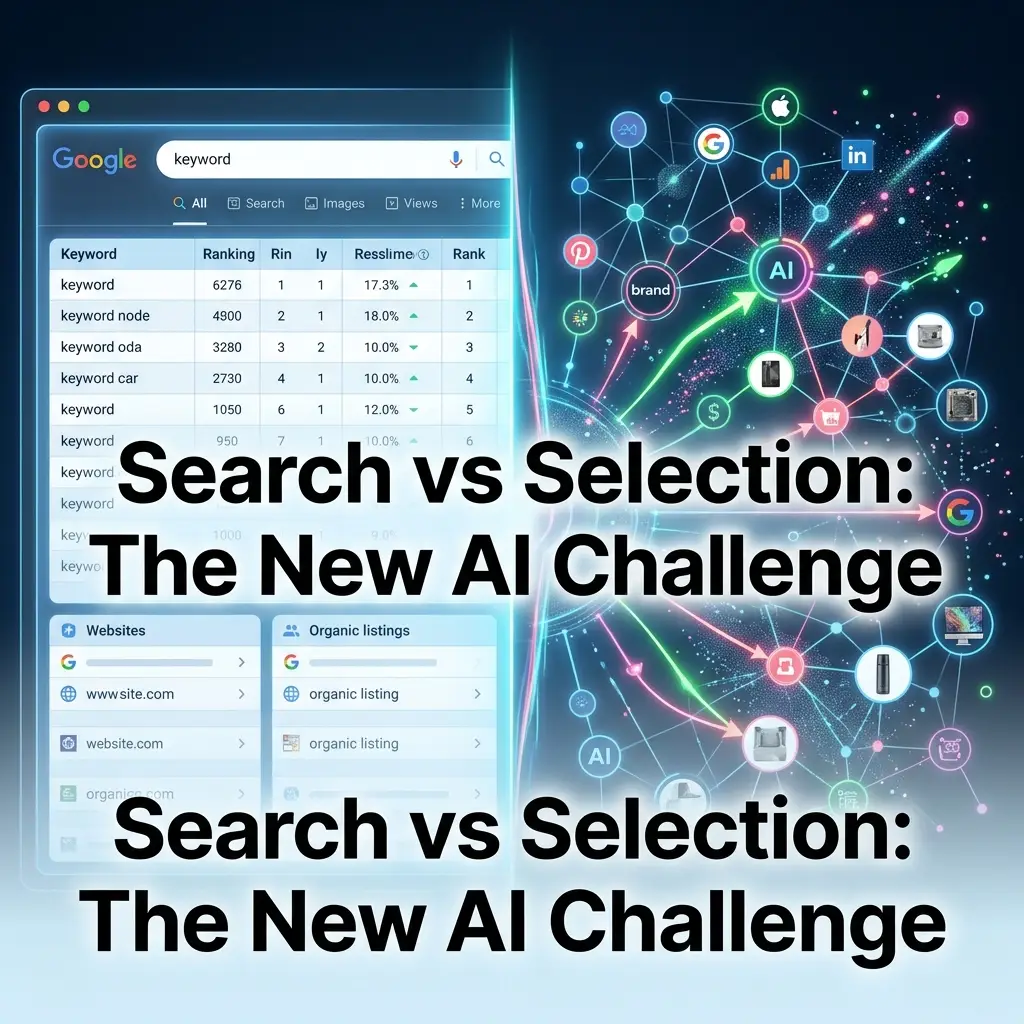
Google just made its position clearer on AI visibility optimization.
Some tactics marketers hoped would matter do not appear to move the needle much. LLMs.txt is not a major factor. Markdown formatting is not a major factor. Special content chunking is not a major factor either.
What does matter, according to Google, is more familiar. Structured data matters. Authentic mentions matter. Content that genuinely answers questions matters.
That guidance is useful, and for Google’s ecosystem, it makes sense. But it also risks creating a false sense of completeness. Many businesses will read those updates and assume they now know how to improve AI visibility everywhere. They do not.
The real issue is bigger than search. The question is no longer just how to rank in Google. It is how to get selected when buyers ask AI systems which company to hire, which platform to trust, or which software to buy. In this post, we will look at what Google clarified, why that guidance is only part of the picture, how AI selection differs from traditional search visibility, and why Axis Suite matters for companies trying to understand how recommendation decisions are actually being made across the broader AI discovery ecosystem.
Google clarified what matters for AI visibility
Google’s recent guidance cuts through a lot of noise.
For a while, many teams chased technical theories about what might help AI systems understand and surface their content. Some of those ideas sounded plausible. Others spread because they gave marketers something new to do. But Google’s clarification points back to fundamentals.
What Google says is not especially impactful
Google has signaled that these items are not the main drivers many hoped they would be:
- LLMs.txt
- Markdown formatting
- Special content chunking
That does not mean they are always useless in every workflow. It means they are not the core levers for Google visibility in the way some people claimed.
This is an important reset. It reminds businesses that AI visibility is not won through gimmicks or formatting hacks alone.
What Google says does matter
Instead, Google is rewarding signals that fit its long-standing approach to information quality and discoverability:
- Structured data
- Authentic mentions
- Content that genuinely answers questions
None of this is surprising. Google has always valued clarity, relevance, and trust signals. Structured data helps machines interpret content. Authentic mentions help validate credibility. Useful content helps match intent.
If your goal is better performance inside Google’s environment, this is a strong foundation.
The problem: Google is optimizing for Google
This is where many businesses stop thinking too early.
Google’s guidance tells you how Google wants to interpret and surface content. That is valuable, but it does not fully answer the broader business question. It answers a platform question.
And those are not the same thing.
Platform optimization is not ecosystem optimization
Google controls its own systems, signals, and priorities. It decides how to combine crawling, indexing, ranking, AI summaries, and other retrieval layers. Its guidance reflects how Google evaluates usefulness and trust.
But the broader AI discovery ecosystem includes many other systems with different behaviors.
These systems do not all retrieve information the same way. They do not all weigh citations the same way. They do not all form recommendations from the same set of signals. Some emphasize publisher authority. Some pull heavily from aggregated web patterns. Some rely on different retrieval pipelines. Some show strong drift in category interpretation and brand selection.
That means a company can be well-optimized for Google and still be weakly positioned for AI recommendation elsewhere.
Search visibility and AI recommendation are different jobs
A ranking model and a recommendation model are not identical.
Search asks, “What results should appear for this query?”
AI selection asks, “Which brands belong in this answer, and how should they be described?”
That second question carries more risk. It does not just determine whether your brand is visible. It shapes whether your brand is chosen, how it is framed, and which competitors appear beside it.
That is a much deeper challenge than classic SEO.
The shift from ranking in search to selection in AI
This is the real strategic pivot.
For years, businesses focused on ranking. That made sense because search was the main gateway to discovery. You improved pages, earned links, aligned with intent, and moved upward over time.
Now a new layer is forming. Buyers are increasingly asking AI systems to shortlist vendors, recommend tools, compare options, and explain markets. In those moments, the goal is not just to appear somewhere. The goal is to be selected.
Selection changes the competitive game
When AI systems recommend brands, they compress the decision set.
A user may not click through ten blue links and do their own comparison. They may get a direct answer with a handful of names. Or fewer. If your brand is not included, you do not just lose a rank position. You may disappear from consideration altogether.
That is why the move from search to selection matters so much.
Selection depends on whether AI systems can:
- retrieve your brand reliably
- understand your category correctly
- describe your value clearly
- compare you against the right competitors
- reinforce your inclusion across repeated prompts and sessions
Those are not simple SEO concerns. They are recommendation infrastructure concerns.
Being visible is not the same as being chosen
A brand might have strong search presence and still fail in AI selection.
Why? Because AI systems need more than pages to rank. They need confidence in what your business is, where it fits, and why it belongs in an answer. If those signals are weak, inconsistent, or fragmented, the system may skip you, misclassify you, or recommend someone else.
This is why businesses need to think beyond traffic and start thinking about selection readiness.
Why Google optimization is not enough for broader AI discovery
Google’s guidance is useful, but it does not map cleanly across the full AI landscape.
That is because the broader AI discovery environment is not one system. It is a mix of models, retrieval patterns, citation behaviors, and answer-generation methods that are still evolving.
Different systems use different retrieval patterns
Some AI systems rely more heavily on web retrieval. Others depend more on model memory or hybrid approaches. Some are better at entity recognition. Others struggle with category precision. Some consistently pull the same brands. Others vary widely across sessions.
That variability matters.
If you only optimize for what Google has confirmed, you may improve one channel while remaining weak across others. You may see better structured understanding in one environment but still lack the signals needed for stable recommendation elsewhere.
Different systems create different recommendation behavior
Recommendation is not neutral.
AI systems do not just gather information. They synthesize, filter, and prioritize. In doing that, they develop patterns. They start favoring certain entities, descriptions, and sources. Over time, those patterns can harden.
This means the business problem is not only “Can the system find us?”
It is also:
- Does the system trust our category framing?
- Does it repeatedly include us in the right context?
- Does it compare us to the right companies?
- Does it describe us in a way that supports selection?
Google’s guidelines do not answer those ecosystem-wide questions.
The broader market still lacks visibility into AI selection
This is the infrastructure gap most companies have not solved.
Many teams can track rankings, impressions, clicks, and search performance. Far fewer can see how multiple AI systems are actually making brand selection decisions. They cannot easily tell where category understanding is drifting, where recommendation consistency is weak, or where competing brands are gaining reinforcement.
That blind spot is becoming more expensive.
If AI becomes a stronger layer of commercial discovery, then not knowing how selection works is a strategic risk.
What businesses should focus on now
The smartest response is not to abandon SEO. It is to expand the frame.
Google optimization still matters. Structured data still matters. Authentic mentions still matter. Strong content still matters. But businesses need to combine those basics with a broader approach designed for AI selection.
Build for clarity, not cleverness
AI systems respond better to clear signals than creative ambiguity.
Your category language should be direct and repeatable. Your differentiators should be easy to retrieve and compare. Your descriptions should make it obvious what you do, who you serve, and how you differ.
If your brand is described in five different ways across the web, AI systems may struggle to interpret you consistently.
Strengthen signals that travel across ecosystems
A useful signal in one platform should ideally support your brand in others as well.
That means focusing on:
- consistent category definitions
- strong entity clarity
- trusted mentions across reputable sources
- precise product and service explanations
- content that answers real buyer questions in plain language
These signals help machines classify and repeat your brand more confidently.
Measure recommendation patterns, not just search metrics
Traditional search metrics only show part of the picture.
You also need to understand:
- where your brand appears across AI systems
- how often it is included
- how it is described
- which competitors are surfaced alongside it
- whether your category is being interpreted correctly
- whether recommendation behavior is stable or drifting
Without that view, businesses are still operating with incomplete information.
How Axis Suite helps close the AI selection gap
This is where Axis Suite becomes essential.
The market does not just need more content. It needs better visibility into how AI systems make selection decisions. That is the missing infrastructure layer, and Axis Suite is designed to address it.
Axis Suite helps businesses move beyond search-only thinking
Most companies still rely on tools built for a search-first world. Those tools are useful, but they were not built to explain AI recommendation behavior across systems.
Axis Suite helps businesses see beyond rankings and into the mechanics of selection. It gives teams clearer visibility into how brands appear across AI environments, where category understanding is strong or weak, and how recommendation patterns differ from one system to another.
Axis Suite helps diagnose the real problem
When a brand is underperforming in AI discovery, the issue is not always obvious.
It could be:
- low retrieval persistence
- weak category clarity
- inconsistent external mentions
- poor competitive framing
- unstable recommendation behavior across platforms
Axis Suite helps separate these problems so teams can fix the right one.
That matters because the wrong diagnosis leads to wasted effort. A company might publish more content when the real issue is category confusion. It might chase mentions when the problem is inconsistent positioning. It might focus on Google improvements while missing weak selection performance elsewhere.
Axis Suite bridges the infrastructure gap
The biggest challenge in AI discovery today is not just optimization. It is visibility into the system itself.
Businesses need a way to understand how AI systems are selecting brands, not just whether a page ranks. Axis Suite helps bridge that infrastructure gap by giving organizations the insight needed to monitor, interpret, and improve their AI discovery position across the broader ecosystem.
That is the difference between reacting to outputs and understanding the structure behind them.
A new standard for AI visibility strategy
The companies that win in this next phase will not treat AI visibility as a copy of SEO.
They will understand that Google guidance is one piece of the puzzle, not the whole puzzle. They will keep doing the fundamentals well, but they will also invest in signal consistency, category precision, and selection visibility across platforms.
The status quo is no longer enough
The old mindset says:
- optimize pages
- improve rankings
- capture traffic
That still matters. But it is incomplete.
The new mindset adds a harder question:
- when AI systems are asked who to recommend, do they choose us?
That is the strategic shift from search to selection.
Early movers will have an advantage
AI recommendation habits are still forming. That creates an opening.
Businesses that build strong, stable signals now may earn a compounding advantage later. As systems reinforce the brands and descriptions they trust, changing those patterns may become harder.
That is why now is the time to act. Not after the ecosystem matures. Before it does.
Conclusion
Google’s AI visibility guidance is helpful, but it is not a complete AI discovery strategy.
Yes, structured data, authentic mentions, and content that genuinely answers questions matter. And yes, tactics like LLMs.txt, Markdown formatting, and special chunking appear far less important than many expected. But that guidance is still fundamentally about how Google evaluates visibility inside Google’s environment.
The larger business question is different. It is not just how to rank in search. It is how to get selected when buyers ask AI systems what to buy, who to hire, and which brands to trust.
That requires a shift in strategy. Businesses need to move from search-first thinking to selection-first thinking. They need to understand how AI systems retrieve, interpret, compare, and recommend brands across a fragmented ecosystem.
Axis Suite helps make that shift possible by giving companies the visibility they need into AI selection decisions and the infrastructure gap most of the market still cannot see.
If your team is still optimizing only for search, now is the time to expand the frame. The future of discovery will not be won by ranking alone. It will be won by being selected.