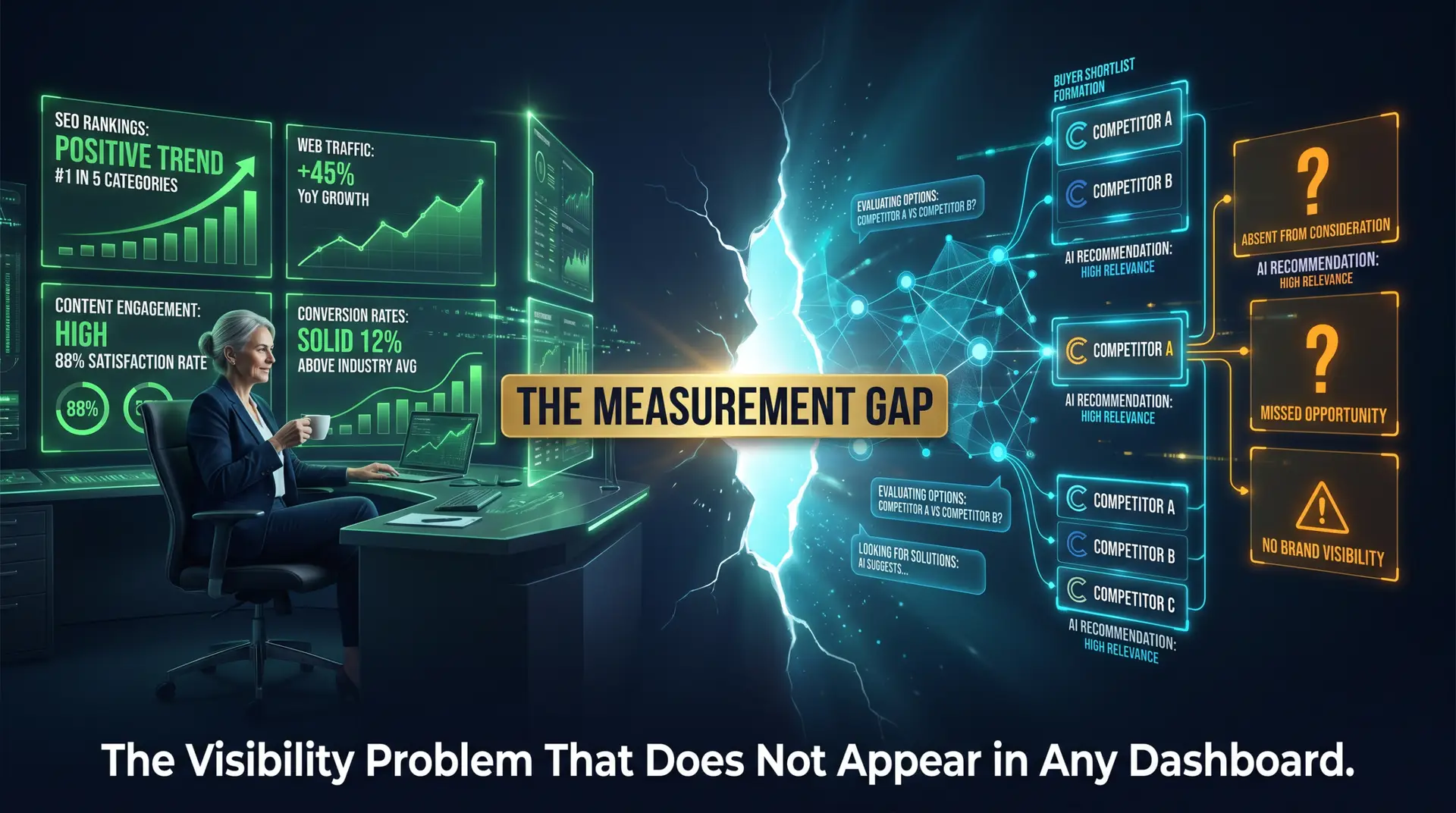
There is a visibility problem forming inside marketing organizations that most dashboards will never surface.
CMOs can have strong SEO rankings. Growing traffic. Healthy content output. Solid conversion rates. Every marketing metric pointing in the right direction.
And still be completely missing from AI-generated recommendation lists when buyers research their category.
This is not a content quality problem. It is not a budget problem. It is not a brand awareness problem.
It is a measurement gap. And it is quietly determining which companies get evaluated and which ones do not.
What Marketing Analytics Actually Measure
Most marketing analytics platforms were built around a specific assumption.
The buyer finds you first. Then your funnel takes over.
Every metric in a standard marketing stack reflects this assumption. Traffic sources tell you how buyers arrived. Time on page tells you how engaged they were. Conversion rates tell you how many took the next step.
These are legitimate and valuable measurements. But they all start at the same moment.
The moment a buyer reaches your website.
What they do not measure is what happened before that. Specifically whether your brand was included when a buyer asked AI who to consider in your category.
That pre-visit moment is increasingly where the shortlist forms. And it is entirely outside the measurement boundaries of every standard analytics tool.
The Question Shifting Underneath Marketing Teams
The question most marketing teams are optimizing for is this:
Can buyers find us when they search?
That is a reasonable question. It has been the right question for a long time.
But a different question is gaining importance underneath it.
Do AI systems include us when buyers ask who to consider?
Those two questions sound similar. They are not.
The first question is about search visibility. It is measured by rankings, traffic, and click-through rates.
The second question is about recommendation presence. It is measured by whether your brand consistently appears in AI-generated vendor shortlists when buyers ask evaluative questions in your category.
A brand can score well on the first question and score zero on the second.
That gap is where the measurement problem lives.
Why This Is a CMO Problem Specifically
Revenue leaders and CMOs are accountable for pipeline. For demand generation. For ensuring that qualified buyers enter the funnel in sufficient volume.
The pre-funnel shortlist stage directly affects all three.
If AI systems are forming buyer shortlists before website visits, and those shortlists determine who gets evaluated, then a brand’s absence from that stage is a pipeline problem not just a visibility problem.
It means qualified buyers are entering evaluation processes with your competitors before your brand ever had a chance to compete.
No traffic drop signals this. No conversion rate change reveals it. No standard dashboard captures it.
The pipeline impact is real. The measurement gap makes it invisible.
What CMOs Should Be Asking Right Now
The right diagnostic questions for any marketing leader navigating this shift are:
When buyers in our target market ask AI who to consider in our category, does our brand consistently appear?
Which competitors are appearing instead and how are they being described?
How does our AI recommendation presence change depending on how the question is asked?
Is our recommendation presence consistent across ChatGPT, Perplexity, and Claude?
What signals are driving the brands that consistently appear in our category?
These questions do not have answers inside a standard analytics platform. They require a different kind of measurement infrastructure built specifically for the pre-funnel stage.
The Measurement Gap Is the Pipeline Gap
Strong SEO does not guarantee AI shortlist presence. Growing traffic does not confirm recommendation visibility. Healthy content output does not ensure category association inside AI systems.
These are related but distinct disciplines. A brand can excel at traditional digital marketing and still be systematically excluded from the AI-generated shortlists that increasingly determine who gets evaluated.
The measurement gap between what marketing dashboards show and what AI systems are deciding upstream is not a technical nuance. It is a pipeline risk that grows larger as AI-assisted research becomes more common in the buying process.
The CMOs who close that measurement gap first will have an intelligence advantage over those still optimizing only for what happens after the click.
FAQ
What is pre-funnel recommendation presence?
Pre-funnel recommendation presence refers to whether your brand appears in AI-generated vendor shortlists when buyers ask category-level questions before visiting any websites. It measures the stage of the buyer journey that happens inside AI systems before traditional analytics begin tracking.
Why do marketing dashboards miss AI shortlist activity?
Standard marketing analytics platforms capture behavior that occurs on your website or in owned channels. When a buyer researches vendors inside ChatGPT, Perplexity, or Claude, no signal reaches your analytics stack unless the buyer subsequently visits your website. The shortlist formation moment is invisible to click and session based measurement tools.
How is AI recommendation presence different from SEO rankings?
SEO rankings measure where your brand appears in search engine results pages. AI recommendation presence measures whether your brand appears when buyers ask AI systems who to consider in your category. A brand can have strong SEO rankings and still be absent from AI-generated vendor recommendations because the signals that influence each are related but distinct.
What signals influence AI shortlist inclusion?
AI systems appear to weight brand mention frequency across authoritative sources, clarity of category association, corroboration across multiple independent sources, specificity of value proposition, and presence in comparison and evaluation contexts. Brands that consistently appear across these signals are more likely to be included in AI-generated shortlists.
How can a CMO start measuring pre-funnel recommendation presence?
A practical starting point is to ask ChatGPT, Perplexity, and Claude who the leading options are in your category without mentioning your brand. Run the same question with different phrasings. Note which brands appear consistently and how they are described. The gap between your analytics data and your AI recommendation presence is your pre-funnel measurement gap.
How does Axis Suite address this measurement gap?
Axis Suite monitors AI recommendation presence across major platforms using buyer-intent prompts that mirror real buyer research behavior. It tracks how consistently your brand appears, how it is described relative to competitors, and what signal gaps explain inconsistent or absent recommendations.
The next step:
Run the pre-funnel audit. Ask AI who to consider in your category without mentioning your brand. See where you appear, how consistently, and who is being recommended instead. That fifteen minute exercise reveals more about your actual pipeline risk than most quarterly marketing reviews.
Then use Axis Suite to track that presence systematically over time.