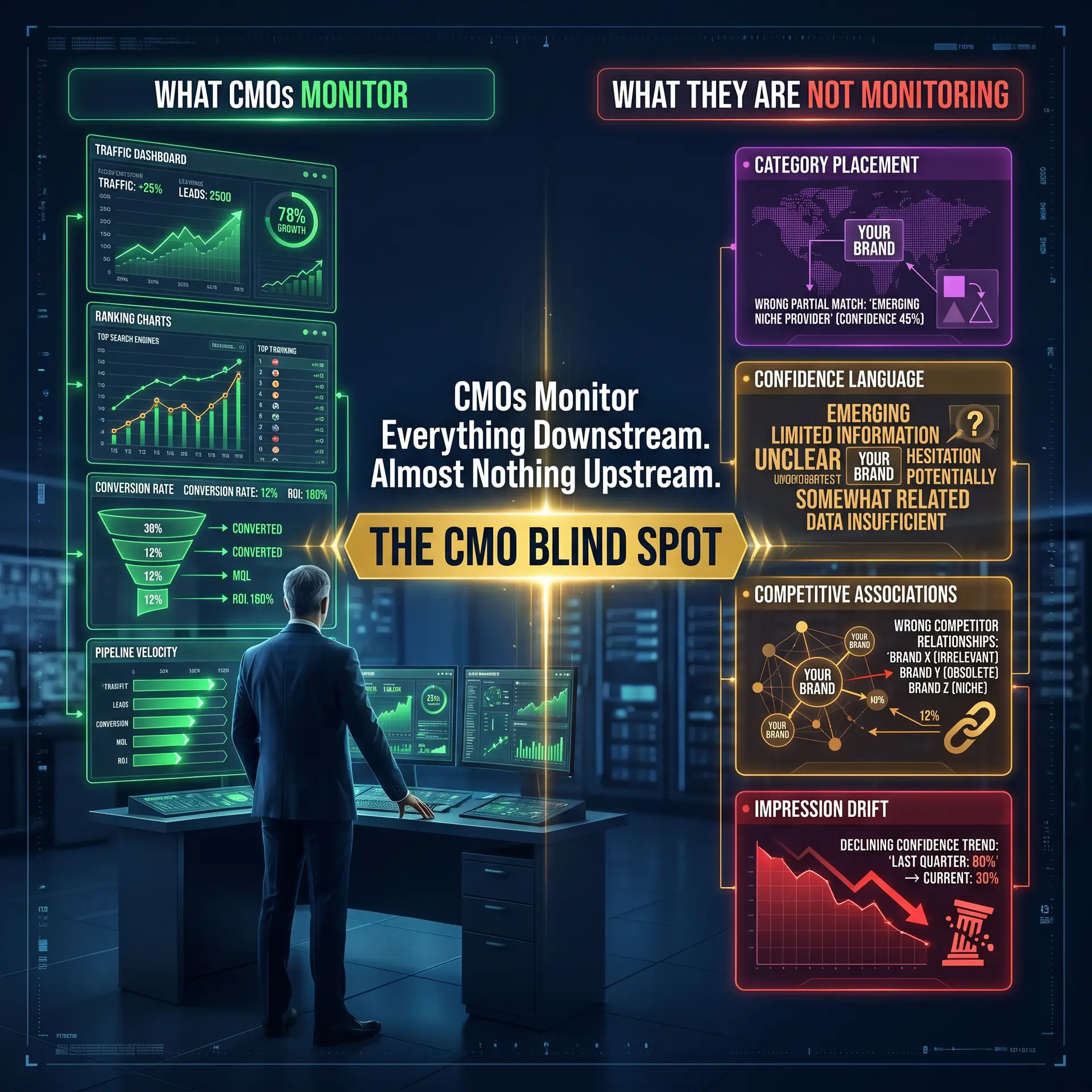
CMOs are monitoring traffic. Rankings. Conversions. Pipeline velocity.
The marketing intelligence stack at most organizations is more sophisticated than it has ever been.
And most of it is completely blind to something that is quietly shaping buyer behavior before any of those metrics even start recording.
What AI has come to durably believe about your brand.
The Measurement Gap at the Senior Marketing Level
Here is what a standard marketing intelligence stack captures:
How many people visited the website. Where they came from. How long they stayed. What percentage converted. How pipeline is moving through the funnel.
Every one of those measurements assumes the buyer has already arrived.
None of them capture what determined whether AI included your brand in the consideration set that the buyer brought into their research.
And increasingly that consideration set is being formed inside AI systems before buyers visit any website, compare any options, or make any contact with a sales team.
The impressions AI has formed about your brand are not just influencing visibility. They are shaping the competitive context your brand enters every time a buyer asks AI who to consider.
Those impressions are invisible to every standard CMO dashboard.
The Four Things AI Believes About Your Brand That Most CMOs Are Not Monitoring
What category AI has filed your brand under
AI does not just know your brand exists. It has formed a belief about what category your brand belongs in. That category placement determines which competitive context your brand enters in every buyer shortlist scenario.
A brand filed under the right specific category competes against the right alternatives and gets evaluated by the right buyers.
A brand filed under a broader or partial match category competes against a wider and less relevant competitive set. Buyers who see that comparison may conclude the brand is not specifically right for their use case even if it is.
Most CMOs have never checked what category AI has actually filed their brand under.
Whether AI is using authority language or hesitation language
When AI describes a brand it uses language that signals its confidence level. Authority language sounds like established, leading, trusted, known for, specializes in. Hesitation language sounds like emerging, newer, limited information, some users report, may be suitable for.
Buyers reading AI descriptions pick up on that confidence signal even when they are not consciously aware of it. A brand described with hesitation language is perceived as less established than a competitor described with authority language regardless of the actual relative quality of the two brands.
Most marketing teams have never audited the confidence language AI consistently uses when describing their brand.
Which competitors AI mentally associates your brand with
AI does not just describe brands in isolation. It forms relational beliefs. Your brand is remembered partly through who AI consistently places alongside it in comparisons, alternative lists, and recommendation scenarios.
If AI consistently associates your brand with the wrong competitive set, buyers evaluating your category will encounter your brand in contexts that do not match your actual positioning.
A brand that has repositioned from one market segment to another may find AI still carrying the old comparative associations months after the repositioning occurred. AI memory updates more slowly than brand strategy changes.
Whether those impressions are drifting away from reality
Brand impressions inside AI systems are not static. They drift.
As new content gets indexed, new comparisons get made, and new associations form, AI updates its understanding of a brand. Sometimes that drift is positive. AI develops more accurate and more specific beliefs.
Sometimes it is negative. Descriptions become more generic. Category placement becomes less precise. Trust language weakens.
Most marketing teams have no visibility into whether their AI brand impression is strengthening or degrading over time.
Why Standard Dashboards Cannot Surface This
The measurement gap is structural not accidental.
Standard analytics platforms are built around behavioral signals. Clicks. Sessions. Conversions. Engagement. These signals are generated when users interact with websites and owned channels.
AI brand impressions are formed inside AI systems through a completely different process. They are built from patterns across external sources, citation ecosystems, comparison content, and accumulated retrieval experiences. None of that signal generation touches your analytics infrastructure.
You can have a perfectly instrumented marketing stack and still have zero visibility into what AI has come to believe about your brand.
That is not a failure of your analytics team. It is a structural gap between what current tools were built to measure and where brand impressions are increasingly being formed.
The Business Consequence
Every buyer using AI for vendor research is experiencing the impressions AI has formed about your brand.
If those impressions are accurate, specific, and confident, your brand enters buyer shortlists in the right competitive context with the right positioning signals.
If those impressions are wrong, generic, or drifting, your brand either enters buyer shortlists in the wrong competitive context or fails to enter them at all.
And your marketing dashboard will look completely normal either way.
The gap between what your metrics show and what buyers are experiencing in AI-assisted research is the CMO blind spot that most marketing organizations have not yet closed.
What CMOs Should Add to Their Intelligence Stack
Three specific measurements that address this gap:
Category placement monitoring: What category is AI actually filing your brand under across ChatGPT, Perplexity, Claude, and Gemini? Does it match your intended positioning?
Brand confidence language audit: Is AI describing your brand with authority language or hesitation language? How does that compare to how AI describes your main competitors?
Competitive association mapping: Which competitors does AI consistently place alongside your brand? Are those the right competitive associations for your current market positioning?
These are not one-time snapshot measurements. They are ongoing intelligence requirements for any marketing team that wants visibility into the pre-funnel stage where buyer consideration is increasingly forming.
FAQ
Why should CMOs care about what category AI files their brand under?
Category placement by AI determines the competitive context your brand enters in every buyer shortlist scenario. A brand filed under the wrong category gets compared against the wrong alternatives and evaluated for the wrong use cases. Buyers who encounter your brand in the wrong competitive context may dismiss it as not relevant to their specific situation even if it would be the right choice for them.
How does AI develop hesitation language about a brand?
AI develops hesitation language when it encounters insufficient corroborating evidence about a brand across trusted sources. If your brand does not have strong consistent presence across the external sources AI trusts most, it hedges its descriptions. Phrases like emerging, limited information, some users report, and newer platform are signals that AI does not have enough confidence to describe your brand with authority. This typically indicates gaps in external corroboration rather than problems with the brand itself.
How often do AI brand impressions change?
AI brand impressions update gradually as new content gets indexed and new patterns emerge across sources. Major repositioning or rebranding can take months to fully propagate through AI memory. Smaller changes like new competitor associations or category drift can happen more quickly as the comparative landscape shifts. This is why Memory Intelligence requires longitudinal measurement rather than one-time snapshots.
What is the difference between AI brand impressions and brand reputation?
Traditional brand reputation is formed through human perception across marketing touchpoints, customer experiences, and word of mouth. AI brand impressions are formed through the patterns AI encounters across external sources, citation ecosystems, and comparative content. The two often correlate but they are not the same. A brand can have strong human reputation and weak AI impressions if the signals AI uses to form its understanding are inconsistent or insufficient.
How does competitive association affect recommendation outcomes?
When AI consistently associates your brand with a specific competitive set, it filters recommendation scenarios through that association. If a buyer asks which brands to consider for a specific use case, AI will draw on its comparative memory to populate the shortlist. A brand associated with the wrong competitive set may appear in the wrong recommendation scenarios and miss the right ones entirely.
How does Axis Suite measure AI brand impressions?
Axis Suite’s Memory Intelligence module tracks what AI systems consistently believe about your brand across multiple scans over time. It surfaces category placement accuracy, confidence language patterns, competitive associations, and impression drift. Because Memory Intelligence is longitudinal, it reveals the durable patterns that shape AI recommendation behavior rather than just showing a single snapshot.
Start monitoring what AI durably believes about your brand: Axis Suite