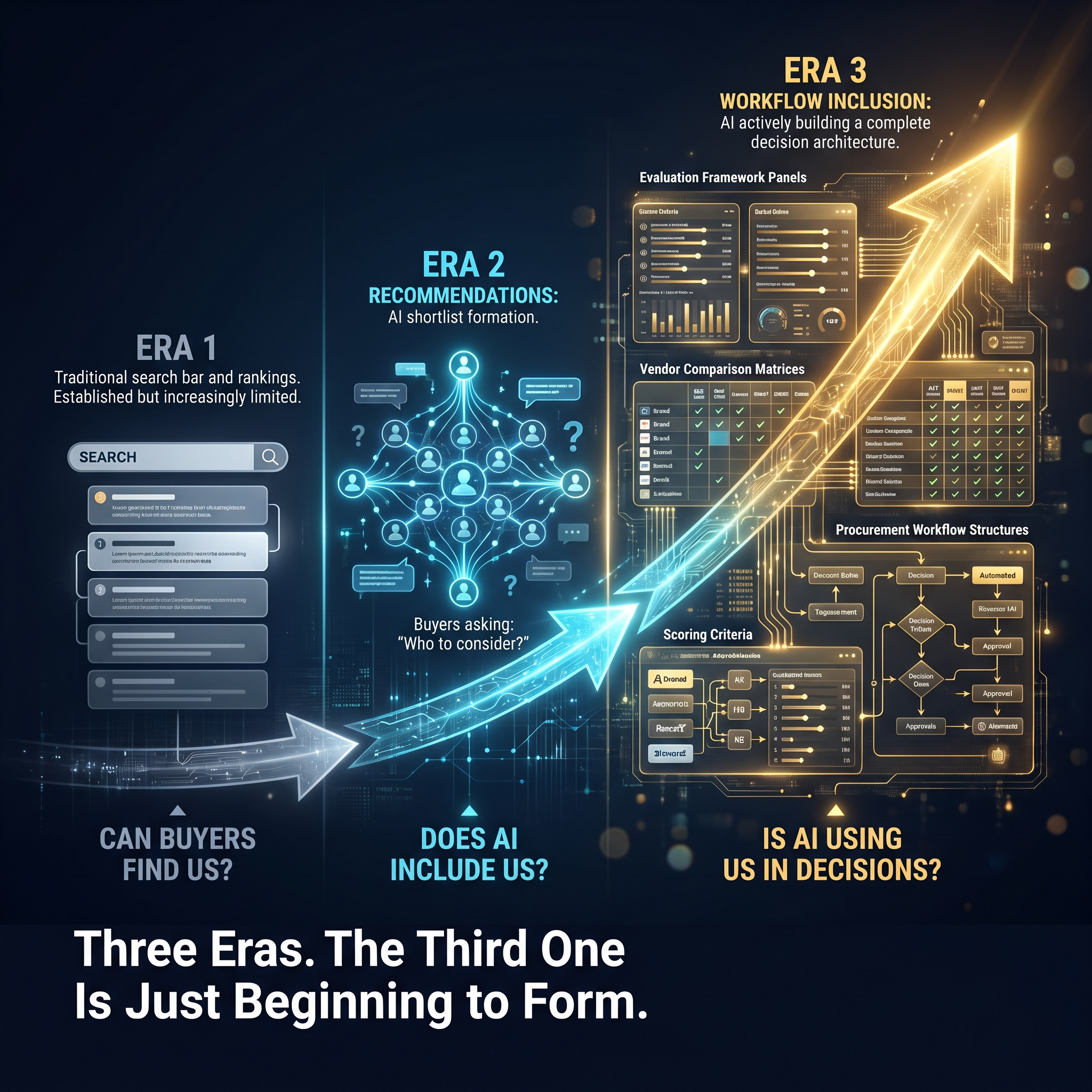
Most businesses have spent the past year asking one question about AI.
Are we appearing in AI answers?
That was the right question to start with.
It is no longer the most important question.
Because the way AI participates in the buying process has evolved in ways most visibility measurements have not kept pace with.
Three Eras. Three Completely Different Questions.
Understanding where we are requires understanding where we have been.
Era One: Search
The question: Can buyers find us?
AI in the search era was a retrieval system. Buyers searched. Results appeared. Brands with strong search presence got found.
The measurement: Rankings. Organic traffic. Keyword visibility.
Era Two: Recommendations
The question: Does AI include us on the shortlist?
AI in the recommendation era became a suggestion engine. Buyers asked conversational AI who to consider. AI generated shortlists. Brands with strong recommendation signals got included.
The measurement: Recommendation frequency. Shortlist presence. Buyer-intent query visibility.
Era Three: Workflows
The question: Is AI using our brand as part of the decision frameworks it builds for buyers?
AI in the workflow era is becoming a decision coordinator. Buyers ask AI to help them evaluate options, build comparison frameworks, and structure procurement processes. AI constructs the architecture of the decision itself.
The measurement: Workflow inclusion. Decision framework presence. Evaluation stage embeddedness.
Most businesses are measuring Era One and building for Era Two.
Era Three is the one most have not yet started asking about.
What AI Decision Workflows Actually Look Like
This is where the shift becomes concrete and consequential.
When a buyer asks AI a simple recommendation question the interaction is contained.
Who are the leading platforms for this category? AI returns a shortlist. Buyer reviews it. Some brands get further exploration.
When a buyer asks AI to coordinate their evaluation the interaction is fundamentally different.
Help me evaluate vendors for this category.
Create a comparison framework for these platforms with scoring criteria.
Build a decision framework for choosing software for this use case.
In these interactions AI is not retrieving information and presenting options.
It is constructing the architecture of a decision.
It builds evaluation criteria. Populates those criteria with brands it associates with the category. Applies comparative judgments. Generates a structure the buyer uses as the foundation for their entire evaluation process.
The brands included in that workflow are being evaluated against each other.
The brands excluded from it may never enter the decision process regardless of how visible they are in individual AI answers.
That is the workflow inclusion gap.
And most current AI visibility measurements cannot detect it.
Why This Gap Is Invisible to Standard Measurement
Standard visibility measurements detect whether you appear in AI answers.
Workflow inclusion requires detecting whether you appear in AI decision frameworks.
Those are different behaviors producing different outputs.
A brand can appear consistently in recommendation queries and still be systematically absent from evaluation workflow queries.
The measurement gap is structural. Visibility metrics were built for a version of AI behavior that no longer fully describes how buyers use these systems.
Why This Matters for CMOs Specifically
Marketing teams have sophisticated measurement for everything that happens after a buyer reaches the website.
Very few have any measurement for what happens when AI coordinates the decision process that determines who gets to the website at all.
Workflow inclusion is the next frontier in pre-funnel measurement.
A brand absent from AI evaluation workflows may see reduced pipeline over time with no obvious explanation in standard dashboards.
Traffic looks normal. Conversion rates look normal. Recommendation metrics look fine.
But evaluation-stage deals are being lost before the pipeline ever starts because the brand was never part of the decision architecture AI built for buyers conducting serious vendor evaluations.
That is an invisible pipeline problem with a measurable cause.
The Fifteen Minute Workflow Inclusion Audit
Run these four queries across ChatGPT, Perplexity, and Claude without mentioning your brand.
“Help me evaluate vendors for [your category].”
“Create a shortlist of providers for [your use case] with comparison criteria.”
“Compare the leading options for [your specific problem].”
“Build a decision framework for choosing [your category].”
For each response note: Does your brand appear? At what stage? How is it framed? Which competitors appear alongside you? What criteria does AI apply?
If your brand is missing from two or more of these workflow responses while competitors appear, you have a workflow inclusion gap.
That gap is distinct from recommendation failure and requires different signal work to address.
The Compounding Advantage Early Movers Are Building
This is the strategic dimension worth understanding.
Workflow inclusion compounds differently than recommendation presence.
Once a brand is consistently included in the decision frameworks AI builds for buyers in a category, that inclusion reinforces itself with every use.
Every evaluation framework that includes the brand strengthens the association.
Every procurement process that references the brand deepens the pattern.
The brand stops being something AI occasionally recommends.
It becomes part of how AI helps buyers decide.
That is a durable and increasingly difficult to displace competitive position.
And the brands building it now are establishing an advantage that late movers will find very difficult to close.
FAQ
What is workflow inclusion and how is it different from recommendation presence?
Recommendation presence measures whether your brand appears when buyers ask AI who to consider. Workflow inclusion measures whether your brand appears when AI builds the evaluation frameworks, comparison structures, and decision architectures buyers use to make choices. A brand can have strong recommendation presence and still be absent from decision workflows. The two behaviors require different signals and have different pipeline consequences.
Why would a brand appear in recommendation queries but not in evaluation workflows?
Because the two query types draw on different aspects of AI’s understanding of a brand. Recommendation queries favor brands with strong general category association. Evaluation workflow queries favor brands with presence in comparison contexts, vendor evaluation discussions, and procurement-related content. A brand strong in informational contexts may be weak in decision coordination contexts.
How does workflow inclusion affect the enterprise sales cycle specifically?
Enterprise buyers increasingly use AI to structure formal evaluation processes, build vendor scorecards, and coordinate RFP processes. A brand embedded in those AI-generated frameworks enters the evaluation at every stage rather than just appearing on an initial shortlist. For enterprise deals where evaluation rigor is high, workflow inclusion may be more consequential for win rates than recommendation presence alone.
What signals build workflow inclusion?
Based on what we observe in scans, brands with strong workflow inclusion tend to have presence in comparison and evaluation contexts, consistent association with procurement and vendor selection language, differentiated positioning that AI can articulate as evaluation criteria, and corroboration from sources that specifically discuss vendor selection processes. These are different from the signals that primarily drive recommendation presence.
How often should I run the workflow inclusion audit?
Run the complete audit once to establish your baseline and identify your primary gaps. After that a monthly check across two or three representative workflow queries is sufficient to track whether your presence is building or stalling. If you are actively running corrective signal work check more frequently to measure whether interventions are producing results.
How does Axis Suite measure workflow inclusion?
Axis Suite runs decision workflow queries alongside standard recommendation queries across ChatGPT, Perplexity, and Claude. By comparing brand presence across both query types we can identify workflow inclusion gaps that recommendation-only measurement misses and provide specific signal recommendations for building evaluation-stage presence.
Start measuring your workflow inclusion presence here: Axis Suite