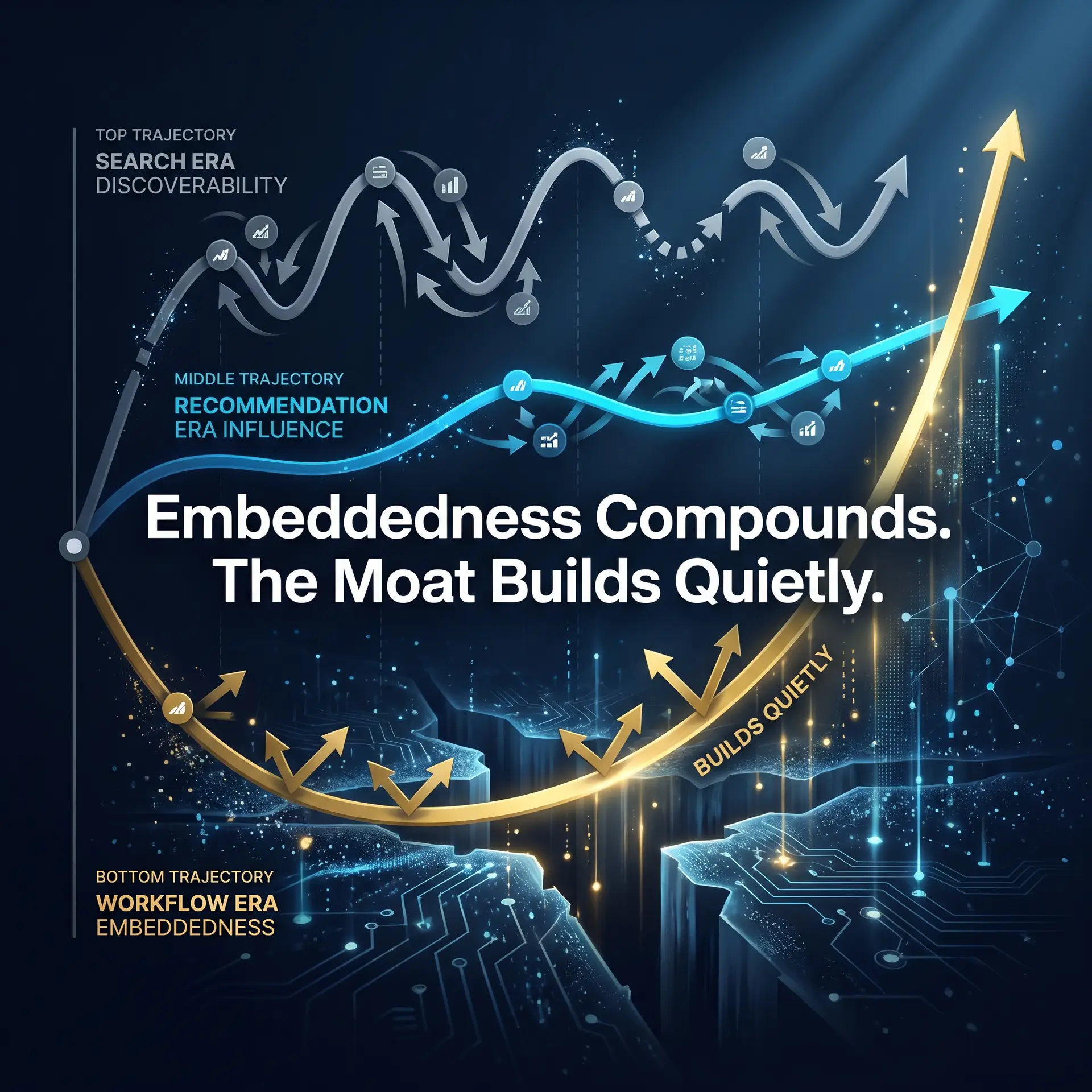
Three eras. Three different competitive dynamics.
Understanding the difference between them changes how you think about AI visibility strategy entirely.
Not just what to measure.
But what kind of competitive advantage you are actually building.
Era One: Search Rewarded Discoverability
In the search era the competitive dynamic was relatively straightforward.
You could be found or you could not be found.
If a competitor outranked you on a keyword, buyers found them first.
If you outranked them, buyers found you first.
The advantage was real but fragile. Rankings fluctuate. Competitors invest more. Algorithm updates redistribute position.
Search discoverability was valuable and contested at the same time.
The brand with the best SEO won the query. Until the next brand invested more in SEO and won it back.
Era Two: AI Recommendations Reward Influence
In the recommendation era the competitive dynamic shifted.
The question moved from can buyers find us to does AI include us when buyers ask who to consider.
Building influence in this era requires stronger and more specific signal work than search ever did. Category association. Co-citation strategy. Buyer-intent language patterns. Recommendation persistence across multiple AI platforms.
This is harder to build than search rankings and harder to displace.
But it can still be displaced.
A competitor with better recommendation signals can appear on more shortlists over time. A brand that lets its recommendation signals decay can lose ground to a more consistent competitor.
Recommendation presence is a stronger competitive position than search rankings. But it is still contestable.
Era Three: AI Workflows May Reward Embeddedness
The workflow era introduces a different competitive dynamic entirely.
The relevant question shifts to whether AI has incorporated your brand into the decision coordination infrastructure it builds when buyers ask it to help them choose.
Embeddedness is distinct from discoverability and influence in one critical way.
It compounds with use.
When AI consistently includes a brand in the evaluation frameworks it builds for buyers, that pattern reinforces itself with every use. Every evaluation framework that includes the brand strengthens the association. Every procurement process that references the brand deepens the pattern. Every comparison structure that features the brand makes the next comparison more likely to include it.
The presence does not just persist at a steady level.
It grows.
Why Displacement Becomes Structurally Harder
This is the strategic dimension most businesses have not yet considered.
In the search era you could displace a competitor by outranking them on a keyword. The displacement was direct and relatively fast.
In the recommendation era you can displace a competitor by building stronger recommendation signals over time. The displacement is slower but achievable with sustained effort.
In the workflow era displacement becomes structurally harder because embeddedness reinforces itself with every use.
A competitor trying to displace an embedded brand is not just competing for signal strength.
They are competing against a pattern of inclusion that has been reinforced across every buyer evaluation that used those frameworks.
That is a different and significantly higher barrier.
The Moat Builds Quietly
Here is the practical implication.
The brands building workflow era presence right now are not announcing it.
It looks from the outside like normal business activity. Creating content. Building external presence. Showing up in comparison contexts.
But the cumulative effect is that AI is increasingly incorporating them into the decision architecture it builds for buyers.
And by the time most competitors notice the pattern the gap has already compounded to a point where closing it requires not just matching the embedded brand’s signals but overcoming the reinforced pattern of inclusion.
That moat builds quietly.
And the window to build your own workflow presence before the category patterns consolidate is the opportunity that exists right now.
What Embeddedness Actually Requires
Embeddedness is not achieved through the same signals that drive recommendation presence.
It requires specifically building presence in the decision coordination contexts where AI acts as an evaluation partner.
Presence in comparison and evaluation content that AI uses when building frameworks.
Association with procurement and vendor selection language that AI applies when coordinating decisions.
Differentiated positioning that AI can articulate as evaluation criteria when building scorecards.
Corroboration from sources that specifically discuss vendor selection and procurement processes in your category.
These are targeted signal investments in the contexts that matter for workflow inclusion.
And most businesses have not started making them yet.
FAQ
What is embeddedness and why is it different from recommendation presence?
Embeddedness refers to the degree to which AI has incorporated your brand into the decision coordination infrastructure it builds when buyers ask it to help them evaluate and choose vendors. Recommendation presence measures whether AI names you when buyers ask who to consider. Embeddedness measures whether AI uses you as part of the architecture of the decision itself. The two require different signals and produce different competitive dynamics.
Why does embeddedness compound while recommendation presence does not?
Recommendation presence is a point-in-time measure of whether AI includes your brand on a shortlist. It can be maintained or lost depending on signal strength. Embeddedness reinforces itself because every time AI includes a brand in a decision framework it strengthens the association between that brand and that type of decision context. The pattern of inclusion becomes part of how AI models the decision space for that category. Over time that pattern becomes increasingly self-reinforcing.
How long does it take to build meaningful embeddedness?
Building embeddedness takes longer than building recommendation presence because it requires establishing presence in specific decision coordination contexts rather than just general category contexts. Based on patterns we observe in scans, consistent signal work targeting evaluation and comparison contexts can produce measurable workflow inclusion improvements within eight to sixteen weeks. The compounding dynamic means early investments produce disproportionate returns over time.
Can embeddedness be built without changing your product?
Yes. Embeddedness is primarily a signal and positioning challenge. The signals AI uses to determine workflow inclusion relate to how your brand is discussed in decision-making contexts, how clearly your evaluation criteria are articulated externally, and how consistently you appear alongside trusted alternatives in comparison environments. These are addressable through targeted content and signal work without product changes.
What is the most underestimated advantage in AI marketing right now?
Workflow era embeddedness. Most businesses are still primarily measuring and optimizing for search era discoverability and recommendation era influence. Very few have started measuring whether their brand appears in the decision frameworks AI builds when buyers ask it to help them evaluate vendors. The brands that build this presence now before category patterns consolidate will have a compounding advantage that becomes very difficult for late movers to displace.
How does Axis Suite help build and measure embeddedness?
Axis Suite runs decision workflow queries to detect current workflow inclusion levels. It identifies the specific signal gaps preventing brands from appearing in AI evaluation frameworks. And it provides targeted recommendations for building presence in the decision coordination contexts that drive embeddedness. The measurement tracks whether workflow inclusion is building over time as signal work takes effect.
Start building your workflow era embeddedness here: Axis Suite