Every marketing team has a content calendar. Blog posts planned. Whitepapers scheduled. Social media queued.
When AI visibility scores are low, the instinct is to fill that calendar faster. More content. More frequently. More channels.
That instinct is almost always wrong.
Not because content does not matter. It does. But because low AI visibility is rarely caused by insufficient content. It is usually caused by structural problems that no amount of publishing will solve.
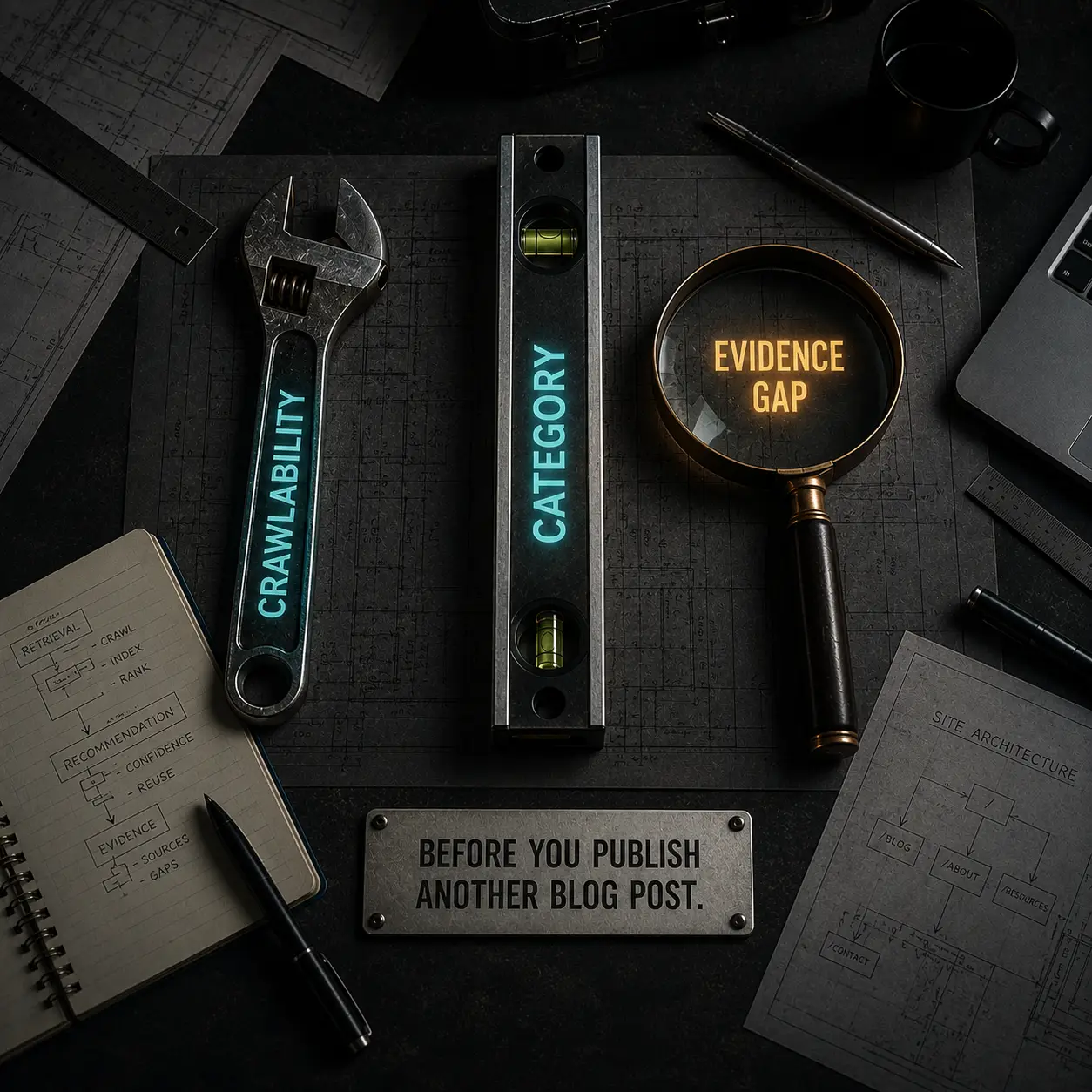
After observing this pattern across brands competing for recommendation in ChatGPT, Claude, Gemini, and Perplexity, three fixes consistently matter more than another blog post.
Fix One: Crawlability
This is the most common and most invisible AI visibility problem.
If AI systems cannot access your website, nothing else matters. Your content exists but AI crawlers cannot reach it. Every blog post you publish goes into the locked room.
Crawlability issues take many forms. Robots.txt files that block AI crawlers. Pages that require JavaScript rendering that AI crawlers cannot execute. Server configurations that reject automated requests. Authentication requirements on pages that should be public. Slow load times that cause crawlers to abandon the page.
Each of these is a structural problem. Each has a specific fix. And each fix is an engineering task, not a content task.
The diagnostic step is simple. Ask ChatGPT, Claude, Gemini, and Perplexity to describe your homepage. If they cannot, you have a crawlability problem. No content strategy should begin until that problem is solved.
For teams that discover crawlability issues, the fix is often straightforward. Update robots.txt to allow AI crawlers. Ensure pages render content server-side. Remove unnecessary authentication from public pages. The fix is usually measured in hours of engineering time, not weeks of content production.
Fix Two: Category Alignment
This is the most underestimated AI visibility problem.
Most brands assume AI categorizes them correctly. Most are wrong.
Ask ChatGPT what category your company belongs in. Then ask Claude. Then Gemini. Then Perplexity. Compare all four answers to your intended positioning.
The gap is often significant. A brand that positions itself as a specialized AI recommendation intelligence platform gets filed by ChatGPT under generic AI marketing tools. A brand that describes itself as a revenue intelligence platform gets categorized by Claude as CRM adjacent software.
This matters because category determines competitive set. If AI places you in the wrong category, every recommendation query puts you against the wrong competitors. Every comparison framework evaluates you against alternatives that are not your actual market. Every buyer who asks AI about your category gets a shortlist that may not include you.
The fix is not more content about your category. The fix is consistent category language across every source AI draws from. Your website. Your G2 listing. Your Crunchbase profile. Your LinkedIn description. Your directory listings. Your comparison profiles.
If these sources use different language to describe what you do, AI averages the conflicting signals. Consistent language across all sources gives AI a clear category signal that strengthens with every source that agrees.
Fix Three: Close One Evidence Gap
This is the most strategic fix.
Identify your top competitor. The one AI recommends most confidently in your category. Then audit where they have independent evidence and you do not.
Do they have 200 G2 reviews while you have 12? That is an evidence gap in the review layer. Do they appear in three analyst reports while you appear in none? That is an evidence gap in the authority layer. Do they show up in five comparison articles while you are absent from all of them? That is an evidence gap in the comparative layer.
Pick one gap. The one that appears most likely to influence AI recommendation. Then invest specifically in closing it.
A structured G2 review campaign may close the review gap. Targeted analyst outreach may close the authority gap. Contributing to or sponsoring comparison content may close the comparative gap.
Each investment creates independent evidence from sources AI trusts. One closed evidence gap often changes AI recommendation dynamics faster than an entire quarter of blog content.
The Question for CMOs
Before the next content calendar meeting, ask one question.
Are we fixing the structure or adding more claims?
If your crawlability is broken, fix it. If your category language is inconsistent, align it. If your competitor has evidence you lack, close the gap.
Then publish content. Content on top of working infrastructure compounds. Content on top of broken infrastructure accumulates without impact.
The order matters. Structure first. Content second.
Frequently Asked Questions
Why do these three fixes matter more than content?
Content addresses what AI knows about you. These fixes address whether AI can find you, classify you correctly, and verify your claims independently. Without the structural foundation, content production cannot improve AI recommendation across ChatGPT, Claude, Gemini, and Perplexity.
How do I check my website crawlability for AI?
Ask ChatGPT, Claude, Gemini, and Perplexity to describe your homepage. If they cannot, check your robots.txt for AI crawler blocks, verify pages render without JavaScript, and ensure public pages do not require authentication.
How do I fix AI category misalignment?
Audit the category language on your website, G2 listing, Crunchbase, LinkedIn, and directory profiles. Identify inconsistencies. Then systematically align all sources to use the same category language. Consistency across sources strengthens the category signal AI receives.
What is an evidence gap in AI visibility?
An evidence gap exists where your competitor has independent validation that you lack. If they have 200 G2 reviews and you have 12, or they appear in analyst reports and you do not, those gaps reduce your AI recommendation confidence relative to theirs.
How long do structural fixes take to affect AI visibility?
Crawlability fixes can produce results within days to weeks. Category alignment changes typically take weeks to months as AI systems update their classification. Evidence gap investments like review campaigns compound over time. Each fix is measurable.
Should I fix all three at once or prioritize?
Fix crawlability first because it is the foundation. If AI cannot access your content, the other fixes cannot take effect. Then address category alignment. Then close evidence gaps. The sequential order ensures each fix builds on the previous one.
Start here: axissuite.ai