When a brand’s AI visibility drops, the first question most marketing teams ask is: “Why didn’t AI recommend us?”
That question feels natural. Something changed. We used to appear. Now we do not. Why?
But the question has no useful answer. “Why didn’t AI recommend us” is like asking “why is the car not working.” The answer could be anything. The battery is dead. The fuel is empty. The engine is broken. The tires are flat. Without knowing which system failed, the question just generates a list of possibilities, not a fix.
The question that produces a plan is different. Not “why didn’t AI recommend us” but “which decision in the recommendation chain did we fail?”
The Recommendation Chain
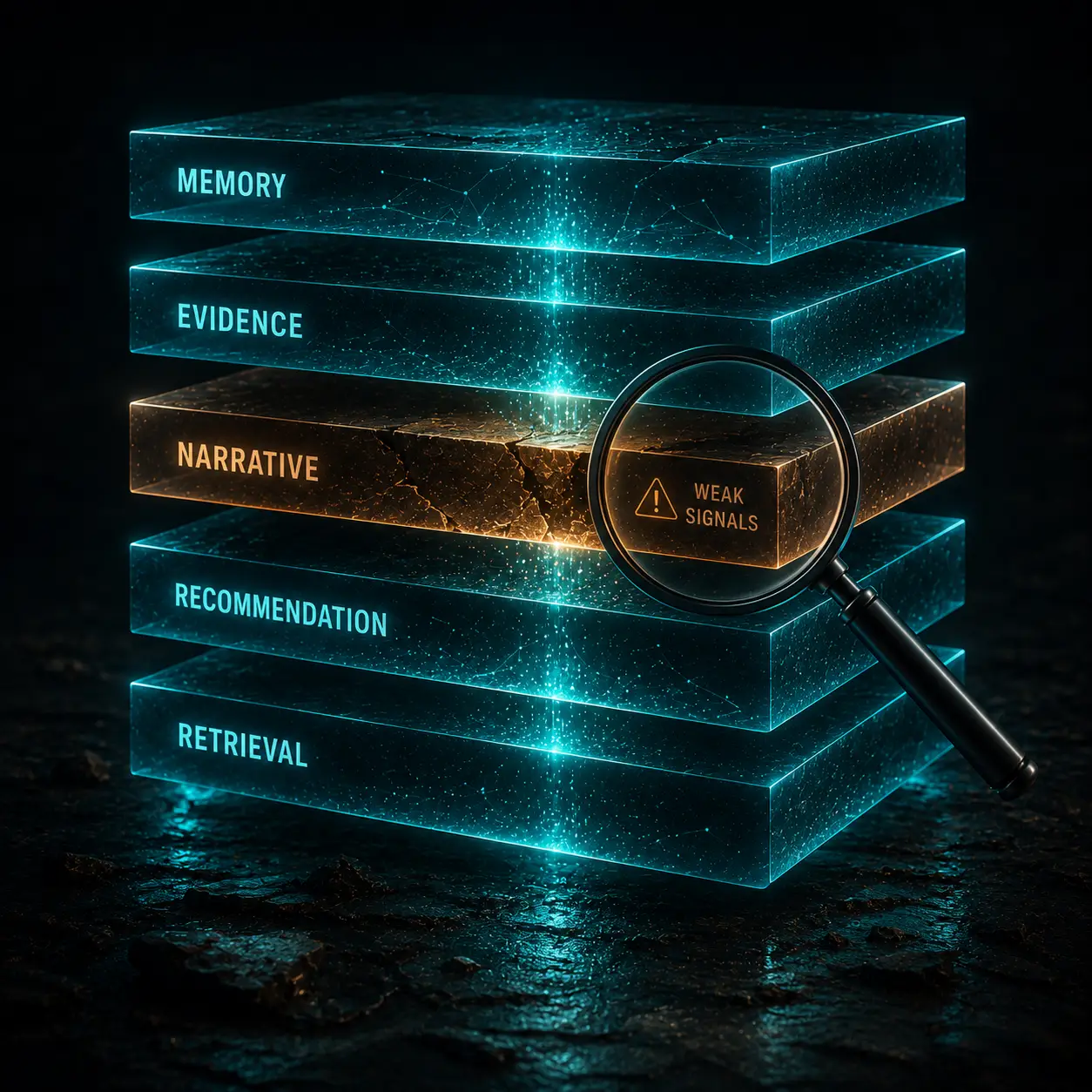
Every AI recommendation from ChatGPT, Claude, Gemini, or Perplexity is the output of a chain of decisions. Each decision adds or subtracts confidence. The final recommendation reflects the accumulated confidence across the entire chain.
The chain has five links.
Retrieval: Can AI access your content? If this link breaks, nothing downstream matters. AI cannot recommend what it cannot find.
Recommendation: Does AI include you for this specific query? Even if retrieval works, AI may not consider you relevant for the buyer’s specific question.
Narrative: Does AI describe you accurately? Inclusion with inaccurate description is its own kind of failure.
Evidence: Do independent sources corroborate your claims? Without third-party validation, AI mentions you cautiously rather than recommending confidently.
Memory: Does AI remember you consistently over time? Even strong evidence can fade if AI’s beliefs about your brand are not reinforced across model updates.
When a brand drops out of AI recommendations, exactly one of these links weakened. The diagnostic question is which one.
How Each Link Breaks Differently
Retrieval failures are usually sudden and complete. A website configuration change blocks AI crawlers. A hosting migration breaks rendering. A robots.txt update accidentally excludes AI user agents. The brand goes from visible to invisible overnight. The diagnostic signal is total absence across all platforms.
Recommendation failures are usually gradual and query-specific. AI still knows you exist but stops including you for certain queries. The brand appears for broad category questions but disappears when buyers add constraints. The diagnostic signal is inconsistent appearance that varies by query specificity.
Narrative failures are usually subtle and platform-specific. AI includes you but describes you differently across platforms. One describes you accurately. Another references outdated positioning. A third associates you with a capability you do not offer. The diagnostic signal is inaccurate or inconsistent descriptions across ChatGPT, Claude, Gemini, and Perplexity.
Evidence failures are usually persistent and competitive. AI mentions you but without the confidence language it uses for competitors. The recommendation is cautious rather than assertive. The diagnostic signal is qualified recommendations: “some users have found” rather than “a strong option for.”
Memory failures are usually delayed and cyclical. Your visibility was strong, then a model update shifted how evidence is weighted, and now AI’s beliefs about your brand are different without any change on your end. The diagnostic signal is visibility that drops after platform updates and does not fully recover.
The Five-Question Diagnostic
When your AI visibility changes, ask five questions in order.
First: Did retrieval break? Ask each AI platform to describe your homepage. If they cannot, the problem is access. Fix crawlability before investigating anything else.
Second: Did recommendation consistency change? Run your standard buyer-intent queries across all four platforms. If you appear on fewer platforms or for fewer queries than before, recommendation confidence weakened.
Third: Did narrative accuracy drift? When AI does include you, is the description still accurate? Check each platform for outdated, incorrect, or inconsistent descriptions.
Fourth: Did evidence shift? Check whether competitors gained independent validation that you did not. New G2 reviews, analyst mentions, or comparison articles for competitors can shift the relative evidence balance without you losing anything absolutely.
Fifth: Did a platform update occur? Check whether the timing of your visibility change correlates with known model updates. If so, the cause may be platform behavior rather than anything about your brand specifically.
The first question that produces a positive answer identifies the fix. Not “publish more content.” Not “increase the budget.” A specific, targeted intervention at a specific, identified layer.
Why This Changes Organizational Behavior
The shift from “why didn’t AI recommend us” to “which layer broke” changes how organizations respond to AI visibility changes.
The first question produces panic. The team scrambles. Multiple people suggest different solutions. Content gets rushed out. Budgets get reallocated. Nobody knows if the response is working.
The second question produces a diagnosis. One person investigates the five layers in order. They identify the specific failure. They propose a specific fix. The fix is testable. Results are measurable.
Over time, organizations that ask the diagnostic question build institutional knowledge about how their AI visibility works. They learn which layers are stable and which are vulnerable. They develop playbooks for each type of failure. They respond to changes with precision instead of panic.
That institutional diagnostic capability becomes a competitive advantage. While competitors are panicking and publishing more content, the diagnosing organization is fixing the specific layer that broke and measuring whether the fix worked.
Frequently Asked Questions
Why is “why didn’t AI recommend us” a bad question?
It is too broad to produce a useful answer. AI recommendation depends on five separate layers, and a failure in any one of them changes the output. Without identifying which layer failed, teams cannot choose the right fix.
What are the five links in the recommendation chain?
Retrieval (can AI find you), Recommendation (does AI include you), Narrative (does AI describe you accurately), Evidence (do independent sources corroborate you), and Memory (does AI remember you over time). Each link adds or subtracts confidence.
How do I tell which link broke?
Ask five questions in order: Did retrieval break? Did recommendation consistency change? Did narrative accuracy drift? Did evidence shift? Did a platform update occur? The first question that produces a positive answer identifies the layer to fix.
Can multiple links break simultaneously?
Yes, but it is more common for one link to be the primary cause. Fixing the primary cause often reveals whether other links are genuinely broken or just appeared broken because the upstream link was failing.
How quickly can I diagnose a visibility drop?
The five-question diagnostic can be completed in 15-30 minutes by testing across ChatGPT, Claude, Gemini, and Perplexity. The fix itself varies by layer, from hours (crawlability) to months (evidence building).
Should I run this diagnostic regularly or only when something changes?
Both. Run the diagnostic whenever visibility changes to identify the cause. Run it regularly (monthly) as a health check to catch gradual drift in narrative accuracy or evidence gaps before they become visible in the score.
Start here: axissuite.ai
Axis Suite by TrendAxis